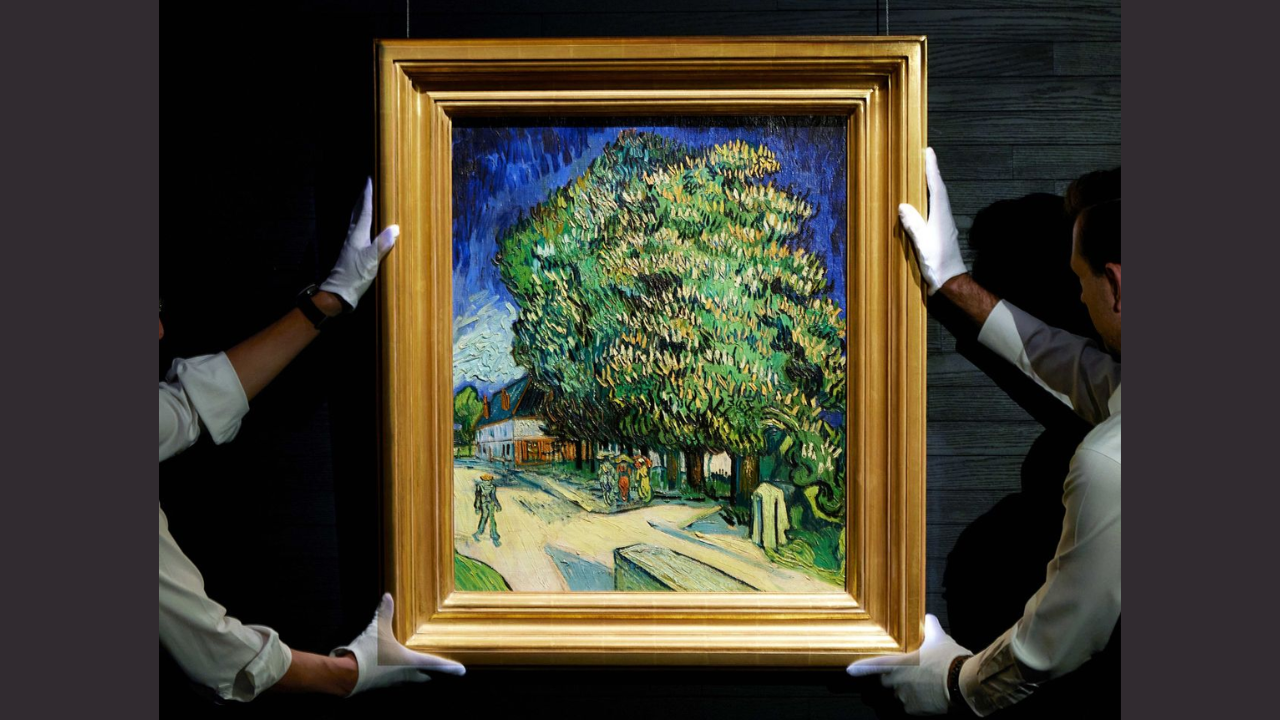
Paint dries. Linseed oil oxidizes, darkens, settles into the weave of coarse linen like memory settling into bone. Yet for six decades, a canvas painted in 1890 by Vincent van Gogh stayed out of sight, held in quiet custody while the world outside grew louder, richer, and infinitely more impatient.
Now it is back. Estimated at $180 million ahead of auction.
Numbers like that stun people into silence. One hundred and eighty million dollars feels less like a price tag and more like a spell cast over a room full of bankers, curators, and private collectors holding their breath. You look at a figure that large and your brain tries to convert it into something tangible—houses, fleets, museums, lifetimes—and fails.
But the real problem lies elsewhere. When a hidden painting from Van Gogh’s final year surfaces after sixty years with a nine-figure estimate, headlines rush straight to the gavel. They talk about records, vaults, trophies, and speculation. They treat art history like a stock ticker. And in doing so, they miss the strangest part of the whole story: how a man who sold almost nothing while alive ended up generating sums that could buy a small principality, all because someone kept a stretcher frame safe behind closed doors while decades turned over.
I have spent years standing inside auction viewing rooms and conservation studios, breathing that faint, unmistakable mix of beeswax, aged varnish, and cool air conditioning. You learn quickly that nothing in the art market is ever just wood, pigment, and canvas. Every work carries two histories. One belongs to the hand that laid down the paint. The other belongs to the hands that guarded it, hid it, doubted it, or waited for the right moment to let it breathe again.
Consider what happens next: a painting that spent sixty years out of public view steps into the glare of spotlights, infrared scanners, provenance lawyers, and billionaire paddle-raisers. Every crack in the impasto becomes evidence. Every stamp on the back of the frame becomes a passport.
Why Sixty Years in the Dark Changes Everything
To understand what a sixty-year disappearance means for a work from 1890, picture an ordinary family home—let us call the owners the Lindholms, a purely hypothetical household created to illustrate how private custody often plays out in real life.
In the Lindholms' version of this story, a relative acquired a small, heavily textured oil painting decades ago, back when serious collectors still trusted instinct over databases. Maybe it hung above a sideboard in a quiet dining room. Maybe it moved into a cedar-lined closet when children arrived, or stayed tucked inside a climate-controlled storage unit after a divorce or a move across oceans. For sixty years, nobody posted it online. Nobody lent it to a retrospective. Nobody invited an art historian over with a magnifying loupe.
That kind of silence does something remarkable to a painting. It keeps it out of circulation, out of gossip, and out of public fatigue.
During those sixty years, Van Gogh’s fame did not merely grow; it hardened into myth. Every brushstroke of cobalt blue or cadmium yellow from Auvers-sur-Oise or Saint-Rémy became sacred text. Scholars cataloged letters to Theo. Exhibitions drew lines around the block. Museums guarded their holdings like crown jewels. Meanwhile, out of sight, a genuine 1890 work sat quietly in the dark, untouched by the churn of modern art fairs.
Let me be clear: I am using the Lindholms as a hypothetical stand-in to show how quiet stewardship works behind the scenes, not claiming an actual family portrait. Real provenance is messier, often stitched together from shipping labels, estate inventories, gallery ledgers, and correspondence that survived two world wars.
Still, the emotional reality is unmistakable. When something vanishes for sixty years and reappears bearing Van Gogh’s unmistakable urgency, people do not just see pigment. They feel a sudden jolt of lost time. It feels as if a letter addressed to the present finally slipped under the door.
The Weight of 1890
Why 1890? Why does that single year carry so much gravity for anyone who cares about painting?
By 1890, Van Gogh was thirty-seven years old and working at a feverish, almost terrifying speed. In the spring he was still at the asylum in Saint-Rémy-de-Provence; by May he had traveled north to Auvers-sur-Oise, north of Paris, under the care of Dr. Paul Gachet. In roughly seventy days in Auvers, he produced dozens of paintings, working outdoors in the wheatfields and village lanes with a restless intensity that leaves viewers slightly breathless even a century and a third later.
Think of 1890 as high tide in an estuary where fresh water and salt water collide. Every current is running fast. His brushwork is thick, directional, almost sculptural—ridges of oil paint catching raking light like plowed earth. His color relationships hum with tension: sulfur yellows against deep ultramarines, chalky whites pressed right up against bruised greens.
When you stand close to a painting from that period, you do not just see what Vincent looked at. You feel the cadence of his wrist. You feel the speed of a mind trying to hold onto light, form, and sanity all at once.
A hidden canvas from 1890 matters because Van Gogh’s surviving oeuvre is finite. Unlike a modern studio painter who might leave thousands of works behind, Vincent’s active mature output spanned only a few intense years. Every authentic canvas from 1890 is a page torn from the final chapter of one of the most consequential lives in modern visual culture.
A hundred and eighty million dollars sounds absurd until you remember that scarcity, memory, and obsession all meet at the exact same point. When a buyer bids at that level, they are not calculating square inches of canvas. They are bidding on proximity to a moment that can never be repeated.
How a Price Tag Becomes a Mirror
Whenever an auction estimate crosses into nine figures, a familiar argument breaks out.
One voice says: It is obscene. A single painting selling for $180 million while schools lack supplies and artists struggle to pay rent.
Another voice replies: That is simply what the market says the rarest cultural artifacts in human history are worth when ultra-high-net-worth buyers compete for them.
Both voices hit a nerve. And honestly, I find myself torn between them more often than I care to admit. Standing in a room where multimillion-dollar bids fly back and forth with a nod of the chin or a subtle raise of a pen can feel intoxicating and alienating at once. You feel the thrill of witnessing history move in real time, followed immediately by a strange, hollow doubt about whether money that large distorts everything it touches.
Money acts like a magnifying glass. It does not create human desire; it exposes it.
If we treat the Lindholms from our hypothetical example as a lens into buyer psychology, you can see why a work like this pulls people in. One collector might want the quiet thrill of owning something nobody else has lived with for sixty years. Another might see a generational store of value, a trophy asset that sits outside currency swings and political noise. A museum director might look at the same canvas and ache at the thought of it disappearing behind private walls for another half-century.
None of those impulses is simple. Greed sits right next to reverence. Vanity sits right next to genuine love for line and light. If you pretend the art market is pure, you are fooling yourself. If you pretend the painting itself has no value beyond its dollar estimate, you are blind to what makes human beings weep in front of a wall.
Behind the Scenes of a Resurgence
People often imagine a lost masterpiece turning up like a pirate chest washed ashore after a storm. Someone lifts a tarp in a dusty attic, blows off a century of cobwebs, and ten minutes later a gavel bangs for $180 million.
Reality is slower, quieter, and far more meticulous.
Before a resurfacing painting ever reaches a public saleroom or a headline estimate like $180 million, specialists spend months—sometimes years—testing every assumption. Think of art authentication like forensic medicine combined with detective work. An expert does not just say, "That looks like Vincent." They examine how the canvas was stretched, how the ground layer was primed, whether the pigments match what was sold in Paris or Provence in 1890, and how the craquelure—the fine network of age cracks—behaves under magnification.
Paint is a time capsule. Microscopic cross-sections, ultraviolet fluorescence, and historical records either lock together or fall apart under scrutiny. When a painting emerges after sixty years of privacy and commands a staggering estimate, that number reflects years of quiet verification behind closed doors, not a wild guess scribbled on a napkin.
Even then, uncertainty never vanishes completely. Art history is not a math equation with a single tidy proof at the bottom. Scholars debate details. Provenance gaps sometimes require painstaking archival digging through old exhibition catalogs, customs declarations, and family letters. Admitting that uncertainty is part of being honest about how rare objects move through the world.
Why We Care When a Ghost Comes Home
There is a reason a story like this hooks people who never set foot in a gallery.
We all know what it is like to lose track of something precious. Sometimes it is a physical object tucked away in a box and forgotten until years later. Sometimes it is a memory, a passion, or a version of ourselves we set aside when life got heavy. When something hidden comes back into the light after sixty years, it triggers a quiet hope that time does not erase everything—that what mattered once can still speak across decades.
Vincent van Gogh died in July 1890 believing his life had been a failure, haunted by isolation, illness, and the ache of wanting to connect through his work. He could never have pictured a world where a canvas from that year would be spoken of in the same breath as $180 million, or studied by millions of people who never knew him.
Yet the painting remained. Patient. Silent. Waiting.
Light still hits the ridges of dry oil paint the same way it did when the brush first dragged across the weave. Blue still deepens beside yellow. And for one brief, electric moment, a canvas that spent sixty years out of sight stands once more in the open air, carrying the whole weight of time on its surface.


