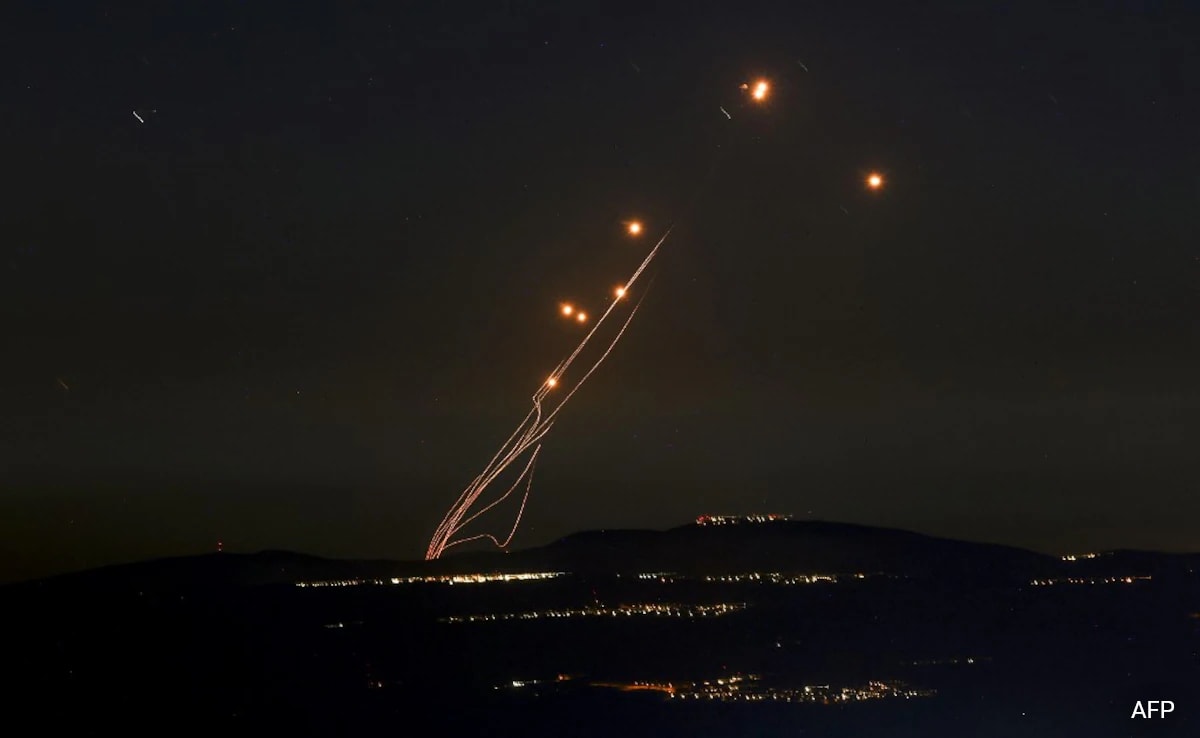
The siren does not scream; it waails. It is a primal, mechanical sob that vibrates in the marrow of your bones before it ever hits your ears. In Tel Aviv, in Sderot, or in the high Galilee, that sound is the universal signal to stop being a person and start being a target. You have ninety seconds. Or thirty. Or seven.
You grab the child. You leave the stove on. You sprint for the mamad, the reinforced security room, and you pull the heavy steel handle shut. Then, you wait for the thud.
For decades, the math of war was simple and cruel. If someone launched a rocket at your house, that rocket hit your house. Defense was a matter of concrete and luck. But over the past few years, and specifically during the unprecedented barrages from Iran, Hamas, and Hezbollah, that math has been rewritten by a silent, invisible hand. The 99 percent interception rate we see splashed across news tickers isn't just a statistic. It is the reason a father can walk back into his kitchen and turn off the burner instead of digging through rubble for a photo album.
The Anatomy of an Invisible Shield
To understand how a small piece of land survives a sky filled with fire, you have to look at the geometry of the intercept. Imagine a pitcher throwing a baseball at a window from fifty feet away. Now imagine a second player standing ten feet from that window, tasked with hitting that baseball out of mid-air with a pebble. Now imagine doing that a thousand times at once, in the dark, while the wind is blowing.
The Iron Dome is not a wall. It is a nervous system. It begins with the ELM-2084 radar, a digital eye that scans the horizon with a persistence that no human could manage. When a rocket—a Grad, a Fajr, or a homemade Qassam—is launched, the radar spots it within seconds. But the genius isn't in the spotting; it's in the discernment.
The system’s Battle Management & Control (BMC) center performs a cold, lightning-fast calculation. It determines the trajectory. If the math shows the rocket is headed for an empty sand dune or the open sea, the system ignores it. It lets it fall. This isn't out of laziness. It’s out of necessity. Every Tamir interceptor missile costs roughly $50,000. The rockets they chase often cost less than a used mountain bike. To survive, the system must be as frugal as it is fast.
If, however, the trajectory intersects with a school, a hospital, or a residential block, the "pebble" is launched.
The Tamir’s Final Seconds
A Tamir interceptor is a masterpiece of miniaturized terror and grace. It does not actually have to hit the incoming rocket "bullet-to-bullet." Instead, it carries a proximity fuse. As the interceptor closes the gap at supersonic speeds, it receives constant steering updates from the ground. In the final fraction of a second, it detects the target, detonates its own warhead, and creates a cloud of high-velocity fragments.
Think of it as a localized, artificial storm. The incoming threat is shredded before it can reach its peak. On the ground, this looks like a sudden, bright star appearing in the afternoon sky, followed by a double-thump that rattles the windows.
During the recent escalations involving Iran, the stakes shifted from tactical to existential. We weren't just talking about short-range rockets anymore. We were talking about drones, cruise missiles, and ballistic threats. This is where the Iron Dome’s older siblings—David’s Sling and the Arrow systems—take over. They operate in the upper atmosphere, even in space, catching threats that move at speeds which turn the air around them into glowing plasma.
When Iran launched over 300 projectiles in April, the world held its breath. It was a saturation attack designed to overwhelm, to find the "leak" in the plumbing. Yet, the 99 percent held.
The Cost of Perfection
There is a psychological weight to living under a dome. When you know the shield works, you start to treat the sirens as an annoyance rather than a death sentence. You see people filming the interceptions on their iPhones from their balconies instead of lying flat on the floor of a shelter.
This is a dangerous luxury.
The 99 percent is a triumph of engineering, but that remaining 1 percent is where the tragedy lives. Technology can be perfect, but the volume of fire can be infinite. If 1,000 missiles are fired and the system is 99 percent effective, ten missiles still hit. Ten missiles can level ten apartment buildings. Ten missiles can change the history of a nation.
Consider the "Arrow" system, designed to hit long-range ballistic missiles. It is the outer layer of the onion. If it fails, David’s Sling takes the shot. If that fails, the Iron Dome handles the debris or the shorter-range threats. It is a symphony of layers, a tiered defense that assumes failure at every level and builds a backup for that failure.
The cost is not just financial. There is an emotional exhaustion in being "saved" by a machine every day. It creates a strange, sterile version of conflict. In the past, wars were felt through the visceral destruction of the home front. Today, the destruction is moved to the sky. It is vaporized. We are left with the "echo" of a war—the smoke trails in the blue, the spent shrapnel in the garden, and the lingering question of how long the batteries can last.
The Invisible War of Attrition
The real battle isn't just about kinetic energy; it’s about logistics. The strategy of groups like Hezbollah is to bleed the system dry. If you can force your opponent to spend $50 million to stop $500,000 worth of scrap metal, you are winning the war of economics.
This is why the next phase of this technology isn't more missiles. It’s light.
The Iron Beam—a laser-based defense system—is the inevitable evolution of the dome. A laser travels at the speed of light. It never runs out of "ammunition" as long as there is electricity. Most importantly, it costs about two dollars per shot. It shifts the math back in favor of the defender. It turns the sky into a place where fire simply ceases to exist.
But we aren't there yet.
Right now, we live in the era of the Tamir and the Arrow. We live in a world where the difference between a normal Tuesday and a national funeral is a set of algorithms running on a server in an undisclosed location.
The silence after an interception is the loudest sound in the world. It is the sound of thousands of people taking a breath they didn't know they were holding. They step out of their shelters. They look at the blue sky. They see a small, dissipating puff of white smoke—the only ghost left of a weapon meant to end them.
The shield is holding. For now, the sky remains where it belongs.