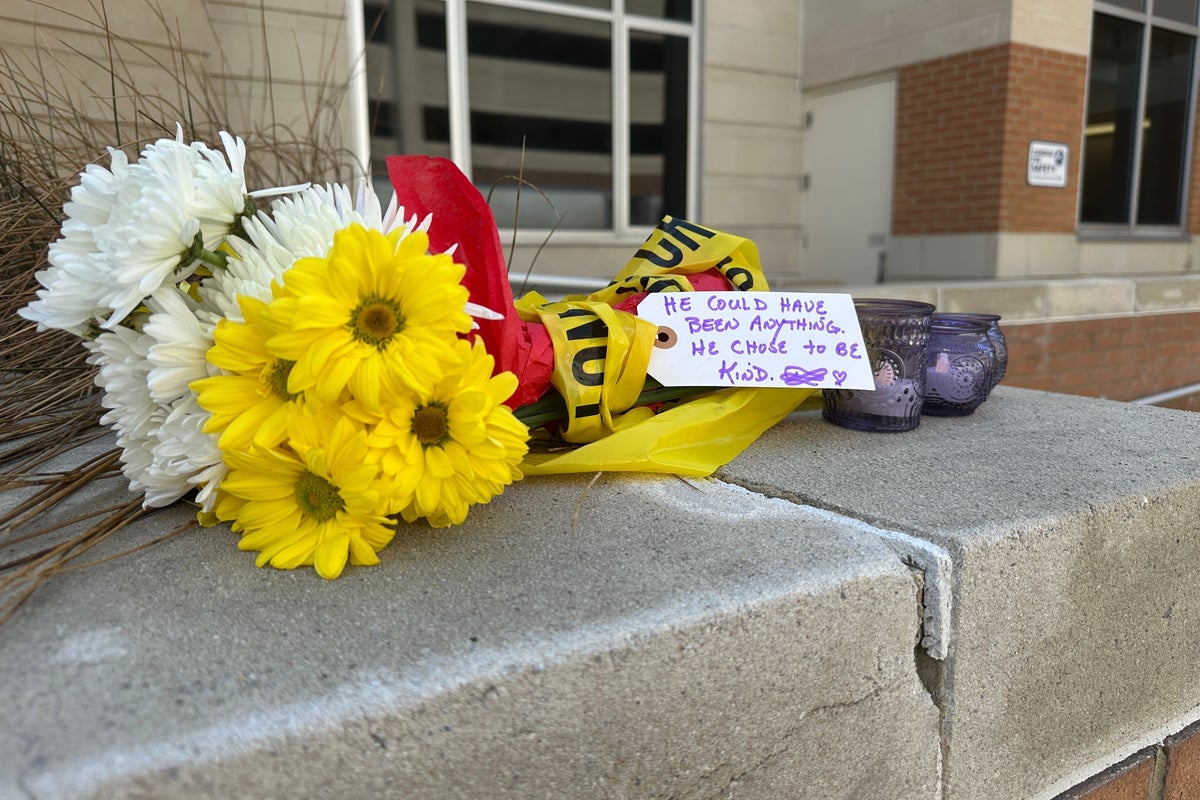
The air in the hallway usually smelled of floor wax and adolescent anxiety. It was a Tuesday. In a high school classroom in Saskatchewan, the mundane rhythm of a school day—the scratching of pens, the hum of fluorescent lights, the muffled laughter from the lockers—was the only reality anyone expected. Then the door opened.
Fear has a specific sound. It isn't a scream; not at first. It is the sharp, collective intake of breath when the brain realizes the world has broken. For a deeper dive into similar topics, we recommend: this related article.
A man walked into the room. He wasn't supposed to be there. He didn't look like a teacher, a student, or a parent. He looked like chaos. In his hand, he carried a knife. Before the students could process the intrusion, the blade found their teacher.
Blood is a jarring color against the drab gray of a classroom floor. It is too bright. Too real. As the teacher fell, the social contract of the school—the unspoken rule that adults protect and children follow—dissolved in an instant. The man wasn't finished. He turned toward the rows of desks, toward the teenagers who were, seconds ago, worrying about math grades and weekend plans. To get more information on this issue, extensive coverage is available on NPR.
The Weight of a Folding Blade
In the back of the room sat young men who wore the uniform of the Royal Canadian Army Cadets. To a casual observer, the uniform is just polyester and brass, a costume of discipline. But discipline is an internal architecture. It is what stays standing when the walls come down.
When the attacker moved, he didn't find a room full of victims. He found a wall.
These boys were armed, though not with the weapons of a soldier. They had pocket knives. Small, utilitarian tools designed for whittling wood or cutting cordage at a campsite. In a world of modern ballistic threats, a two-inch folding blade is almost an afterthought. It is a toy compared to the malice held by a man intent on slaughter.
But a weapon is only as effective as the hand that holds it.
The cadets didn't huddle. They didn't climb out the windows while their classmates were hunted. They drew those small blades. They stepped forward.
Consider the physics of that moment. A man with a larger weapon and a head start of pure adrenaline against teenagers with tools meant for scouts. The odds weren't just bad; they were suicidal. Yet, the cadets engaged. They didn't wait for a tactical plan or a whistle. They moved with the frantic, messy, terrifying necessity of the moment.
They stabbed him. Not because they wanted to be killers, but because they refused to be witnesses to a massacre.
The Invisible Stakes of Training
We often talk about "youth" as a period of preparation, a waiting room for real life. We treat teenagers as fragile things to be shielded. But the events in that classroom suggest we have the timeline wrong.
The training these boys received in the Cadet program isn't just about marching in straight lines or learning to tie a sheepshank knot. It is about the cultivation of a specific kind of "other-centeredness." In the heat of the struggle, when the attacker’s knife was swinging and the room was a blur of motion, the cadets weren't thinking about their own skin. They were thinking about the girl in the front row. They were thinking about the teacher bleeding out by the chalkboard.
One cadet later described the sensation of the struggle. He didn't talk about bravery. He talked about the weight of the man, the smell of the sweat, and the terrifying realization that if he let go, people would die.
It is a visceral, ugly thing to fight for your life. There is no slow-motion. There is no heroic music. There is only the frantic rasp of breathing and the wet slap of shoes on a floor that has become a skating rink of blood. The cadets used their small knives to puncture the momentum of a monster. They didn't need to be experts in hand-to-hand combat; they just needed to be a physical obstacle that wouldn't break.
The Cost of the Save
The man was eventually subdued. The police arrived. The sirens replaced the silence. But the story didn't end when the handcuffs clicked shut.
The teacher did not survive.
That is the jagged pill at the center of this narrative. The cadets fought, they bled, they scarred the attacker, and they stayed the hand of a killer—but they couldn't perform a miracle. They had to walk out of that school into the cold Saskatchewan air knowing that they had done everything, used every inch of steel they possessed, and still lost a mentor.
Society likes to package these stories into neat boxes of "heroism." We want to believe that the good guys win and the bad guys lose and everyone goes home for dinner. But these boys went home with the memory of what it feels like to have a human life end in the same room where you're trying to save it.
They were 14, 15, 16 years old.
They saw the veil between "normal" and "nightmare" torn apart. They learned that a pocket knife, while enough to stop a killer, is not enough to stop grief.
The Geometry of a Response
If you look at the statistics of school attacks, the outcome is almost always determined in the first sixty seconds. Before the first 911 call is processed, the trajectory of the event is set. In this case, those sixty seconds were occupied by young men who decided that their lives were secondary to the safety of the collective.
They used what they had.
They didn't complain that they didn't have a rifle. They didn't wait for a "good man with a gun." They were the good men with what was in their pockets.
There is a profound, haunting lesson in the image of those small blades. We spend so much time debating policy, hardening entrances, and analyzing the "why" of the attacker. We forget to look at the "how" of the survivor. The survivors in that room didn't survive because of a security camera or a locked gate. They survived because of a choice made by a few boys who refused to be spectators.
The scars on the hands of those cadets will eventually fade into white lines. The trauma, less so. Every time they open a folding knife to cut a piece of fruit or trim a loose thread, they will feel the ghost of that Tuesday. They will remember the resistance of the blade, the heat of the struggle, and the face of a man who brought darkness into a place of learning.
They didn't just save their classmates; they defined the limit of a killer's power. They proved that even in a room where the light has been extinguished, a two-inch blade held with conviction can be enough to find the way back to the dawn.
The desks have been uprighted. The floors have been scrubbed. The school has reopened. But in the quiet moments between classes, if you stand in the doorway of Room 209, you can almost feel it—the echoing vibration of a moment where the world demanded everything from a group of children, and they reached into their pockets and handed it over.


