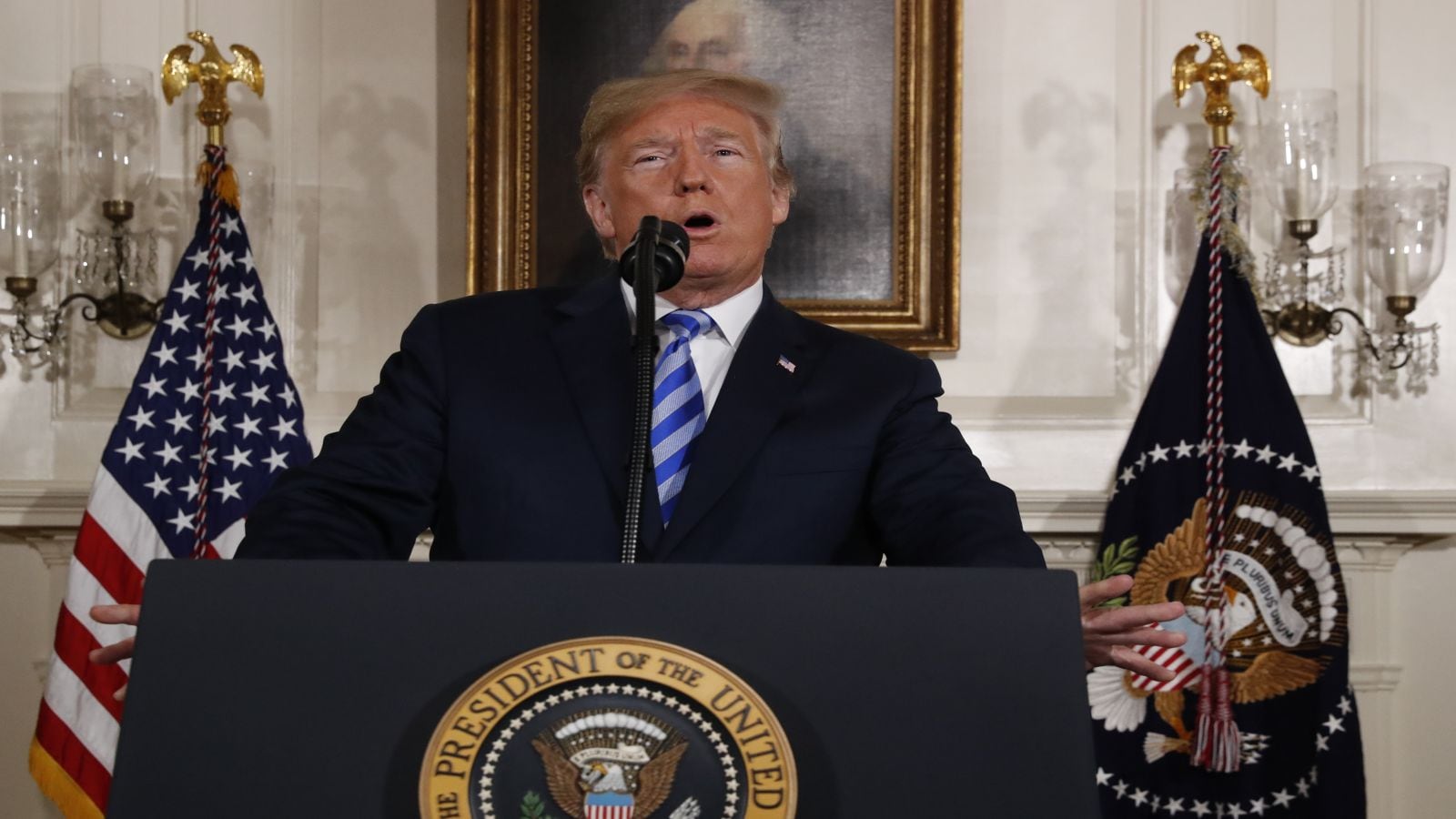
The humidity in the Rose Garden always clings to the wool of a suit, but on a late Thursday evening in June, the heat felt heavy with a different kind of pressure. Standing before a crowd of American farmers, Donald Trump leaned into the microphone. He spoke of a new frontier, a market salvaged from the ashes of a bruising, months-long conflict in the Persian Gulf.
"We have a new market coming up," he announced, his voice carrying that familiar, conversational cadence that treats global geopolitics like a real estate transaction. "And that’s called the lovely country of Iran. It’s a beautiful place. Would anybody like to go there?"
To the men and women who spend their lives watching the skies and praying for rain, the words sounded surreal. Iran. A nation that just months earlier, on February 28, the United States had entered a hot war against—a conflict aimed at curbing Tehran's nuclear ambitions, missile programs, and regional proxies. Yet here was the president, pivoting from the language of destruction to the language of the harvest.
He told the farmers that Iran was experiencing severe food shortages. He promised that Washington would freeze $12 billion of Tehran's overseas funds, lock them in a U.S.-controlled escrow account, and spend that money exclusively on American wheat, soybeans, and corn.
The strategy sounds simple on a teleprompter. It reads like a stroke of populist genius: take the enemy's frozen wealth and channel it directly into the pockets of the American heartland. Vice President J.D. Vance framed it as a dual victory, claiming the assets would make American farmers richer while feeding the Iranian people.
But out in the fields, where the dirt meets the fingernails, global trade is never that clean.
Consider a farmer named Thomas. He is a hypothetical composite of the thousands of growers across Iowa and Illinois who have spent the last few years drowning in a brutal agricultural trade deficit. For Thomas, a soybean isn’t a geopolitical chess piece; it is the mortgage on his tractor, the tuition for his daughter, the survival of a century-old family legacy. When the markets shrank over the last decade, his margins evaporated. He knows what it feels like to sit at a kitchen table under the hum of a single fluorescent bulb, staring at a ledger that refuses to balance.
To Thomas, the promise of a multi-billion-dollar windfall injected straight into the grain elevators feels like a lifeline. It represents a 42% reduction in the agricultural trade deficit, an opening of floodgates that could stabilize the price of corn for a generation.
But a shadow falls between the promise and the paycheck.
Thousands of miles away, across oceans and deep diplomatic divides, the view from Tehran looks entirely different. The narrative of a neatly controlled escrow account shatters against the reality of sovereign pride and deep-seated mistrust.
Iranian Foreign Ministry spokesperson Esmaeil Baghaei did not hide his disdain. He remarked on the bitter irony of the situation, noting how the original philosophy of the war—which he described as the destruction of Iranian civilization—had suddenly mutated into a government program to enrich American farmers.
The Iranian government explicitly rejects the U.S. terms. They insist that if their $12 billion is unfrozen as part of the tentative peace deal brokered in Versailles, they will spend it with absolute freedom. They will buy crops based on price and quality, not because Washington dictates the terms.
Iran’s Parliamentary Speaker, Mohammad Bagher Ghalibaf, took to social media to drive the point home with a biting metaphorical truth. He claimed that the only crop the U.S. was truly harvesting in the region was decades of deep mistrust—a crop he called organic, abundant, and homegrown.
This is where the grand narrative of trade diplomacy encounters a massive technical friction. Sanctions experts are openly flummoxed. For years, U.S. sanctions have kept these billions locked away. Moving money from a foreign bank into a U.S. bank to buy American grain requires a delicate financial ballet. If a foreign bank refuses to cooperate with the Treasury's strict escrow rules, the U.S. would have to sanction that bank too, potentially collapsing the fragile peace talks before the 60-day negotiation window closes in August.
It is a high-stakes gamble played with the livelihood of people who have nothing to do with international espionage or uranium enrichment.
The conflict has left the Strait of Hormuz choked and the global economy tense. Now, the peace deal relies on whether two bitter rivals can agree on how to buy a bushel of wheat. The president views the transaction through the lens of a closed deal, a humanitarian intervention that simultaneously rewards his most loyal domestic constituency. The Iranian leadership views it as an unbearable humiliation, an attempt to force them to buy American goods with their own stolen money.
Meanwhile, the grain continues to grow in the dirt of the Midwest, indifferent to the signatures on the memorandum of understanding. Farmers like Thomas can only watch the ticker symbols fluctuate, caught in the middle of a grand experiment where the line between a financial windfall and a broken promise is as thin as a single line of text in a treasury regulation.
The music played at the end of the Rose Garden dinner, a celebratory note for an audience eager for relief. But as the sun set over the White House, the real question lingered, unanswered and heavy in the humid air. You cannot eat promises, and you cannot build a market entirely out of leverage.