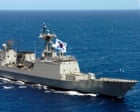
Mainstream defense desks are celebrating Seoul’s decision to push the Cheonghae Unit closer to the Strait of Hormuz. They frame it as a bold projection of middle-power muscle. They call it a necessary shield for global energy arteries.
They are completely wrong.
This deployment is not an act of maritime strength. It is an expensive, high-risk geopolitical compromise dressed up as naval strategy. While defense commentators applaud the sight of a South Korean destroyer edging closer to Iranian territorial waters, maritime logistics veterans and regional security analysts see a glaring vulnerability. Seoul is trading its most valuable diplomatic asset—strategic ambiguity—for a single warship that cannot meaningfully alter the military balance in the Persian Gulf.
The Lazy Consensus on Maritime Chokepoints
Read any standard wire report on South Korea’s expanded naval footprint and you will find the exact same three talking points recycled verbatim. First, roughly 70 percent of South Korea’s crude oil imports pass through the Strait of Hormuz. Second, commercial shipping faces escalating harassment from regional proxies and state actors. Third, deploying a destroyer protects Korean-flagged vessels and pleases Washington.
That logic collapses the moment you examine the geography and the hardware involved.
The Strait of Hormuz is just 21 nautical miles wide at its narrowest point, with two-mile-wide shipping lanes separated by a two-mile buffer zone. A single Chungmugong Yi Sun-sin-class destroyer—built primarily for anti-piracy patrols off the Horn of Africa—does not deter asymmetric swarm tactics, sea mines, or shore-based anti-ship ballistic missiles launched from the Zagros Mountains. In a confined littoral battlespace, a lone surface combatant without integrated carrier air support or regional basing infrastructure is not a deterrent. It is a target.
Defense planners in Seoul know this. Naval officers who have actually rotated through the Combined Maritime Forces in Bahrain know this. Yet the public narrative remains stubbornly stuck on the idea that showing the flag equals securing the supply chain.
The Real Reason Seoul Moved the Cheonghae Unit
If a single destroyer cannot secure the Strait of Hormuz against state-level interdiction, why did South Korea expand its operational zone?
Follow the diplomatic paper trail, not the naval charts. For years, Washington pressured Seoul to join formal US-led maritime coalitions in the Persian Gulf. Joining those coalitions directly would have triggered immediate economic retaliation from Tehran, threatening South Korean construction conglomerates, electronics exporters, and billions of dollars in frozen Iranian assets held in Korean banks.
Expanding the Cheonghae Unit’s independent operational radius—without formally placing it under a US-led coalition command structure—was a bureaucratic workaround. It allowed Seoul to tell Washington it was stepping up while telling Tehran it was acting independently.
That balancing act worked briefly when regional tensions stayed below a boiling point. Once kinetic exchanges across the Middle East intensified and maritime chokepoints became active theaters of attrition, the middle ground vanished. By pushing a warship closer to the Strait of Hormuz under an independent mandate, South Korea inherited all the kinetic risks of a combat zone without the unified command-and-control umbrella of a formal alliance structure.
Why Asking Whether South Korea Can Protect Its Oil Is the Wrong Question
Search engines are flooded with queries asking whether South Korea’s navy can protect its oil tankers in the Persian Gulf. Defense pundits love debating radar ranges, vertical launch cells, and intercept probabilities.
They are asking the wrong question entirely.
You do not protect a global energy supply chain at the chokepoint after a crisis erupts. By the time a warship is escorting a Very Large Crude Carrier through the Strait of Hormuz under threat of fire, the economic damage has already happened. War risk insurance premiums skyrocket overnight. Charter rates double. Refiners in Ulsan and Yeosu start bleeding margin weeks before a single hull takes damage.
Having spent years watching energy traders and maritime insurers price geopolitical risk, I have seen shipping firms blow millions on private armed guards and naval coordination desks only to realize that hull protection means nothing when Lloyds underwriters pull coverage for the entire Gulf. Insurance, not naval firepower, dictates whether commercial hulls move through Hormuz.
When naval presence escalates without a corresponding diplomatic off-ramp, underwriters do not lower premiums because a destroyer arrived. They raise premiums because the presence of more warships signals higher kinetic probability.
The Operational Reality Inside the Gulf
To understand why expanding operations near Hormuz backfires, look closely at the mechanics of modern naval deployments in contested littorals:
- The Logistics Tether: Operating continuously near the Strait of Hormuz requires relentless replenishment at sea. Without dedicated forward fleet bases in the immediate Gulf, a lone destroyer relies heavily on allied port access in Oman or the UAE for fuel, spare parts, and crew rotation. Every port call telegraphically maps the vessel's operational tempo to regional intelligence networks.
- Rules of Engagement Paralysis: An independent deployment outside a unified coalition operates under strict national rules of engagement. If an allied commercial vessel—say, a Liberian-flagged tanker carrying Korean-bound crude—comes under drone attack three miles away, an independent commander faces agonizing legal and political thresholds before engaging. Hesitation invites disaster; premature engagement sparks a bilateral war Seoul never authorized.
- Opportunity Cost on the Korean Peninsula: South Korea faces an acute demographic crunch that is already hollowing out its naval manpower pool. Every veteran surface warfare officer, radar technician, and anti-submarine specialist deployed to the Arabian Sea is one fewer specialist monitoring North Korean submarine-launched ballistic missile tests in the East Sea or countering gray-zone naval intrusions in the West Sea.
Alfred Thayer Mahan famously argued that command of the sea decides the fate of nations, yet modern naval theorists like Geoffrey Till have repeatedly warned that expeditionary prestige deployments can fatally dilute a medium power’s core coastal defense. South Korea is falling straight into that trap.
The Uncomfortable Downside of Pulling Back
Critics of my position will immediately point out a glaring flaw: if South Korea does not deploy naval assets near Hormuz, it looks like a free-rider.
They are right. That is the exact price of strategic restraint, and pretending otherwise would be dishonest.
If Seoul keeps its destroyers strictly in the Gulf of Aden or pulls them back to Northeast Asia, Washington hawks will accuse South Korea of outsourcing its energy security to the US Navy Fifth Fleet. Bilateral friction over defense cost-sharing agreements will spike. Domestic opposition parties in Seoul will accuse the government of abandoning Korean merchant mariners to foreign pirates and militias.
Those political headaches are real. They are loud, uncomfortable, and expensive in Washington lobby shops.
Yet political discomfort in Washington is infinitely cheaper than a burning destroyer in the Gulf of Oman or an asymmetric retaliatory strike against South Korean industrial facilities. A mature maritime strategy weighs actual kinetic survivability against diplomatic optics—and refuses to sacrifice hulls for headlines.
What Genuine Energy Security Actually Looks Like
If deploying warships closer to the Strait of Hormuz is a theatrical distraction, what should an import-dependent industrial powerhouse actually do?
Stop treating naval hardware as a substitute for supply-chain architecture. True insulation from Middle Eastern chokepoints happens on land, in financial markets, and in long-term procurement contracts—years before a crisis hits the Persian Gulf.
1. Aggressively Diversify Crude Sourcing Beyond the Gulf
Over-reliance on Persian Gulf crude is a structural choice, not a physical law. South Korean refiners have long favored Middle Eastern grades because their complex cracking facilities are calibrated for heavy, sour crude. Retooling refineries to process light, sweet crude from the United States, West Africa, and Latin America requires massive upfront capital expenditure. That capital expenditure costs a fraction of maintaining a permanent blue-water expeditionary fleet—and permanently severs the chokepoint leverage held by Gulf actors.
2. Expand Strategic Petroleum Reserves Beyond IEA Minimums
South Korea maintains robust government and private oil stockpiles that meet International Energy Agency benchmarks, typically covering around 90 to 100 days of net imports. In a prolonged Hormuz closure, 100 days vanishes in a blink as panic hoarding grips domestic markets. Expanding underground cavern storage to 180 days creates an unassailable buffer that allows Korean refiners to wait out maritime blockades without begging for naval escorts.
3. Weaponize Sovereign Maritime Reinsurance
Instead of sending destroyers to lower shipping risk, Seoul should deploy its sovereign balance sheet. When commercial war-risk insurers flee the Persian Gulf, a state-backed maritime reinsurance backstop keeps Korean-bound tankers moving without putting naval personnel in the crosshairs of shore-based missile batteries. Money absorbs financial risk; steel absorbs shrapnel.
4. Harden Domestic Littoral Defense First
South Korea’s naval shipbuilding industry—led by giants like HD Hyundai Heavy Industries and Hanwha Ocean—is arguably the most efficient in the world. Every won spent on naval expansion should go toward unmanned surface vessels, distributed sensor networks, and submarine warfare capabilities in Northeast Asia. Protecting the sea lanes within 500 nautical miles of Busan matters infinitely more to national survival than patrolling 4,000 miles away off Bandar Abbas.
The Hard Truth About Middle-Power Naval Strategy
History is brutal to middle powers that confuse global economic reach with global military reach. Having factories in Europe, semiconductor fabs in Texas, and oil contracts in Saudi Arabia does not mean the Republic of Korea Navy can—or should—police every waterway connecting them.
The United States Navy struggles to maintain uncontested sea control in the Red Sea and the Persian Gulf despite deploying nuclear-powered aircraft carriers, guided-missile cruisers, and global satellite surveillance networks. Expecting a single South Korean destroyer operating on an extended logistics tether to meaningfully secure shipping near the Strait of Hormuz is not strategy. It is wishful thinking disguised as deterrence.
Seoul does not need more warships steaming toward Iran. It needs the strategic discipline to pull its hulls back to waters where they actually hold the advantage, harden its energy reserves at home, and stop letting diplomatic pressure dictate naval deployments.