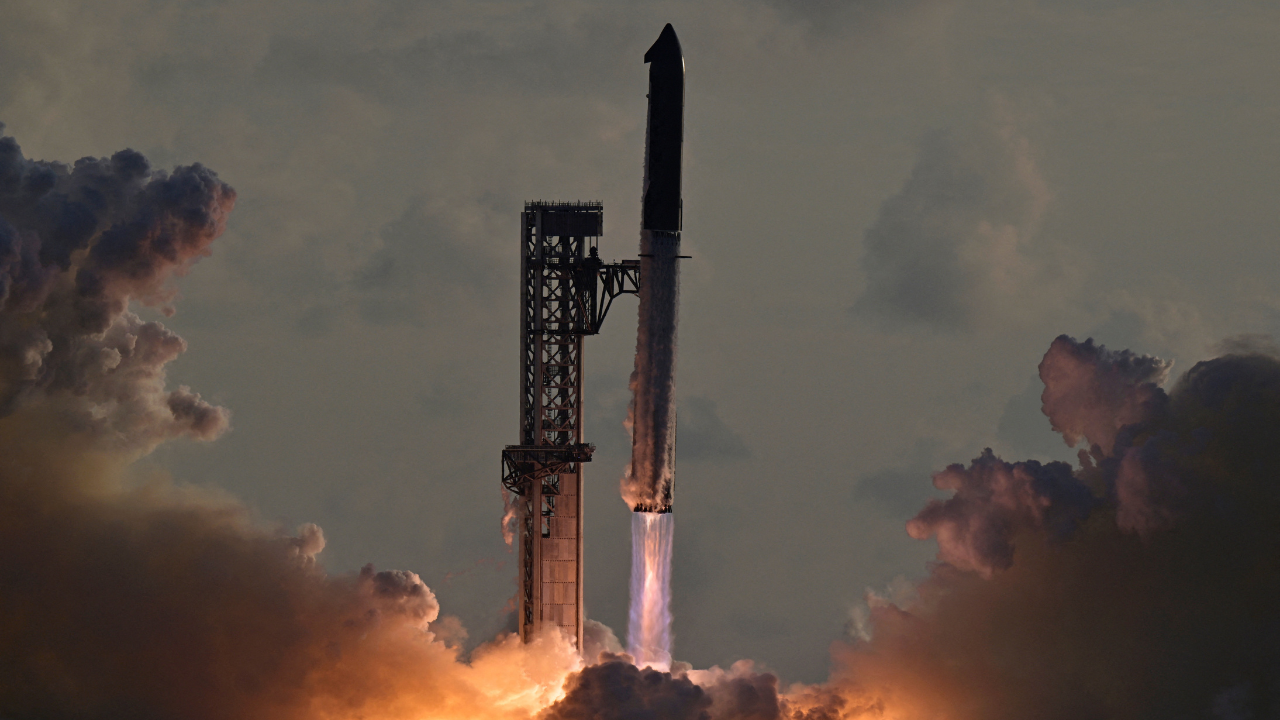
When SpaceX finally pushed its monolithic Starship system into a stable orbital trajectory for the first time, the live broadcast captured cheers in the control room. Outside mission control, however, a profound silence settled over legacy boardrooms from Huntsville to Toulouse. For decades, the aerospace industry operated under a predictable set of economic and physical constraints. Rockets were expensive, disposable machines built with meticulous, hand-crafted precision over years of assembly. Starship shattered that model. Crossing the threshold into Earth orbit with a vehicle standing nearly four hundred feet tall is not merely a technical achievement. It is an industrial earthquake that signals the permanent obsolescence of traditional rocket manufacturing.
The milestone did not happen in a vacuum. Years of catastrophic pad explosions, structural shreddings during max-q, and fiery atmospheric re-entry failures preceded this moment. Every shattered prototype served as a violent stress test for an iterative engineering philosophy that treats failure as a cheap data-gathering exercise. Traditional aerospace companies live in fear of failure because a single grounded rocket can bankrupt a defense prime contractor or stall a government program for a decade. SpaceX inverted that risk equation. They treat hardware as disposable and iteration as the only true path to velocity.
Understanding the weight of this milestone requires looking closely at the propulsion architecture. Thirty-three Raptor engines roaring beneath the Super Heavy booster generate nearly sixteen million pounds of thrust. That is more than double the power of the Saturn V rockets that carried astronauts to the Moon. Managing thirty-three high-pressure, full-flow staged combustion methane engines firing simultaneously was considered an insurmountable control nightmare by classical rocket scientists. A single acoustic resonance or a localized combustion instability can trigger a rapid unscheduled disassembly in milliseconds. The fact that the system cleared the tower, executed a hot-staging maneuver—where the upper stage ignites while still attached to the boosting stage—and guided itself toward an orbital insertion vector proves that brute-force computational control can tame chaotic physical systems.
Yet, reaching orbit is only half the battle. The true commercial viability of Starship hinges entirely on rapid, full reusability. If SpaceX has to rebuild a heat shield or replace engines after every single flight, the economic model collapses. During the orbital test flight that crossed this historic boundary, telemetry data showed significant thermal stress on the forward flaps and missing heat shield tiles. The vehicle survived long enough to complete its primary objectives, but the imagery of plasma chewing through steel flaps exposed the immense difficulty of managing atmospheric entry at orbital velocities. A stainless steel airframe offers incredible high-temperature strength compared to traditional aluminum-lithium alloys, but it is not invulnerable. Atmospheric friction turns the leading edge into a blowtorch. Solving this thermal protection problem without adding prohibitive dead weight remains the defining engineering hurdle of the next phase.
Beyond the raw physics lie massive economic shockwaves. Legacy launch providers charge upwards of sixty million dollars for medium-lift flights using expendable hardware. SpaceX is designing Starship to lift over one hundred metric tons to low Earth orbit for a marginal cost that could eventually drop below ten million dollars per flight. This cost reduction changes the mathematics of space exploration entirely. Launching hardware into orbit is no longer restricted by mass budgets or stringent component miniaturization. If sending a ton of steel into orbit costs the equivalent of a shipping container, the types of payloads we launch will shift dramatically. Orbital manufacturing, space-based solar power, and massive multi-satellite constellations transition from theoretical academic papers to immediate financial realities.
National security implications are accelerating just as fast. The Pentagon has watched the development of Starship with a mix of awe and intense operational interest. The ability to move up to one hundred and fifty tons of cargo anywhere on Earth within an hour using sub-orbital point-to-point trajectories represents a terrifying logistical capability for the United States military. While commercial applications focus on Mars colonization and lunar landings, the United States Space Force sees an entirely different utility. Moving heavy equipment, medical supplies, or combat engineering gear across the globe in thirty minutes bypasses traditional airlift constraints entirely. This dual-use reality means that Starship is heavily insulated by national security funding and strategic interest, regardless of commercial turbulence.
Regulatory bottlenecks, however, loom large over the program. Environmental groups, marine biologists, and federal agencies maintain constant pressure on launch operations out of South Texas and Florida. The sheer acoustic footprint of thirty-three Raptor engines rattles ecosystems and disrupts coastal wildlife habitats. The Federal Aviation Administration finds itself caught between the mandate to foster commercial space leadership and the statutory requirement to protect public safety and environmental assets. Every flight clearance requires arduous environmental assessments and protracted legal battles. These earthly roadblocks may ultimately slow down the cadence of launches far more than any technical hurdle in the upper atmosphere.
The commercial satellite market is also bracing for disruption. Starlink, the primary internal customer for Starship, stands to gain an insurmountable advantage. Current Falcon 9 launches deploy dozens of satellites at a time, but Starship can deploy hundreds of next-generation, larger satellites in a single drop. This capacity scaling will make competing constellations economically unviable. Competitors who rely on third-party launch providers will find themselves waiting years for a slot while paying significantly higher prices per kilogram. The market concentration in low Earth orbit will tighten sharply around a single corporate entity.
Attention now shifts to orbital propellant transfer. Reaching low Earth orbit is insufficient for lunar missions or interplanetary travel. Starship requires thousands of tons of super-cooled liquid methane and liquid oxygen to leave Earth orbit, meaning the vehicle must be refueled in space by a series of tanker flights. This choreography involves docking massive spacecraft in zero gravity and transferring cryogenic propellants without venting or freezing valves. No space agency has ever attempted orbital fluid transfer at this scale. Until SpaceX successfully demonstrates this capability, plans for crewed lunar landings on the Artemis timeline remain deeply speculative.
Critics often point out that the timeline set by leadership is frequently missed by years. That critique misses the overarching reality. Even with aggressive schedule slippage, SpaceX moves at a velocity that makes traditional aerospace timelines look glacial. While legacy programs spend five years in preliminary design reviews, Starship prototypes are built, tested, blown up, and redesigned in a matter of months. The traditional paradigm of risk aversion has been replaced by an aggressive culture of empirical discovery.
The aerospace industry is no longer arguing about whether full reusability is possible. They are frantically trying to figure out how to survive in a market where their primary competitor can throw a hundred-ton payload into orbit and land the booster back on a mechanical arm. The rules of the space age have been permanently rewritten from the ground up, and the rest of the world is desperately trying to catch up to a moving target.