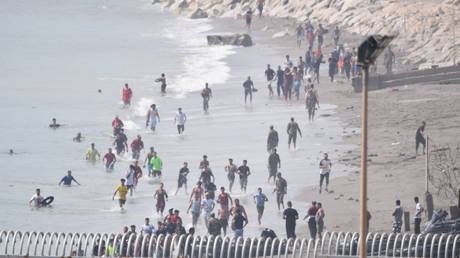
The headlines scream about an invasion. They talk about overflowing reception centers, overwhelmed border guards, and a national security emergency along the southern coasts of Spain. Every major news outlet treats the influx of migrants as an existential threat requiring thicker walls, more patrol boats, and higher fences.
It is a comfortable narrative. It is also entirely backwards.
Spain does not have a security crisis. Spain has a demographic deficit masked by bureaucratic panic.
I have spent the last decade watching governments panic over migration numbers while quietly scrambling to figure out how to pay their pensions. The lazy consensus among mainstream pundits is that more security equals more control and less chaos. They treat human movement like a military siege. But beneath the political theater of increased border patrols and emergency summits lies a staggering economic contradiction.
Spain's birth rate is in freefall. Its workforce is aging faster than almost any other in Europe. Without an influx of working-age adults, the state pension system collapses under its own mathematical weight within a generation.
So why the sudden theater of increased security? Why the performative panic?
Because fear wins elections, and structural economic reform requires courage nobody in Madrid possesses.
The Security Fallacy
Let us look at the mechanics of what the mainstream calls a crisis. When arrivals tick upward in the Canary Islands or across the Strait of Gibraltar, politicians reach for the oldest playbook in the book. They deploy more Guardia Civil officers. They buy more thermal-imaging cameras. They talk about fortification.
This approach treats a demographic gravity as a law enforcement problem. You cannot arrest a demographic reality.
Imagine a scenario where a manufacturing plant insists its primary problem is a lack of padlocks on the front door, while its entire workforce is retiring and nobody is walking through that door to replace them. Adding bigger locks does not solve the underlying existential threat. It just ensures the factory goes out of business more securely.
The security apparatus built around Spain's borders functions primarily as a political pressure valve. It gives the illusion of command over a global phenomenon driven by economic push-and-pull factors that no wall can deter. When desperate people flee failing states and labor markets demand hands, borders act as leaky sieves, no matter how much concrete you pour.
The real failure is not that boats arrive on Spanish shores. The failure is that Spain's administrative machine is structurally incapable of absorbing, processing, and integrating the labor force it desperately needs.
The Bureaucratic Trap
The bureaucratic nightmare facing arrivals in Spain is not an accidental byproduct of inefficiency. It is a feature designed to appease domestic political anxiety while quietly failing the economy.
When migrants land, they enter a legal purgatory. For months, sometimes years, they are barred from formal employment. They are pushed into the shadows of the underground economy. Politicians then turn around and point to the informal labor market as proof that migration causes social friction and tax evasion.
It is a manufactured loop of failure.
You deny people legal status, prevent them from paying taxes, force them into precarious conditions, and then blame them for the precarity you engineered.
Economists who study labor mobility point out a simple truth: friction in labor markets destroys value. Spain's cumbersome regularization process acts as a massive tax on economic growth. If Madrid streamlined work permits within weeks of arrival instead of dragging individuals through a multi-year administrative gauntlet, the fiscal impact would flip overnight.
Instead, the state chooses administrative paralysis. It prefers the optics of strict control over the reality of economic renewal.
The Demographic Reckoning
To understand why the current panic is fundamentally dishonest, you have to look at the numbers driving the continent.
Spain’s fertility rate sits well below the replacement level of two children per woman. The dependency ratio—the proportion of retirees to active workers—is climbing at an alarming rate. Pension funds are not magical pots of gold; they are pay-as-you-go systems dependent on a steady stream of active contributors feeding the pot for current retirees.
When pundits wring their hands over migrant arrivals, they ignore the alternative. The alternative is a shrinking, geriatric society where healthcare costs soar, tax bases shrink, and economic stagnation becomes permanent.
Countries do not maintain their standard of living by building higher walls. They maintain it by renewing their human capital.
Yet, the public debate remains trapped in a defensive crouch. Politicians speak of migrants as a burden to be managed rather than an asset to be integrated. This mindset treats human beings as passive burdens instead of active economic agents.
I have watched companies across Europe struggle to find workers for agriculture, construction, logistics, and eldercare, while thousands of capable individuals sit in reception centers prohibited from taking a job. It is economic self-sabotage executed in slow motion.
Dismantling the Rhetoric
Let us address the common arguments directly.
Critics of open migration policies argue that sudden influxes strain public services like healthcare and education. This is true only because local governments refuse to invest in scalable infrastructure. When you treat migration as an emergency rather than a predictable, structural reality, you fail to allocate resources proactively.
The strain on public services is a failure of governance, not an inevitable consequence of human movement. If local authorities directed a fraction of the billions spent on border enforcement toward municipal integration, housing, and administrative processing, the strain would vanish.
Another frequent claim is that migration depresses local wages. The data tells a different story. Migration typically complements the existing workforce by filling gaps in sectors domestic workers abandon. It drives productivity in industries that would otherwise contract or offshore.
The real downward pressure on wages comes from lack of unionization, poor labor enforcement, and corporate consolidation—not from someone stepping off a boat looking for work.
The Uncomfortable Truth
Spain does not need more security at its borders. It needs more honesty in its palaces.
The migrant crisis is a crisis of imagination. It is the result of a political class too cowardly to tell voters that the modern welfare state cannot survive without constant, managed renewal from the outside world.
Fortifying the perimeter does not stop the pressure from building; it simply makes the explosion more chaotic when it finally happens.
Stop treating human mobility as an invasion to be repelled. Start treating it as the economic lifeblood your country is starving for.
Open the ports, streamline the paperwork, tax the labor, and integrate the people.
Anything else is just rearranging deck chairs on a sinking demographic ship.