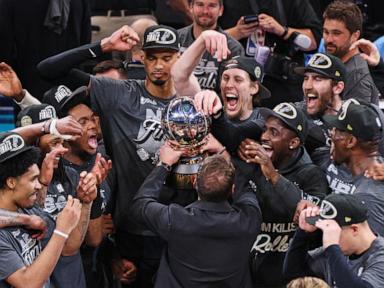
The San Antonio Spurs are heading back to the NBA Finals after a grueling 111-103 victory over the Oklahoma City Thunder in Game 7 of the Western Conference Finals. It was a masterclass in execution. While everyone expected a chaotic, high-scoring track meet, San Antonio dictated the terms of engagement from the opening tip. They didn't just win a basketball game. They provided a masterclass in how to dismantle a hyper-athletic opponent under the highest possible pressure.
Many analysts picked Oklahoma City to ride their youth and athleticism straight to the biggest stage. They were wrong. San Antonio relied on depth, methodical ball movement, and an unrelenting defensive scheme that forced the Thunder into contested individual play. Expanding on this theme, you can also read: The Blueprint Devoured: How San Antonio Decoded the Thunder and Returned to the Finals.
The Tactical Adjustments That Decided the Western Conference Finals
To understand how the Spurs clinched this series, you have to look beyond the final box score. Everyone talks about star power in a Game 7, but this matchup came down to spatial control and bench execution. San Antonio systematically took away the transition passing lanes that Oklahoma City thrived on throughout the regular season.
The primary adjustment came on the defensive glass. Instead of sending multiple players to hunt for offensive rebounds, the coaching staff ordered an immediate retreat into a heavy drop coverage. This decision effectively neutralized the Thunder's transition offense, forcing them into half-court sets where their spacing lacks consistency. Analysts at FOX Sports have provided expertise on this trend.
San Antonio also exploited the defensive over-rotations of the Thunder big men. By using high ball screens and crisp baseline cuts, the team consistently found open shooters on the weak side. The ball didn't stick. Every pass had a purpose, and that wore down Oklahoma City over forty-eight minutes.
Breaking Down the Definitive Statistical Shifts
The numbers tell a story of efficiency versus isolation. San Antonio finished the game with twenty-eight assists on forty-one made field goals. That ratio is absurd for a high-stakes elimination game.
Look at how the point distribution broke down across the four quarters:
- Paint Scoring: San Antonio outscored Oklahoma City 48-36 in the restricted area, defying the narrative that the Thunder possessed too much rim protection.
- Bench Points: The Spurs reserves provided a massive thirty-four points, keeping the energy levels high while the starters rested.
- Turnover Points: Oklahoma City gave up eighteen points off miscues, many of them coming during a critical four-minute stretch in the third quarter.
The Thunder relied heavily on isolation plays during the fourth quarter. It killed their rhythm. When the game slowed down, Oklahoma City stopped moving the ball, settling for difficult, contested mid-range jumpers. You cannot beat a disciplined team by trading complex team execution for difficult solo shots.
Why Depth Trumps Star Heavy Rotations in Elimination Games
Star players win headlines, but deep rosters win conference championships. The heavy minutes logged by the Oklahoma City starters throughout the series finally caught up to them in the second half of Game 7. Fatigue causes mental mistakes, and mental mistakes turn into open three-pointers for the opposition.
San Antonio kept their rotations tight but highly functional. Every player who checked into the game understood their precise defensive assignment. There was no hesitation. If a shooter drove past the first line of defense, the secondary help arrived instantly, forcing tough kick-out passes to reluctant shooters.
This victory completely validates the roster-building philosophy of prioritizing versatile, multi-positional players over top-heavy lineups. When your eighth and ninth men can step onto the floor in a Western Conference Finals elimination game without causing a defensive collapse, you possess a massive structural advantage.
Preparing for the Ultimate Championship Test
The celebration will be short. The focus now shifts entirely to the NBA Finals, where an entirely different stylistic challenge awaits. San Antonio proved they can handle a fast, athletic group, but the next opponent will bring a much more physical, half-court oriented style to the floor.
To prepare for the upcoming series, the immediate priority must be recovery and film study. The coaching staff will need to dissect how to maintain this level of defensive intensity against a team that utilizes far more post-up actions and interior screens than Oklahoma City did.
Review the defensive tape from the third quarter of Game 7 immediately. Identify the minor communication breakdowns on the switching coverages. Clean up the defensive rebounding block-outs to ensure no second-chance opportunities are gifted to the next opponent. The margin for error is officially gone.