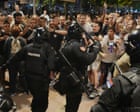
Detaining active-duty police officers for alleged excessive force against demonstrators represents a calculated institutional concession rather than a spontaneous triumph of the rule of law. In Serbia, where civil mobilization frequently collides with centralized executive authority, the arrest of law enforcement personnel functions as a pressure-release valve designed to contain street-level escalation while preserving the broader command structure. Understanding this event requires stripping away standard journalistic framing—which treats arrests as isolated legal milestones—and examining the underlying operational incentives, principal-agent dynamics, and legal bottlenecks that govern state coercion.
The Principal-Agent Breakdown in Crowd Control Operations
Public order policing operates on a strict principal-agent model. Political leadership (the principal) delegates the monopoly on legitimate violence to the Ministry of Internal Affairs and its tactical units (the agents) to maintain civil stability. During high-friction demonstrations, this delegation creates an inherent structural vulnerability known as agency loss.
Three distinct variables drive this breakdown during Serbian street protests:
- Ambiguous Rules of Engagement (ROE): Tactical directives issued prior to mass gatherings frequently rely on broad mandates to "restore public order" without defining precise kinetic thresholds. When operational boundaries are vague, field commanders default to maximalist containment strategies to avoid the career penalty of losing territorial control.
- Information Asymmetry: Command centers rely on real-time telemetry and field reports generated by the exact units deployed on the line. Unless independent video documentation penetrates the public sphere, headquarters lacks the granular visibility required to distinguish between defensive containment and punitive retaliation.
- Asymmetric Risk Profiles: Rank-and-file officers face immediate physical threats and acute cognitive overload in dense urban environments, whereas senior ministry officials face delayed political and diplomatic costs. Officers optimize for immediate physical dominance, creating long-term legitimacy deficits for the state.
When video evidence of disproportionate force goes viral, the information asymmetry collapses. The principal can no longer claim ignorance, forcing a rapid recalculation of political liability. Detaining the specific officers captured on camera resolves the immediate public relations crisis by isolating the violence as individual misconduct rather than systemic policy.
The Architecture of Selective Prosecution
In post-transition European states with strong executive branches, internal affairs investigations follow a predictable sequence when external pressure mounts. The initiation of detention proceedings against police personnel does not indicate institutional reform; instead, it reflects a triage mechanism designed to protect upper-echelon decision-makers.
Stage 1: Containment Through Scapegoating
The primary objective of early detention is boundary-setting. By charging low-ranking or mid-level operational personnel with abuse of office or infliction of bodily harm, the prosecutor's office establishes a legal firewall. The narrative shifts from command responsibility—who ordered the deployment, selected the tactical posture, and authorized the use of chemical irritants or batons—to individual deviation. This containment strategy insulates the Minister of Internal Affairs and the Director of Police from parliamentary or judicial scrutiny.
Stage 2: Evidentiary Friction and Procedural Attrition
Detention at the preliminary investigation phase is governed by procedural rules intended to prevent witness tampering or flight, not to guarantee conviction. Once public attention subsides, the prosecution enters a phase of high evidentiary friction.
- Identification Bottlenecks: Riot control units frequently operate in full protective gear, obscuring facial features and badge numbers. Establishing beyond a reasonable doubt which specific officer delivered an unlawful strike requires forensic video synchronization that local investigative bodies often lack the resources or mandate to execute.
- The Solidarity Wall: Internal police culture enforces strict horizontal loyalty. Fellow officers present during an incident routinely provide corroborating testimony framing the use of force as a necessary response to unprovoked aggression, neutralizing civilian witness accounts.
- Statutory Ambiguity: Serbian criminal statutes regarding abuse of official position require prosecutors to prove intent to inflict unlawful harm, rather than mere tactical error under stress. Defense counsel exploits the chaotic nature of crowd dispersal to downgrade criminal charges to minor disciplinary infractions.
Stage 3: Institutional Equilibrium Restoration
If the legal process drags across multiple electoral cycles, the state achieves its optimal outcome: initial protests are pacified by the optics of accountability, while the coercive apparatus remains intact and loyal because its members know the institution will ultimately shield them from severe custodial sentences.
The Cost Function of State Coercion
Every deployment of riot police forces the state to balance two competing variables: deterrence value and legitimacy erosion. Conventional reporting treats police brutality as an irrational failure of discipline. In reality, it is a measurable output of how the state prices political dissent.
When an administration perceives protests as an existential threat to its grip on power, the deterrence value of aggressive policing rises sharply. Visible, overwhelming force raises the personal physical cost of protesting for ordinary citizens, shrinking crowd sizes over time. However, if that force crosses a threshold of perceived cruelty—such as beating compliant detainees or targeting journalists—it triggers a backlash effect. Legitimacy erosion accelerates, transforming niche political grievances into broad-based moral outrage that draws previously apathetic demographics into the streets.
Detaining officers represents an emergency adjustment to this cost function. The state attempts to capture the deterrent benefit of the initial crackdown while retroactively refunding the legitimacy lost during the operation. This maneuver only succeeds if the public believes the detentions are the beginning of a structural purge rather than a temporary tactical retreat.
Operational Limitations of Reactive Detentions
Relying on post-incident arrests to manage civil unrest introduces severe structural vulnerabilities into both the security apparatus and the judiciary.
First, it degrades operational morale and creates hesitation. When field units observe that following implicit commands to clear streets aggressively results in criminal detention once cameras roll, risk aversion spikes. During subsequent demonstrations, units may delay intervention during critical phases of crowd escalation, increasing the likelihood of property destruction or genuine threats to public safety before order is established.
Second, it politicizes the Public Prosecutor's Office. In a system where prosecutorial independence is already contested, rapid detentions following executive statements reinforce the perception that the judiciary operates as an extension of political crisis management. If charges are later quietly dropped or reduced to suspended sentences, public cynicism deepens, permanently damaging institutional trust across all state organs.
Third, it fails to address tactical doctrine. Arresting three or five officers leaves the underlying crowd-control manual unchanged. Without mandatory body-worn cameras, visible alphanumeric identifiers on all tactical helmets, and strict statutory limits on the deployment of plainclothes units during public assemblies, the exact same friction points will generate identical incidents during the next cycle of civil unrest.
Institutional Signals to Monitor
To determine whether these detentions represent a genuine shift in accountability mechanics or standard political containment, analysts must track four specific procedural indicators over the next ninety days:
- Indictment Scope: Monitor whether the prosecutor's office expands the investigation beyond the physical perpetrators to include the immediate platoon or company commanders who supervised the sector where the abuse occurred. An investigation capped strictly at the lowest operational rank confirms a containment strategy.
- Custody Duration vs. Release Conditions: Track whether pre-trial detention is extended beyond the initial thirty-day window or rapidly converted into house arrest or release pending trial. Early release typically correlates with eventual charge reduction.
- Parallel Disciplinary Proceedings: Verify whether the Ministry of Internal Affairs immediately suspends the detained officers without pay and initiates internal dismissal proceedings independent of the criminal trial. Retaining detained officers on active administrative status signals institutional protection.
- Transparency of Forensic Evidence: Observe whether the prosecution formally enters citizen-recorded video and medical trauma reports from independent clinics into the evidentiary record without procedural challenges regarding chain of custody.
Strategic Imperative for Civil Society and Legal Observers
External actors—including human rights monitors, legal aid networks, and international oversight bodies—cannot rely on the state's initial detention announcements as proof of compliance with European human rights standards. Public pressure must immediately pivot from demanding arrests to enforcing procedural transparency.
Legal teams representing injured demonstrators should bypass reliance on state-gathered police testimony by constructing parallel, time-stamped evidentiary dossiers using open-source intelligence (OSINT) methodologies, synchronized metadata from multiple civilian devices, and certified forensic medical documentation obtained within twenty-four hours of injury. Simultaneously, institutional pressure must target the specific regulatory gaps that enable anonymity during deployments: mandating high-contrast identification markers on all riot gear and establishing statutory criminal liability for unit commanders who fail to prevent or report visible unlawful force within their immediate line of sight. Until accountability targets the command architecture rather than isolated field personnel, state detention of police officers will remain a tactical instrument of regime stabilization rather than an instrument of justice.