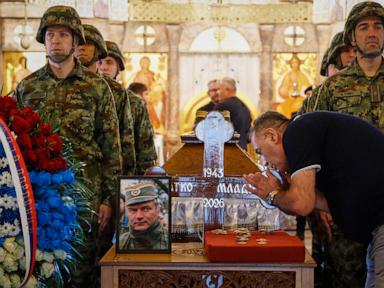
The physical repatriation of Ratko Mladic’s remains to Belgrade was never going to be a quiet affair. When the flag-draped coffin of the convicted war criminal arrived via a state-arranged flight, it signaled more than the final chapter for the man once dubbed the Butcher of Bosnia. It laid bare an institutional reality that Western capitals have spent three decades trying to ignore: Serbia's political establishment has chosen historical revisionism over reconciliation, turning a convicted architect of genocide into a martyr of state-backed nationalism.
Thousands of mourners, alongside figures in fatigues and senior clergy, gathered at the Church of St. Luke in Belgrade to honor a legacy built on the graves of more than 8,000 Muslim men and boys in Srebrenica and the multi-year terrorization of Sarajevo. The optics were meticulously orchestrated. While populist President Aleksandar Vucic claimed clean hands by labeling the public mourning an organic "emotional outpouring," the state apparatus facilitated every major logistical hurdle. Military honors, official army venues, and national media broadcasts transformed a criminal's sendoff into a nationalist demonstration.
The Anatomy of State Denial
To understand why Belgrade risks its European Union integration path over a dead general, one must examine the utility of permanent grievance. For decades, the political elite in Serbia has operated on a foundational premise: admitting full culpability for the horrors of the 1990s Yugoslav dissolution fractures the nationalist narrative required to win elections.
President Vucic’s political lineage is no secret. A former extreme nationalist who cut his teeth during the expansionist wars of the Milosevic era, Vucic has mastered the art of balancing transactional diplomacy with the West while feeding red meat to domestic hardliners. Approaching early parliamentary elections, the timing of the state's implicit embrace of Mladic functions as a familiar political shield. Whenever economic pressures mount or democratic backsliding faces external scrutiny, the political machinery defaults to the safe harbor of anti-Western rhetoric and defiant victimhood.
The European Union’s reaction was swift on paper but predictably toothless in practice. Enlargement commissioner Marta Kos canceled an upcoming diplomatic visit in protest, stating that the public glorification of a war criminal contradicts foundational European values. Yet, freezing diplomatic junkets does little to alter a domestic reality where murals of Mladic gaze down from Belgrade apartment blocks and soccer stadiums erupt into coordinated chants bearing his name. Brussels holds financial and political levers, yet it repeatedly hesitates to pull them, fearing that total alienation of Belgrade will push the entire Western Balkans further into the orbit of Moscow—a dynamic underscored by the prominent presence of the Russian ambassador at the funeral proceedings.
The Cost of Unhealed Wounds
Across the border in Bosnia and Herzegovina, the Mothers of Srebrenica watched the state-backed pageantry with a familiar, searing grief. Their characterization of the funeral as a major fascist gathering is not hyperbole; it is a direct response to a systemic campaign of erasure. When a government officially honors men linked to concentration camps, forced deportations, and mass graves, it invalidates the fragile peace brokered at Dayton in 1995.
The institutional normalization of war criminals creates a dangerous precedent for future generations. Consider a hypothetical scenario familiar to sociological researchers: children educated under a curriculum that frames convicted perpetrators as national defenders grow up immune to historical facts, primed to repeat the cycles of ethnic hostility when political expediency demands it. Belgrade's refusal to use the word "genocide," opting instead for sanitized euphemisms like "horrific crime", is a deliberate linguistic weapon designed to preserve the myth of Serbian innocence.
This strategy of active remembrance for monsters and active forgetting for victims is corrosive. It traps the entire region in an eternal 1995, where economic potential and modern governance are continually sacrificed on the altar of blood-and-soil mythology. As long as the state apparatus finds political profit in carrying the flag-draped coffins of war criminals, the shadow of the Bosnian war will continue to stretch across the Balkans, uncontained by borders or time.
Bosnian Serb war criminal Ratko Mladić dies in prison
This archive footage provides historical context on the life and legal accountability of Ratko Mladić following his conviction by the UN tribunal in The Hague.


