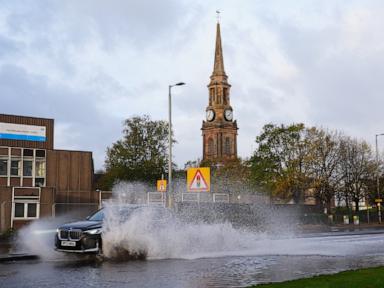
Every time two low-pressure systems cross the North Atlantic within forty-eight hours, British media outlets dust off the exact same headline. The script never changes. A named storm rolls in, rail networks grind to a halt, power lines snap across Cumbria and Northumberland, and journalists frame the chaos as an unprecedented act of nature battering a helpless island.
It is lazy journalism covering up an even lazier consensus.
The real story of a double-storm weekend in Northern Britain has nothing to do with wind speeds or rainfall totals. It is a story about decades of chronic underinvestment, Southern-centric capital allocation, and an operational culture that treats predictable winter meteorology like an alien invasion. When a 65-knot gust knocks out power to forty thousand homes in Yorkshire, the weather did not fail the public. The engineering standard did.
The Myth of the Unprecedented Weekend
Look at the meteorological mechanics of a North Atlantic storm track. Extratropical cyclones do not travel in isolation. They form along the polar front jet stream, riding atmospheric waves in families—clusters of two, three, or four distinct low-pressure centers spinning off the same thermal gradient between Arctic air and subtropical ocean currents.
Having two major storms hit the UK between Friday night and Sunday evening is not a statistical anomaly. It is basic synoptic meteorology. Meteorologists at the Met Office and the European Centre for Medium-Range Weather Forecasts track these Rossby wave trains days, sometimes weeks, in advance.
Yet the public narrative always acts surprised. Media coverage leans heavily on dramatic imagery—waves crashing over sea walls in Blackpool, lorries overturned on the A66, flooded high streets in Calderdale—while giving infrastructure operators a free pass. By framing the event as "the UK enduring a second big storm," reporters subtly absolve the private monopolies and state agencies responsible for keeping the lights on and the trains running.
I have spent fifteen years analyzing European grid resilience and transport logistics, and I have watched UK utility executives use "exceptional weather" as a regulatory shield every single winter. They lobby Ofgem and the Department for Transport for lower maintenance baselines during dry summers, pocket the shareholder dividends, and then act shocked when saturated soil and 70-mph gusts topple unpruned trees onto century-old overhead cables.
Why Northern Britain Always Bears the Brunt
The geography of Great Britain dictates that Atlantic depressions hit the western and northern coasts first and hardest. The Pennines, the Lake District, and the Scottish Highlands force moist maritime air upward, triggering orographic lift that dumps catastrophic volumes of rain onto steep, narrow river catchments.
That physical reality has not changed since the last Ice Age. What has changed is where the money goes.
Compare the infrastructure resilience of London and the South East with the North of England. When Thames Water or UK Power Networks faces a threat in the capital, capital expenditure flows freely. Underground cabling is standard. Flood barriers like the Thames Barrier receive constant, multi-million-pound upgrades. Rail lines feature modern drainage, concrete sleepers, and automated monitoring.
Cross the Humber or the Trent, and the engineering standards drop off a cliff.
- Overhead Vulnerability: Rural distribution networks in Northern England and Scotland still rely heavily on wooden poles carrying bare copper conductors through dense forestry. When Storm One saturates the ground, root systems lose their grip. When Storm Two arrives thirty-six hours later, the trees fall. Undergrounding high-voltage distribution lines costs roughly three to five times more per kilometer than stringing overhead wires, so Distribution Network Operators (DNOs) simply refuse to do it at scale outside urban centers.
- Victorian Drainage: Much of the rail network across the Pennines—including vital arteries like the TransPennine Route and the West Coast Main Line—relies on nineteenth-century masonry culverts and open earthwork cuttings. These structures were never engineered for modern rainfall intensity. When two storms hit back-to-back, the first saturates the clay embankments, and the second triggers landslips.
- Single-Point Failures: Northern transport corridors lack redundancy. If a single bridge washes out in Cumbria or a single overhead line comes down near Berwick-upon-Tweed, entire regions are severed from the national economy. In the South, commuters switch to an alternative tube line or a parallel motorway. In the North, you stay home.
Dismantling the "Climate Change" Excuse
Whenever infrastructure crumbles during a winter storm, politicians and corporate spokespeople immediately pivot to climate change. They tell the public that warming oceans are supercharging Atlantic storms, rendering existing defenses obsolete.
Let us separate the science from the corporate spin.
According to the Intergovernmental Panel on Climate Change (IPCC) and the UK Climate Projections (UKCP18) compiled by the Met Office Hadley Centre, a warmer atmosphere holds approximately 7 percent more moisture per degree Celsius of warming (the Clausius-Clapeyron relation). That undeniably increases extreme precipitation events. Winter rainfall in Northern Britain is getting heavier.
However, using climate change as an excuse for immediate operational failure is intellectual cowardice. Climate scientists have been publishing these exact projections since the 1990s. The engineering community has known for thirty years that drainage capacities needed to expand, floodplains needed restoration, and overhead power grids needed hardening.
Blaming global warming for a flooded substation in Lancashire is like refusing to fix a leaking roof for twenty years and then blaming the rain when the ceiling collapses. The trend was entirely predictable. The failure to adapt was a conscious financial choice.
Answering the Questions Nobody Wants to Ask
When severe weather strikes, search engines flood with predictable queries from stranded commuters and freezing homeowners. Most coverage answers these questions with shallow public-relations talking points. Here is the brutal reality behind what people actually want to know.
Why do UK trains cancel services before the storm even hits?
Network Rail routinely imposes blanket speed restrictions or outright pre-emptive closures hours before wind speeds peak. Officials claim this is purely for passenger safety, preventing trains from hitting fallen trees at 125 mph.
Safety is part of it, certainly. But the deeper driver is financial and contractual penalty avoidance. Under the UK rail franchising and track access regime, Network Rail pays massive compensation (Schedule 8 payments) to train operating companies for unplanned delays. However, if Network Rail declares an "extreme weather event" in advance and shuts down the line, liability rules shift. Pre-emptive cancellations protect balance sheets and prevent rolling stock from getting trapped out of position—which would trigger a cascade of penalties on Monday morning. Your weekend travel plans are sacrificed to protect corporate accounting metrics.
Are UK storms actually getting windier?
No. The data flatly contradicts the breathless reporting.
While rainfall intensity has measurably increased, long-term wind speed records analyzed by the Met Office show no statistically significant upward trend in storm wind gusts across the UK over the past four decades. In fact, some of the most destructive windstorms in British history—such as the Great Storm of 1987, the Burns' Day Storm of 1990, and the Boxing Day Storm of 1998—featured peak gusts that match or exceed almost everything seen in recent winters. The wind is not breaking new physical records; our aging, poorly maintained infrastructure is simply breaking at lower thresholds.
Why does it take days to restore power in rural areas?
When a storm knocks out power to 100,000 customers, DNOs triage repairs based on customer density per fault. Fixing a single damaged transformer in downtown Manchester restores electricity to 5,000 meters in four hours. Fixing a snapped pole in rural Northumberland requires a four-person crew, specialized off-road cherry pickers, tree surgeons to clear the access road, and six hours of labor—all to reconnect twelve farmhouses.
Under current regulatory incentives, utilities face steep fines for total customer minutes lost. Math dictates that rural residents always go to the back of the queue. Until regulators penalize utilities specifically for individual customer outage durations exceeding twelve hours—regardless of population density—rural Northern communities will continue to sit in the dark every winter.
The Real Cost of "Just-in-Time" Resilience
The British economy runs on a dangerous illusion: that you can strip away physical redundancy to maximize short-term efficiency and never pay the price.
Consider the energy grid. For twenty years, energy policy focused almost exclusively on generation—building offshore wind farms in the North Sea—while treating the transmission and distribution networks as an afterthought. We built gigawatts of clean power off the coast of Scotland and Yorkshire, yet we failed to build the high-capacity north-south transmission lines required to carry that electricity safely during extreme weather. When high winds hit, wind turbines actually have to be paid hundreds of millions of pounds in "constraint payments" to shut down because the grid cannot safely handle the surge.
Imagine a scenario where the UK applied military-grade asset management to its civil infrastructure. Instead of reactive patch-ups every Monday morning after a storm, operators would enforce mandatory 30-meter tree-felling corridors along every critical rail line and high-voltage feeder—a standard practice in Scandinavia and North America. Flood defense budgets would be allocated based on hydrological risk rather than metropolitan GDP. Local authorities would be legally barred from approving housing developments on functional floodplains, a reckless practice that continues across Northern England despite repeated catastrophic inundations.
The Uncomfortable Truth About Hardening the Grid
Advocating for radical infrastructure hardening is easy on paper, so let us confront the massive downside that advocates conveniently ignore: someone has to pay for it, and the bill is astronomical.
Burying overhead power lines across Northern England, rebuilding Victorian rail embankments, and quadrupling urban drainage capacity would cost tens of billions of pounds. Private utilities will not absorb those costs out of corporate goodwill. They will pass every single penny directly onto consumers through higher standing charges on energy bills, higher rail fares, and higher council taxes.
Furthermore, aggressive vegetation management—clear-cutting corridors along railways and power lines—triggers immediate, fierce backlash from environmental groups and local residents who value ancient woodlands and scenic rural landscapes. You cannot simultaneously preserve every picturesque oak tree overhanging a railway track and demand zero weather delays during a 75-mph gale.
The British public has been sold a lie that they can have world-class, weather-proof infrastructure on a bargain-basement maintenance budget without altering the landscape. That trade-off does not exist in physics or economics.
How to Actually Fix the Weekend Meltdown
If the UK wants to stop grinding to a halt every time two depressions cross the Atlantic, decision-makers need to abandon their obsession with reactive emergency response and overhaul the structural incentives governing utilities and transport.
- Rewrite the Regulatory Penalty Matrix: Ofgem must shift DNO incentives away from aggregate outage numbers toward strict, punitive fines for any single household left without power for more than twelve hours. Force utilities to invest in automated switching, microgrids, and undergrounding for vulnerable rural feeders.
- Mandate Statutory Clearance Zones: Give Network Rail and electricity operators sweeping legal authority to clear trees within falling distance of critical infrastructure, overriding local preservation orders where national connectivity is at stake.
- Decentralize Infrastructure Capital: Abolish the Treasury's Green Book appraisal methodology, which systematically funnels infrastructure spending toward high-wage areas in London and the South East because they generate higher theoretical economic returns. Assess Northern resilience projects on national security and supply-chain continuity, not flawed cost-benefit ratios.
- Enforce Sponge-City Urban Planning: Stop building concrete flood walls that merely push water downstream to the next town. Mandate upstream natural flood management—peatland restoration, leaky dams, and reforested upland catchments across the Pennines—to slow water runoff before it hits valley towns.
Until those structural changes happen, stop treating winter storms like breaking news. The weather is just doing what it has done for millennia. The only thing breaking is a system designed to fail.