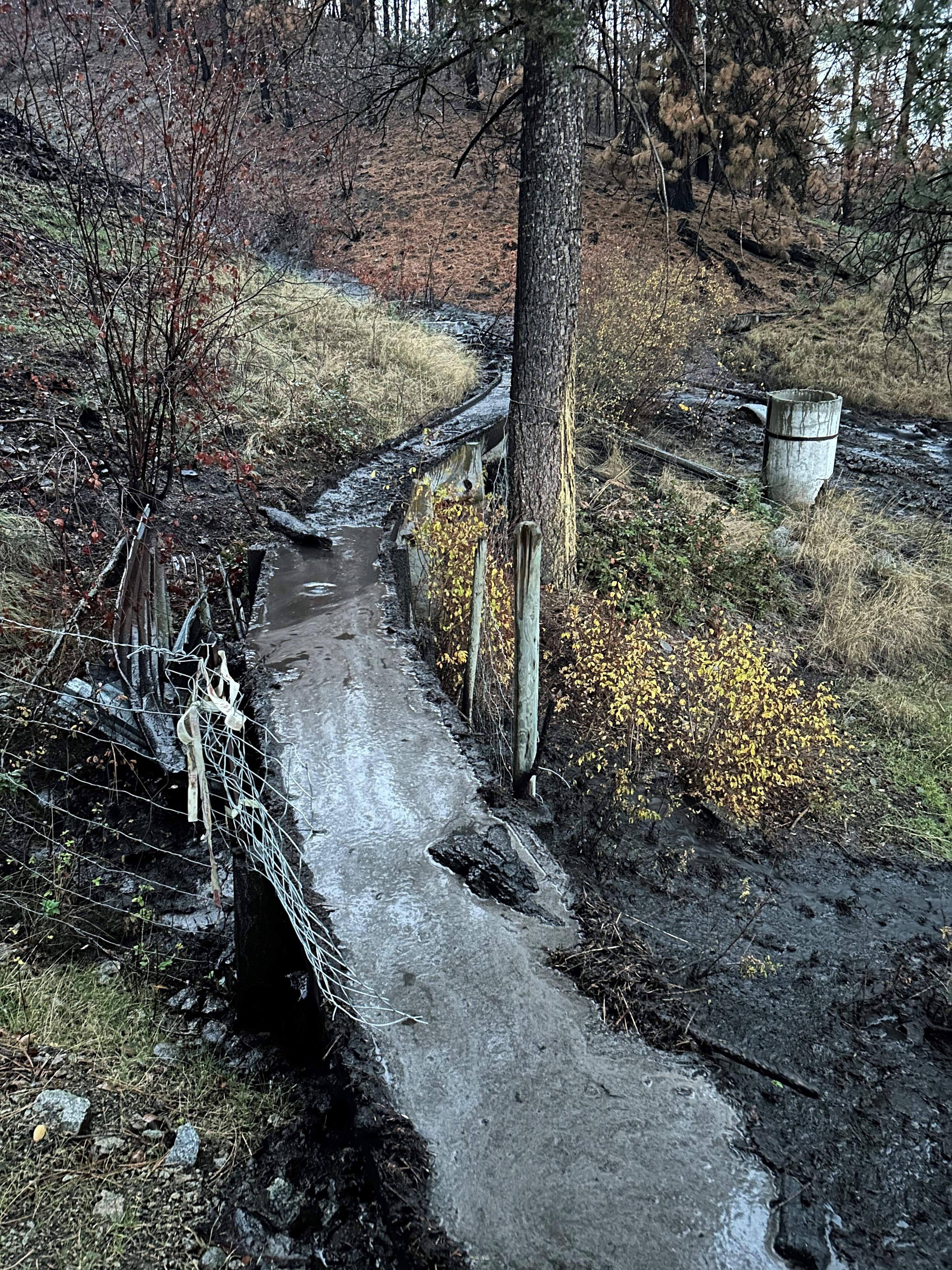
Blaming a wildfire for the landslides in Summerland is like blaming a match for burning down a house soaked in gasoline. It misses the point entirely.
Every time a hillside gives way after a burn scar dries out, local headlines trot out the exact same lazy consensus. The fire stripped the trees. The roots died. The rain fell. The mud slid. Case closed.
It is a neat, comforting narrative because it paints the disaster as an unavoidable act of nature. You cannot sue a lightning strike. You cannot zone away a drought. By pinning the Summerland slides exclusively on post-wildfire slope vulnerability, municipal planners, developers, and nervous homeowners get a convenient free pass.
They are wrong. And that comforting lie is going to get people killed the next time an atmospheric river parks itself over the Okanagan Valley.
Fire is merely the trigger. The gun was loaded decades ago by reckless hillside grading, archaic stormwater engineering, and a stubborn refusal to respect basic soil mechanics. If you want to understand why slopes are failing—and how to actually stop them from taking homes with them—you have to stop looking at the charred trees and start looking at what we did to the dirt long before the smoke ever rolled in.
The Myth of the Post-Fire Mudslide
Walk into any municipal council meeting in British Columbia after a rough fire season, and you will hear the exact same buzzwords. People throw around "hydrophobic soil" like a magic spell that explains away every failure of civil engineering.
Here is the real science, stripped of the PR spin.
Yes, intense heat from a wildfire vaporizes organic compounds in the upper layer of soil. Those gases condense slightly deeper down, creating a waxy, water-repellent crust. Geologists call this fire-induced soil water repellency. When rain hits that crust, it cannot soak in. Instead, it sheets off the surface at terrifying speeds, picking up ash, gravel, and boulders to form a debris flow.
That is a real phenomenon. It happens in steep, unlogged, untouched wilderness areas all the time.
Look closely at the failures threatening infrastructure, highways, and subdivisions in places like Summerland, though. Many of these are not pure, untouched wilderness debris flows. They are deep-seated rotational slumps and translational slides happening on modified slopes, road cuts, and terraced subdivisions.
A wildfire only bakes the top few inches of the earth. The heat from a fast-moving brush or forest fire rarely penetrates more than five centimeters below the surface. It does not cook the clay layers twenty feet down. It does not magically liquefy glacial till at the base of a forty-foot retaining wall.
When a twenty-foot bank of earth shears off and buries a road or threatens a foundation, the fire did not cause the structural weakness. The fire simply removed the canopy that was acting as an umbrella, exposing a slope that was already operating on a razor-thin factor of safety.
I have walked dozens of slide paths across the Pacific Northwest and the Interior. I have watched municipalities blow millions of dollars hydroseeding burn scars with ryegrass, patting themselves on the back for "stabilizing the slope," only to watch the entire hillside—grass, straw wattles, and all—slump into the valley floor two springs later. Why? Because you cannot fix a deep structural drainage problem with grass seed.
How We Engineer Our Own Disasters
To see the real culprit behind Summerland's slope instability, you have to understand the geology of the Okanagan Valley.
This is not solid granite bedrock. Much of the benchland and hillside terrain around Summerland consists of glaciolacustrine silts, sands, and gravel deposits left behind by retreating ice sheets. Geotechnically speaking, these soils are notoriously temperamental. Dry, those steep silt bluffs can stand nearly vertical for decades, lulling everyone into a false sense of security. Add water, and their shear strength drops off a cliff.
For fifty years, development patterns in the Interior have treated these sensitive glacial benches like flat prairie farmland.
Developers cut into the toe of a slope to create flat building pads. Removing the toe of a hillside is the geotechnical equivalent of knocking out a load-bearing wall in a two-story house. All that earth uphill is still pushing down, driven by gravity, and you just removed the wedge of soil that was holding it back.
Then, we pave over the top of the bench. Roofs, driveways, asphalt streets, and manicured lawns replace native bunchgrass and deep-rooted ponderosa pines. Every drop of rain that used to be intercepted by pine needles or absorbed by porous forest duff now shoots into catch basins and storm drains.
Where does that concentrated stormwater go? Usually, it gets piped to the edge of the bench and dumped onto the slope face, or worse, routed into drywells that inject thousands of gallons of pressurized water directly into the subsurface silt layers.
Imagine a scenario where a homeowner at the top of a silt bluff waters their lawn every morning, their septic field leaches into the subsoil, and their roof downspouts dump directly into the ground ten feet from the crest. For twenty years, mature trees and brush downslope act like giant biological pumps, transpiring that excess groundwater back into the atmosphere. The slope stays in a state of fragile equilibrium.
Then a wildfire sweeps through. The trees die. The biological pumps shut off overnight. The homeowner keeps watering the lawn, the municipal storm drains keep dumping water onto the bench, and the autumn rains arrive. Without the trees pulling water out of the ground, the water table inside the slope rises. Pore water pressure builds up between the microscopic grains of silt, pushing them apart until friction vanishes.
The hillside lets go. The news reports a "post-wildfire landslide." The insurance companies invoke act-of-God clauses. And nobody looks at the stormwater outfall pipe sitting right at the headscarp of the slide.
The Questions Nobody Wants to Ask
When landslides hit the news, homeowners start searching for quick fixes. Most of the conventional wisdom floating around online is not just unhelpful; it is actively dangerous.
Will replanting trees immediately stop the erosion?
No. In fact, relying on reforestation as a short-term landslide mitigation strategy is a textbook mistake.
While living roots provide crucial mechanical reinforcement—what geotechnical engineers call root cohesion—a seedling takes ten to fifteen years to establish a root network deep enough to bind soil across a potential failure plane. Worse yet, the roots of the trees killed in the fire do not vanish immediately. They remain intact for the first two to three years, holding the soil together. The absolute peak window for shallow landslides actually hits three to seven years after a fire, right when the old roots rot away and the new saplings are still too small to take over. Planting trees is great for 2040. It does nothing for next Tuesday's rainstorm.
Are retaining walls the best way to protect a hillside property?
A poorly engineered retaining wall is just a heavier projectile waiting to slide down the hill.
Homeowners love segmental concrete block walls because they look neat and create flat yard space. Unless those walls are tied back into stable soil with geogrid reinforcement and equipped with robust weeping tile drainage behind them, they act like dams. Water builds up behind the blocks, hydrostatic pressure spikes, and the wall blows out. As the United States Geological Survey and the British Columbia Ministry of Forests have documented for decades in their landslide hazard guidelines, uncontrolled groundwater—not lack of concrete—is the primary driver of slope failure.
Does standard homeowner insurance cover these slides?
Almost never. Standard residential policies in Canada and the United States routinely exclude earth movement, including landslides, mudflows, and slope subsidence. You might have coverage if a burst municipal water main directly caused the washout, or if fire damage directly triggered a covered peril under specific endorsements, which is precisely why the "wildfire caused it" narrative gets fought over so fiercely in courtrooms. Relying on an insurance policy to save you from a geotechnically unsound lot is a losing bet.
What Actually Works on Vulnerable Slopes
If you own property on or below a steep slope in a fire-prone region, you cannot wait for municipal studies or provincial relief funds. Government mitigation moves at glacial speed, and by the time a consultant finishes a three-year hazard mapping project, the dirt has already moved.
Real slope stabilization requires aggressive, unglamorous water management and mechanical intervention.
1. Divorce Water from the Slope
Your number one enemy is pore water pressure. Every single drop of water hitting your roof, driveway, and yard needs to be captured in solid, non-perforated PVC pipes and routed completely off the slope to a verified municipal storm system or safe valley-bottom discharge point.
Rip out drywells near slope crests. Disconnect downspouts that empty onto splash blocks. If you have an in-ground irrigation system within fifty feet of a steep bank, shut it off and cap it permanently.
2. Install Horizontal Subsurface Drains
Surface ditches only catch runoff; they do nothing for the water already trapped deep inside the hillside. Geotechnical contractors can drill perforated PVC pipes horizontally into the face of a vulnerable slope. These drains tap directly into perched water tables and bleed the pressure out before the soil reaches saturation. It is not pretty, and watching water trickle out of pipes sticking out of a bank won't win any landscaping awards, but reducing internal pore pressure is the single most effective way to raise a slope's factor of safety.
3. Ditch the Grass and Use Mechanical Soil Nails
If a slope is actively creeping or steeper than a 2:1 grade (26 degrees), surface vegetation will not save it. You need structural reinforcement. Soil nailing—drilling steel bars deep into the hillside, grouting them in place, and tying them to a high-tensile wire mesh draped over the slope face—pins the unstable upper layers directly into the competent strata underneath.
Let's be honest about the downside here: this is brutally expensive. Retrofitting a residential hillside with horizontal drains and soil nails can easily run into the hundreds of thousands of dollars, sometimes exceeding the value of the structure it protects. It turns a natural-looking hillside into an industrial civil engineering site. Sometimes, the smartest, most honest geotechnical recommendation isn't building a bigger wall—it is recognizing that the lot should never have been zoned for residential construction in the first place, and walking away before the next storm hits.
Stop Waiting for the Next Fire
The conversation around Summerland's slopes is stuck in a loop because blaming climate and wildfire absolves everyone in the room of responsibility. It turns a preventable land-use failure into a tragic inevitability.
Wildfires are going to keep burning through the Okanagan. Atmospheric rivers are going to keep slamming into the coast and spilling over the mountains. That is the baseline reality of living in the West.
You cannot stop the sky from raining, and you cannot stop the forest from burning. You can stop cutting the toes off glacial silt bluffs, stop pumping urban stormwater into unstable hillsides, and stop pretending that a burn scar is the only reason the earth is moving. Until we start treating slope stability as an engineering and zoning problem rather than a forestry side effect, the mud will keep coming down.