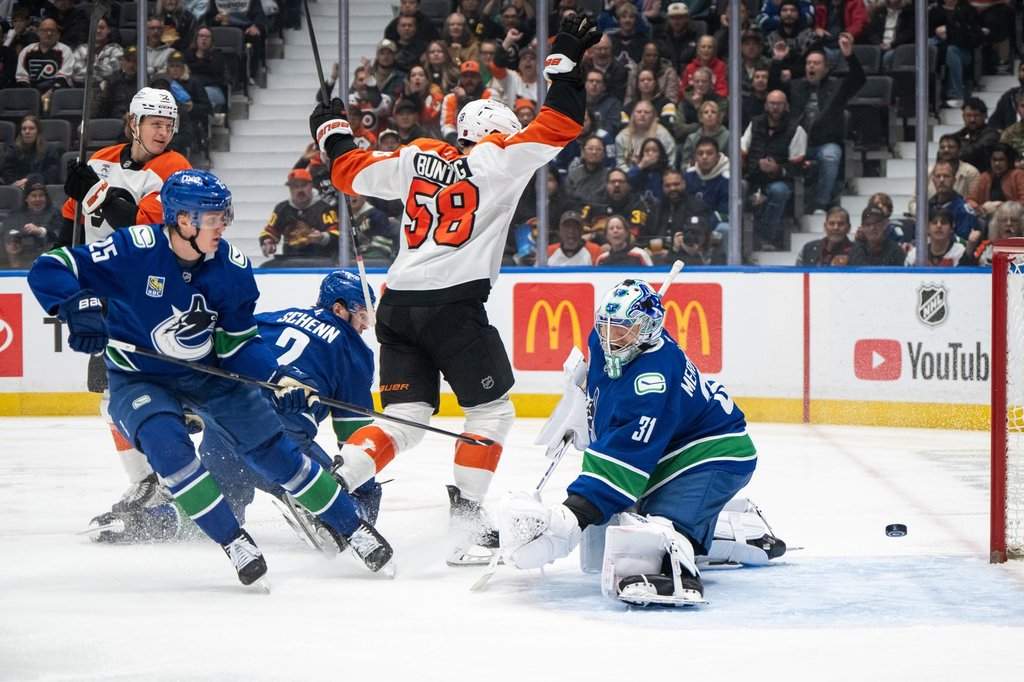
The standard post-game recap is a monument to lazy sports journalism. You know the exact script before you even click the link. A team wins 3-1, gets heavily outshot in the third period, leans on a hot goaltender, and adds an empty-netter to seal the box score. The beat writers immediately fire up the word processors to praise their "grit," their "resilience," and their ability to "outlast" a tough opponent.
It is complete nonsense. Recently making news recently: The Final Eight Minutes Under Water.
When the Philadelphia Flyers beat the Vancouver Canucks 3-1, the prevailing narrative was predictable: Philadelphia found a way to win a tight, defensive battle against a high-flying Western Conference opponent. They bent, they didn't break, and they walked away with two points in the standings. Case closed.
Except if you actually understand how modern hockey works, that 3-1 victory wasn't a blueprint for sustainable success. It was a flashing red warning light disguised as a celebration. More insights into this topic are covered by ESPN.
I have spent over a decade tracking NHL front-office analytics, sitting in press boxes, and watching general managers talk themselves into bad roster extensions because of three-week stretches of unsustainable goaltending. Every single year, a fanbase falls in love with a gritty, low-event, shot-blocking team that "outlasts" superior opponents in November, only to watch that exact same roster get obliterated in four straight games come April.
Winning a hockey game 3-1 does not mean you played well. Often, it means you got lucky, your goalie stood on his head, and your coaching staff is quietly terrified of what the underlying numbers actually say.
The Myth of "Outlasting" an Opponent
Let's dissect the word "outlast." In boxing, outlasting an opponent means absorbing body blows until their cardio fails, then knocking them out in the eleventh round. In hockey, "outlasting" is almost always a polite euphemism for getting caved in territorially for forty minutes and surviving solely because the opposing shooters hit three posts and your goaltender posted a .960 save percentage.
Look at the mechanics of a typical 3-1 NHL scoreline. Usually, one team jumps out to a 2-0 lead on a couple of rush chances or a power-play deflection. Then, score effects take over. The trailing team—in this case, a Vancouver squad loaded with elite offensive talent—pushes the pace. They activate their defensemen. They cycle the puck below the goal line. They generate wave after wave of high-danger scoring chances from the inner slot.
Meanwhile, the leading team collapses into a passive five-man box in front of their own crease. They stop skating. They stop attacking the neutral zone. They resort to flipping the puck off the glass and praying for a whistle.
Mainstream hockey media calls this "locking it down." Analytics departments call it turtling, and the data proves it is a losing strategy over an 82-game sample.
When you willingly surrender puck possession for an entire period, you are no longer controlling the outcome of the game. You are outsourcing your livelihood to variance. A puck deflects off a shin pad. A stick breaks on a clearing attempt. A referee calls a borderline hooking penalty because you are chasing shadows in your own end. Suddenly, a 2-1 lead evaporates, and you are scrambling for a loser point in overtime.
Why Box Scores Lie to Casual Fans
The biggest trap in sports analysis is outcome bias—judging the quality of a decision or performance purely by its final result rather than the process that produced it.
If a poker player goes all-in pre-flop with seven-two offsuit and hits two pair on the river to win the pot, nobody calls him a genius. Everyone at the table knows he made a catastrophic mathematical error and got bailed out by the deck. Yet in the NHL, when a team gets out-attempted 65 to 35, loses the expected goals battle by two full goals, and wins 3-1 because their goalie stopped 34 of 35 shots, the post-game presser is full of praise for their "character."
To understand why the Flyers-Canucks box score is deceptive, you have to strip away the empty-net goal and look at five-on-five play.
- Shot Quality vs. Shot Volume: Not all shots are created equal. A wrist shot from the blue line with zero traffic has roughly a 2% chance of going in. A one-timer from the royal road—the imaginary line splitting the offensive zone down the middle—has closer to a 25% or 30% chance. Teams that "outlast" opponents usually survive on the perimeter while allowing the opposition into the house.
- The Empty-Net Illusion: A 3-1 final score looks decisive. It looks like a comfortable two-goal cushion. In reality, 90% of 3-1 games are razor-thin 2-1 nail-biters until the final forty-five seconds, when the trailing team pulls their goalie and rolls the dice. Treating a 3-1 win as a dominant performance is a fundamental misreading of game state.
- Goaltending Volatility: Goaltending is voodoo. Even the best netminders in the world—guys like Igor Shesterkin, Connor Hellebuyck, or Thatcher Demko—experience massive year-to-year and month-to-month fluctuations in save percentage. Building an identity around winning 2-1 and 3-1 games requires your goalie to be superhuman every single night. That is not a strategy; it is a prayer.
What Everyone Gets Wrong About Defensive Hockey
Whenever you criticize a low-scoring, grind-it-out victory, the old-school hockey purists immediately push back. They ask: "Don't you know that defense wins championships? Look at the teams that win the Stanley Cup—they all know how to play tight, 2-1 playoff hockey!"
This is the single most persistent misconception in the sport. Yes, Stanley Cup champions play suffocating defensive hockey. No, they do not play like a team clinging to dear life in a passive defensive shell.
Look at the true defensive juggernauts of the modern era—the 2022 Colorado Avalanche, the 2023 Vegas Golden Knights, the 2024 Florida Panthers. How did those teams defend?
They defended by having the puck.
The best defense in hockey is played two hundred feet away from your own net. It is relentless forechecking that forces opposing defensemen to rush their breakout passes. It is tight gap control at the offensive blue line that kills transitions before they start. It is cycling the puck in the offensive zone for forty-five seconds at a time until the other team is too exhausted to mount a counterattack.
Compare that to the brand of "defensive" hockey celebrated in a gritty, shot-blocking 3-1 win. Blocking thirty shots a night is not a badge of honor. Think about what a blocked shot actually represents: it means the other team has the puck, and you are desperately trying to stop them from scoring.
If you block thirty shots in a game, it means you spent the entire night chasing the play. You didn't win puck battles. You didn't exit your zone cleanly. You just stood in shooting lanes, absorbed bruises, and hoped the puck didn't ricochet straight onto an opponent's tape. Over a seven-game playoff series, the team blocking thirty shots a night ends up with broken ankles, bruised ribs, and an empty gas tank by Game 5.
The Real Cost of "Gritty" Hockey Culture
Let's talk about the Philadelphia Flyers specifically, because their entire organizational identity under John Tortorella has been built around this exact ethos. Hard work. Shot blocking. Accountability. Never taking a shift off. Making life miserable for skill teams like Vancouver.
There is undeniable value in structure and work ethic. If you have a roster lacking elite, game-breaking superstars, you have to outwork the opposition just to stay competitive. You have to clog the neutral zone, win board battles, and turn games into rock fights. It raises your floor. It keeps you out of the basement.
Here is the catch that nobody in the local media wants to admit: raising your floor often lowers your ceiling.
Imagine a scenario where a rebuilding franchise adopts a hyper-conservative, defense-first system too early in its development cycle. For two seasons, they overachieve. They beat superior teams 3-1 on random Tuesday nights in November. They finish with 88 or 92 points, just missing the playoffs or sneaking in as the eighth seed.
What happens next?
- Draft Lottery Purgatory: Instead of drafting in the top five—where you actually acquire the generational centermen and franchise defensemen needed to win a Cup—you pick 14th or 16th every June. You get good middle-six wingers instead of superstars.
- Stunted Offensive Creativity: Young, dynamic forwards learn to dump the puck in at the red line and retreat into defensive posture rather than making high-skill plays off the rush. By the time they hit their mid-twenties, their offensive instincts have been coached right out of them.
- False Confidence at the Trade Deadline: A general manager looks at the standings, sees his team hanging around a wild-card spot because of a string of gritty 3-1 wins, and decides to hold onto expiring veterans—or worse, trade draft picks for rentals—instead of selling high and stockpiling future assets.
I have watched this exact movie play out in Calgary, in Minnesota, in New York with the Islanders, and in Philadelphia for the better part of a decade. It is the mushy middle—the worst place an NHL franchise can possibly exist.
What Vancouver Actually Learned From Losing 3-1
Now flip the perspective. Look at the Vancouver Canucks walking out of a 3-1 loss.
If you are the Canucks' coaching staff, you are annoyed about leaving two points on the table, especially against an Eastern Conference opponent. You hate giving up early leads. You hate failing to capitalize on power-play opportunities.
However, when the video coaches break down the tape on the flight home, they aren't panicking. They are looking at process metrics that tell a completely different story than the scoreboard.
Elite offensive teams like Vancouver—built around high-end skill players like Quinn Hughes, Elias Pettersson, and J.T. Miller—understand that hockey is a game of probabilities. Over a small sample size of one game, a hot goalie and a few blocked shots can beat you. Over a sample size of 82 games, skill and possession always win out.
Let's examine what actually matters when evaluating a contender's loss to a gritty underdog:
| Metric Category | What the Box Score Shows | What Front Offices Actually Track |
|---|---|---|
| Offense | 1 goal on 30+ shots ("Struggled to finish") | Expected Goals (xG) and inner-slot pass completions |
| Defense | Allowed 2 real goals ("Leaky at key moments") | Controlled Zone Entries Allowed and rush chances against |
| Special Teams | 0-for-3 on the power play ("Cost them the game") | Shot-attempt generation per 2 minutes of power-play time |
| Physicality | Out-hit and out-blocked ("Outworked") | Puck-retrieval rate on dump-ins and forecheck pressure |
When a contender loses 3-1 while dominating the underlying possession metrics, the coaching staff tells the room to stay the course. Changing your system because you ran into a hot goalie is the quickest way to ruin a good hockey team.
The Honest Caveat: When "Ugly" Wins Actually Matter
To be completely fair, there is a time and a place for the 3-1 grind-it-out victory. Pretending that analytics explain 100% of hockey is just as naive as ignoring them entirely.
In Game 6 of a second-round playoff series, when your top-line center is playing with a separated shoulder and your power play has gone cold, nobody cares about expected goals. You need a greasy deflection, twenty-five blocked shots, and a goaltender who refuses to let anything cross the red line. In a single-elimination or short-series environment, variance is your best friend if you are the underdog.
Furthermore, if you are a young locker room trying to establish basic professional standards—showing up on time, backchecking hard, refusing to quit when things get difficult—winning a tough road game against a skilled opponent builds real psychological buy-in. Players are human beings, not spreadsheets. If you ask them to block shots and grind along the boards, they need to see that sacrifice rewarded on the scoreboard occasionally, or they will tune out the coach by January.
The mistake isn't winning ugly. Every good team wins 10 to 15 games a year they had no business winning. The mistake is confusing survival with dominance.
How to Watch Hockey Like an Insider
If you want to stop getting fooled by the daily NHL highlight reels and cookie-cutter game recaps, change how you evaluate a hockey game. Stop looking at the final score in isolation and start asking three specific questions after every buzzer:
- Who dictated the pace of play? Did the winning team force the opponent to play their style, or did they merely survive the opponent's attack? If a team spends 65% of the night in their own defensive zone, they didn't dictate anything—they survived.
- How were the goals scored? Were they the result of repeatable offensive mechanics—cross-seam passes, screen-and-tip plays, sustained cycle pressure—or were they fluky bounce goals, shorthanded breakaways, and empty-netters? Repeatable offense translates to April; fluky offense dries up when the intensity spikes.
- What happens if they play that exact same game ten times? This is the ultimate litmus test. Replay that Flyers-Canucks matchup ten times with the exact same shot locations, possession splits, and defensive breakdowns. If one team wins seven of those ten simulations despite losing tonight, you know who the better team actually is.
The next time your favorite team grinds out a 3-1 win while getting outshot by fifteen and leaning on thirty-five saves from their backup goalie, take the two points in the standings. Put them in the bank. Just don't go on social media bragging about how tough, gritty, and unbeatable your roster looks.
Because in the NHL, the teams that brag about outlasting their opponents in the regular season are usually the ones booking tee times before the second round of the playoffs even starts.


