Every media outlet in British Columbia just ran the exact same lazy story. Premier-designate Lorne Doerkson sent a letter telling the outgoing NDP government to freeze work on the George Massey Tunnel replacement, claiming a switch back to a bridge will save taxpayers $2.5 billion to $3 billion.
Cue the predictable political theater. The incoming Conservatives wave around a fantasy savings number without a single line-item engineering estimate. Meanwhile, the outgoing NDP and their union allies clutch their pearls, screaming that canceling an $8.5 billion project after sinking roughly $580 million into early works is fiscal vandalism.
Both sides are wrong. Worse, the press corps covering this circus is asking the wrong questions entirely.
You are being fed a false binary: an $8.5 billion immersed-tube tunnel versus a mythical, discounted 10-lane bridge. Neither camp wants to admit the structural, financial, and geometric reality of the Fraser River corridor. When you strip away the press releases and look at how civil megaprojects actually get priced, permitted, and built in the Lower Mainland, a much uglier truth emerges.
The Sunk Cost Fallacy vs. The Time-Machine Delusion
Let’s dismantle the NDP’s favorite talking point first. Former Transportation Minister Mike Farnworth and the outgoing administration love to cite the $580 million-plus already spent on early works, corridor prep, and design. Their argument boils down to a textbook sunk cost fallacy: we already burned half a billion dollars, so we have to burn another eight billion to justify it.
Anyone who has ever managed a distressed capital project knows that throwing $7.9 billion of good money after $580 million of bad money is how organizations go bankrupt. Sunk capital is gone. Whether you build a tunnel, a bridge, or a giant catapult across the south arm of the Fraser River, you are never getting that $580 million back. The only rational financial metric is marginal cost going forward versus marginal benefit.
On that front, the NDP’s numbers fell off a cliff. In 2021, Victoria promised an eight-lane immersed-tube tunnel for $4.15 billion, open by 2030. By July 2026, that budget had more than doubled to $8.5 billion, and the opening date quietly slid to September 2031—and that is before a single main-works contract for the immersed tube itself has even been awarded. In infrastructure procurement, when an estimate doubles before the primary contractor signs a fixed-price or progressive design-build agreement, $8.5 billion is not a ceiling. It is a floor.
Now let’s take a blowtorch to Lorne Doerkson’s side of the ledger.
Doerkson’s letter and his subsequent cabinet mandate letters rest on a magical assumption: that British Columbia can simply dust off the 2016 BC Liberal bridge blueprints, shave $2.5 billion to $3 billion off the NDP’s $8.5 billion tunnel tab, and start pouring concrete.
That is pure fiction.
You cannot buy a 2016 bridge at 2016 prices in 2027. Back in 2016, the cancelled 10-lane cable-stayed bridge carried an estimated price tag of $3.5 billion, with low bids coming in around $2 billion for the structure and approach works. Over the past decade, North American heavy civil construction inflation—driven by structural steel tariffs, concrete supply bottlenecks, specialized marine labor shortages, and skyrocketing financing rates—has obliterated those unit costs.
Look at the Pattullo Bridge replacement just upstream. That four-lane crossing was supposed to wrap up in 2023; it dragged into 2026 with spiraling costs and delayed highway connections. Look at the North Shore Wastewater Treatment Plant, which ballooned from $700 million to nearly $4 billion. You do not get to teleport back to a 2016 bid sheet just because you won an election in October 2026.
Why Immersed Tubes Are Financial Traps in the Fraser River
To understand why the NDP’s tunnel exploded to $8.5 billion—and why Doerkson has a legitimate technical opening if he stops peddling fantasy math—you have to look at the dirt under the river.
The Fraser River delta is not solid granite. It is hundreds of meters of alluvial silt, sand, and soft marine clay sitting in one of the highest-risk seismic zones in North America.
An immersed-tube tunnel does not bore deep underground like a subway. Instead, crews must dredge a massive trench across the active river bottom, build gigantic hollow concrete boxes in a dry casting basin, float them out into fast-moving tidal currents, sink them precisely into the mud, pump out the water, and backfill the trench with engineered rock.
I have watched major infrastructure owners bleed hundreds of millions of dollars on marine geotechnical surprises, and immersed tubes are uniquely unforgiving. Here is why the risk profile of the Massey tunnel is so toxic:
- Microscopic Bidder Pool: Only a tiny handful of global marine engineering consortiums possess the bonding capacity and specialized floating equipment to immerse multi-thousand-ton concrete segments in a major river. When three bidders show up instead of twelve, competitive tension dies, and contractors price massive risk premiums directly into their bids.
- Environmental Window Chokepoints: Dredging the Fraser River is governed by strict federal fisheries windows to protect migrating salmon and eulachon. Miss a dredging window by three weeks due to high spring freshet flows, and your entire marine fleet sits idle for nine months while standby charges burn millions per week.
- Seismic Liquefaction Mitigation: Because the river bottom silt turns to liquid during a major subduction-zone earthquake, engineers have to execute extensive ground improvement—essentially vibro-compaction and stone columns—across the entire riverbed footprint before laying a single tube segment.
By comparison, a cable-stayed bridge concentrates its geotechnical risk into discrete tower foundations. Yes, driving deep steel pipe piles through hundreds of feet of Fraser delta silt is brutal engineering—just ask anyone who worked on the Alex Fraser Bridge. But once those tower piers are founded, the superstructure goes up in the open air, shielded from river currents, fish windows, and underwater hydrostatic pressure.
The Bottleneck Nobody Wants to Talk About
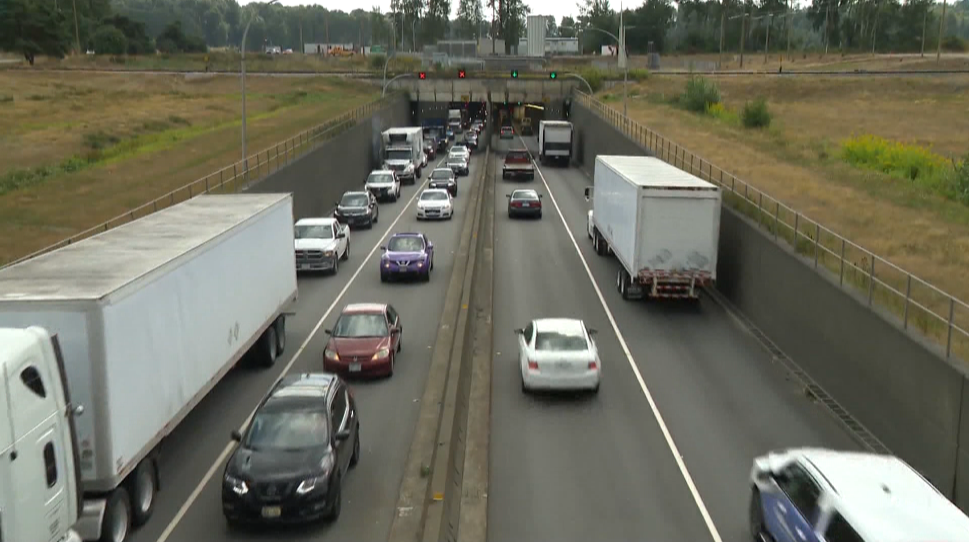
Here is the dirty secret that neither Lorne Doerkson, Mike Farnworth, nor the municipal mayors in Delta and Richmond will say out loud: whether you spend $6 billion on a bridge or $9 billion on a tunnel, Monday morning commuters are still going to sit in gridlock.
Why? Because of basic traffic geometry.
The existing George Massey Tunnel is a four-lane counterflow bottleneck feeding an eight-lane corridor. Naturally, drivers assume that widening the river crossing to eight or ten lanes fixes the jam. It does not. It simply moves the choke point five kilometers north.
Roughly 80 percent of northbound traffic exiting the Massey Tunnel does not stay on Highway 99 all the way to Vancouver; it disperses into Richmond or funnels straight toward the Oak Street Bridge. Look at the Oak Street Bridge at 8:15 AM on a Tuesday. It is a four-lane, 1950s-era crossing dumping directly onto city streets with traffic lights at 70th Avenue.
Building an eight-lane tunnel or a 10-lane bridge south of Richmond while leaving the Oak Street Bridge untouched is like attaching a firehose to a drinking straw. You will clear the Deas Island backup in record time, only to turn Steveston Highway, Knight Street, and the Oak Street approach into a permanent parking lot.
Furthermore, look at what happened to rapid transit in both designs. The original 2016 bridge plan at least preserved structural capacity for future dedicated transit. The NDP’s $8.5 billion tunnel plan stripped out rail entirely, offering a dedicated bus lane and an enclosed pedestrian/cyclist pathway. Spending nearly nine billion dollars on a 100-year piece of regional infrastructure without building in a grade-separated rail spine between Richmond-Brighouse and South Surrey is urban planning malpractice.
Dismantling the Common Myths
If you listen to talk radio or read the comment sections on local news sites, the debate gets bogged down in three recurring myths. Let’s clear them out.
"Will Ottawa pull the $3 billion federal grant if B.C. switches to a bridge?"
No. People love to panic about losing federal matching funds whenever a provincial government pivots. Yet Federal Transport Minister Steven MacKinnon explicitly stated after the B.C. election that Ottawa supports crossing the Fraser River whichever way the premier decides. Ottawa cares about political credit and ribbon cuttings in swing ridings, not whether the concrete sits above the water or beneath it. The real risk isn't Ottawa cancelling the cheque; it’s inflation eating the purchasing power of that fixed $3 billion cap while Victoria spends three years redoing environmental assessments.
"Didn't the NDP already start building the tunnel?"
Barely. When politicians say "construction is underway," voters picture concrete tubes being lowered into the river. In reality, the work done since early 2026 consists mostly of corridor widening, preload soil placement, utility relocations, and early site preparation. The B.C. Environmental Assessment Office hadn't even finished its review before pausing the process on November 17 at the incoming government's request. The Request for Qualifications for the actual immersed-tube tunnel contract wasn't even scheduled to close until July 2027. We are in the prep phase, not the point of no return.
"Is a bridge actually cheaper to maintain over 100 years?"
This is where Doerkson’s camp gets lazy. A tunnel is wildly expensive to build upfront because of dredging, ventilation systems, fire-suppression infrastructure, and massive dewatering pumps. However, once an immersed concrete tube is buried under the riverbed, it is largely shielded from freeze-thaw cycles, road salt corrosion, and wind loading. A massive cable-stayed bridge in a coastal marine environment requires relentless, multi-million-dollar cable inspections, dehumidification systems, deck resurfacing, and structural steel painting over a century. When you compare a bridge and a tunnel, you cannot just look at Capital Expenditure (CapEx); you have to model 75-year Lifecycle Operating Expenditure (OpEx). Neither party has released an honest apples-to-apples lifecycle model to the public.
The Uncomfortable Downside of Pivoting Now
As tempting as it is to applaud Doerkson for halting a runaway $8.5 billion tunnel train, pivoting back to a bridge carries a brutal price that Conservatives are glossing over: time.
Every single year a major infrastructure project sits in regulatory limbo, construction escalation eats another 5 to 8 percent of the budget. To switch from an immersed-tube tunnel back to a high-level cable-stayed bridge, the Ministry of Transportation and Transit cannot just wave a magic wand. They must:
- Re-open consultations with First Nations along the Fraser River, many of whom raised sharp objections to the navigational clearance and river impacts of the 2016 bridge design before endorsing the tunnel.
- Submit a brand-new project description to the Environmental Assessment Office, resetting a multi-year permitting clock.
- Cancel existing procurement packages—triggering break fees for shortlisted engineering consortiums—and draft entirely new technical specifications from scratch.
By the time a new bridge clears environmental permitting, finishes geotechnical bore-hole testing for tower piers, and goes out to tender, it will be 2029 or 2030. By then, the "cheaper" bridge will easily cost $6.5 billion to $7.5 billion anyway, and drivers will still be white-knuckling it through a crumbling, seismically deficient 1959 tunnel well into the mid-2030s.
What a Serious Government Would Actually Do
If Premier Doerkson wants to prove he is a pragmatic builder rather than just another partisan wrecking ball undoing his predecessor's work, he needs to abandon both the NDP’s bloated tunnel and his own campaign-trail nostalgia for a 2016 mega-bridge.
First, audit the $8.5 billion tunnel estimate line by line within 60 days—not behind closed doors in Victoria, but by releasing the unredacted business case and risk register to independent civil engineers. Force the Transportation Investment Corporation to explain exactly how a $4.15 billion project doubled in five years without pouring main-structure concrete.
Second, decouple the Highway 99 corridor upgrades from the river crossing itself. Interchange improvements at Steveston Highway, Westminster Highway, and Ladner Trunk Road are needed regardless of whether cars go over or under the water. Keep those crews working so the province doesn't hemorrhage penalty fees and lose momentum.
Third, stop designing crossings for 1990s commuting patterns. Any replacement crossing—bridge or tunnel—must be engineered from day one to carry light rail or SkyTrain tracks, paired with an immediate, funded plan to overhaul the Oak Street Bridge bottleneck.
Until someone in Victoria has the spine to admit that you cannot solve a regional transit and bottleneck failure by simply arguing over steel cables versus concrete boxes, British Columbians are going to keep paying billions of dollars for the privilege of sitting in traffic.