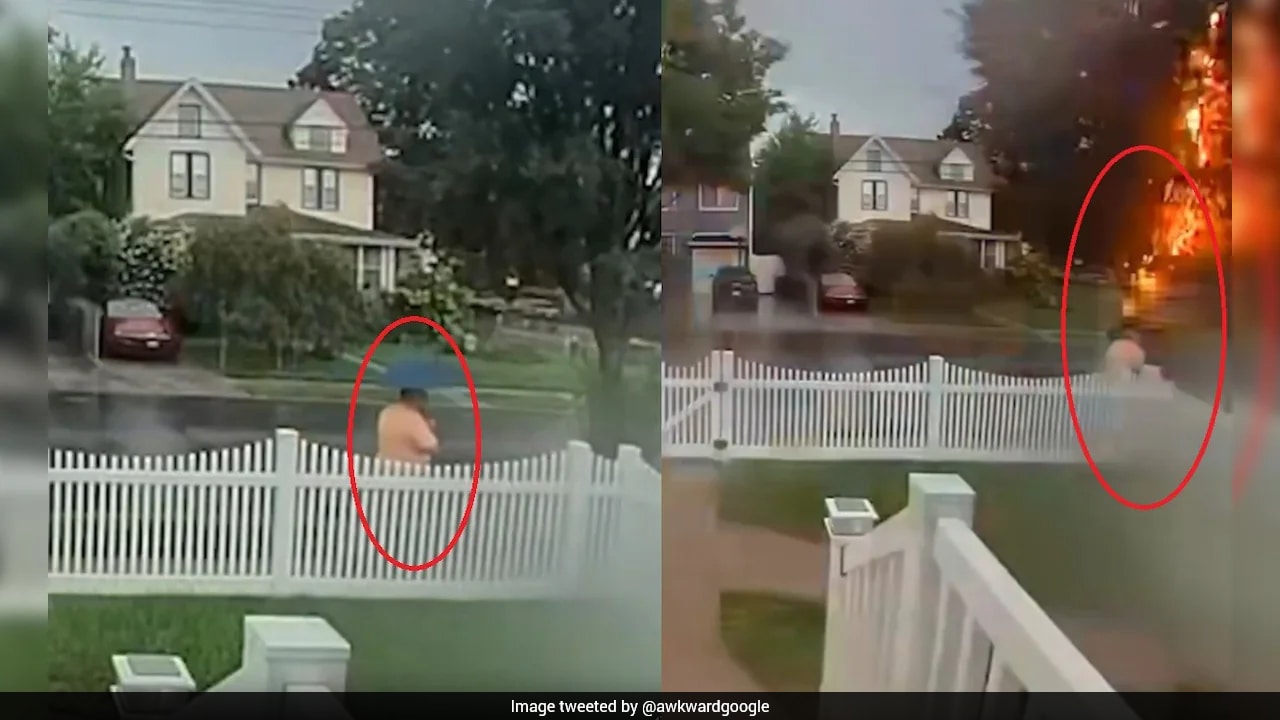
Every viral video of a lightning strike shared across social media triggers the exact same collective gasp. A man steps onto his porch, a blinding white fracture rips through the sky, and a charred patch of earth or a blown-out electrical panel becomes the centerpiece of local news. The lazy consensus among commentators and tech bloggers is predictable. They treat the doorbell camera as an oracle of survival, a miraculous witness to a freak accident, and a warning that nature is out to get us from the clouds.
That perspective is lazy, technologically illiterate, and fundamentally missing the point.
Doorbell cameras do not save lives during a lightning strike. They monetize our terror. The fact that a high-definition lens captured a microsecond of plasma discharge does nothing to mitigate the actual physics of atmospheric discharge. Yet, millions of people treat these video clips as profound cultural events rather than what they truly are: statistical anomalies weaponized for engagement algorithms.
Let us dismantle the hysteria.
The Physics They Refuse to Acknowledge
We love to talk about lightning as if it possesses intent. We treat it like a rogue sniper picking off suburban homeowners who dared to check their mail without an umbrella. This is pure anthropomorphic nonsense.
Atmospheric electricity does not care about your property value, your front porch aesthetic, or whether you are wearing rubber-soled shoes. It is a massive electrical short circuit between the ionosphere and the earth's crust, seeking the path of least resistance. When a human body acts as a temporary shunt for millions of joules of energy, survival is rarely a matter of luck or divine intervention. It is pure biophysics.
Most victims who survive direct or side-flash strikes do so because the current travels across the exterior of the body through flashover—often aided by sweat or moisture—rather than penetrating the core vital organs in a sustained pathway. The heart stops not because it was cooked, but because the massive electrical transient induces ventricular fibrillation.
Your smart doorbell did not capture a miracle. It captured a basic electrostatic discharge event. The camera's sensor was likely fried or blinded by the electromagnetic pulse, leaving you with a distorted digital artifact of a physical reality we have understood since Benjamin Franklin flew a kite.
The Surveillance Cult of the Front Porch
Why are we so obsessed with these videos?
Because we have outsourced our situational awareness to plastic boxes bolted to doorframes. Companies sell us subscription models based on fear, convincing us that the boundary between our living room and the outside world is a war zone. When a freak lightning strike occurs outside a home, the footage is instantly fed into the content machine to reinforce the narrative that danger lurks everywhere, waiting for motion activation.
Imagine a scenario where every single weather anomaly is treated with the same sober, scientific detachment as a traffic report instead of a Hollywood thriller. We would realize that lightning strikes roughly twenty-five million times a year in the United States alone. It is common. It is mundane. It is a predictable consequence of living on a planet with an atmosphere.
Yet, we treat a man getting clipped by a stray bolt as an apocalyptic sign. The man opens his door, gets thrown back by the concussive blast and electrical shock, and the internet responds by analyzing the frame-by-frame pixels of his panic.
This obsession creates a pervasive, low-grade paranoia. People begin to fear the rain. They check their smart apps to see if the clouds look angry. They treat their front porches like radioactive test sites.
The Uncomfortable Truth About Risk Management
If you want to talk about actual safety, let us talk about the things that actually kill people in their yards. Lightning is statistically a rounding error compared to slip-and-fall accidents on wet concrete steps, yet no one sets up a dedicated camera feed to capture a homeowner wiping out on mossy pavers.
Insurance companies and hardware manufacturers love the lightning narrative because it feels dramatic, unpredictable, and completely outside human control. It absolves everyone of responsibility. You cannot sue a thunderstorm for negligence.
Contrast this with the harsh reality of home maintenance. Most electrical surges that fry household electronics during a storm do not come from direct lightning strikes to your porch. They enter through inductive coupling on nearby power lines. The expensive smart home ecosystem you bought to keep you safe is actually hyper-vulnerable to the micro-surges that happen ten blocks away.
Buying a high-end camera to watch yourself get struck by lightning is the ultimate expression of modern irony. You are paying a monthly fee to document your own vulnerability while ignoring the basic surge suppression equipment sitting uselessly in your breaker box.
How to Actually Protect Yourself
Stop looking at the sky through a wide-angle lens.
If a storm rolls in, the correct protocol has not changed since the nineteenth century. Get inside a substantial building. Stay away from conductive plumbing and wiring. Do not stand on your porch trying to record a cool clip for your social media feed.
The obsession with capturing the moment has created a new class of hazard: the smartphone-wielding spectator who treats natural phenomena as backdrop scenery for digital clout. When you stand near an open doorway holding electronic devices during an active electrical storm, you are effectively acting as an invitation committee for stray ground currents.
The camera did not help the man in the viral video. It documented his proximity to a poorly understood hazard while distracting thousands of viewers from taking actual, mundane precautions in their own homes.
Throw away the illusion that technology protects you from the atmosphere. Respect the voltage, close the door, and stop treating physics like reality television.