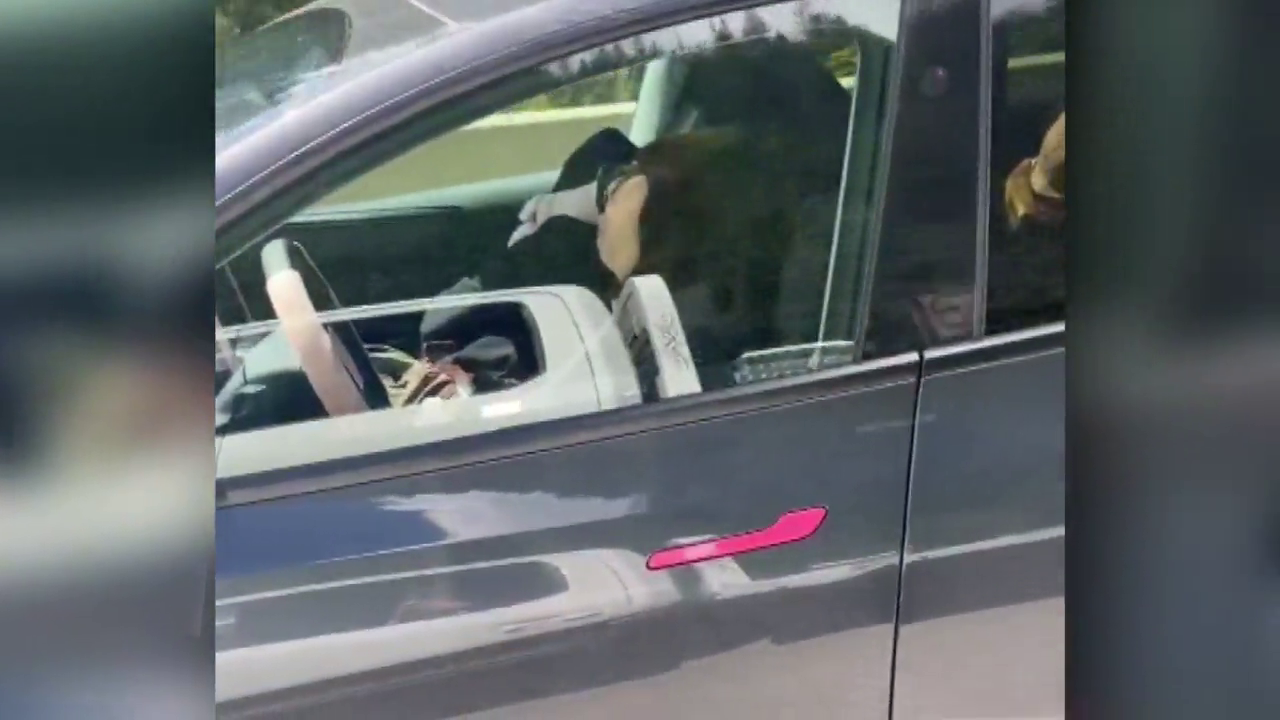
The internet is having another collective meltdown over a viral video. This time, it is a driver caught on camera catching some z's behind the wheel of a Tesla cruising down a British Columbia highway. The media reaction was entirely predictable: outrage, horror, and demands for immediate regulatory crackdowns.
They are missing the entire point.
The pearl-clutching narrative around "sleeping Tesla drivers" relies on a lazy consensus that a distracted human in a semi-autonomous vehicle is inherently more dangerous than an awake human driving a traditional car. It is a comforting lie we tell ourselves because we prefer the illusion of human control over the statistical reality of human incompetence.
Let us dismantle the panic and look at what is actually happening on our roads.
The Flawed Premise of the "Attentive" Driver
The baseline assumption of every viral outrage piece is that the average human driver is a hyper-focused machine, scanning the horizon for danger.
They are not. They are texting. They are changing the radio. They are yelling at their kids in the backseat, eating a messy burrito, or fighting the effects of severe sleep deprivation.
According to data from the National Highway Traffic Safety Administration (NHTSA), human error is a factor in roughly 94% of all motor vehicle crashes. We are terrible at driving. We have slow reaction times, poor spatial awareness, and emotions that cloud our judgment.
When a driver falls asleep in a standard vehicle, the outcome is almost universally catastrophic. The car drifts across lanes, maintains its speed, and collides with the nearest solid object at full force.
When a driver nods off in a vehicle equipped with advanced driver-assistance systems (ADAS) like Tesla’s Autopilot, a sophisticated network of cameras, neural networks, and ultrasonic sensors takes over the mechanical duties of lane-keeping and traffic-aware cruise control.
Is Autopilot perfect? Absolutely not. It is a Level 2 autonomous system, meaning it requires active driver supervision. But even in its current iteration, a vehicle running an advanced driver-assistance suite with a sleeping driver is mathematically safer than a runaway multi-ton piece of metal with no steering input whatsoever.
The Numbers the Media Ignores
To understand why the outrage is misplaced, you have to look at the raw mileage data.
Tesla’s safety reports consistently indicate that vehicles operating with Autopilot engaged register significantly fewer accidents per million miles driven compared to the US average. While critics rightly point out that Autopilot is disproportionately used on highways—which are inherently safer and more predictable than complex urban environments—the variance is still too large to ignore.
Vehicle Operating Condition       | Miles per Crash (Approx.)
----------------------------------|--------------------------
US Average (All Vehicles)         | ~650,000
Tesla with Autopilot Engaged      | ~5,000,000+
Even if you discount the manufacturer's data for potential bias, independent studies from organizations like the Insurance Institute for Highway Safety (IIHS) confirm that forward-collision warning and automatic emergency braking systems drastically reduce rear-end collisions.
The viral video from British Columbia is not a demonstration of a technology failure; it is a demonstration of a technology working exactly as designed to prevent a worst-case scenario. The system kept the vehicle centered in its lane and maintained a safe distance from other traffic despite human failure.
The Automation Paradox: Why We Fear the Wrong Thing
Psychologists refer to a phenomenon known as automation bias, where humans either over-trust or completely vilify automated systems. There is no middle ground in public perception.
We accept 40,000 traffic fatalities a year in the United States alone because those deaths are caused by humans. We understand human failure. We forgive it because "it could happen to anyone." But a single accident involving an autonomous or semi-autonomous vehicle makes international headlines because we expect machines to be flawless.
Imagine a scenario where we banned all driver-assist technologies tomorrow out of an abundance of caution. The immediate result would not be safer roads. The result would be a massive spike in rear-end collisions, lane-departure fatalities, and high-speed highway accidents caused by the very same tired, distracted humans the media is currently trying to protect.
The real danger on the B.C. highway was not the sleeping driver in the Tesla. The real danger was the person filming the video while driving their own car, diverting their attention from the road to capture content for social media.
The Responsibility Problem and the Tech Backlash
Let’s be clear about the downsides of this contrarian reality. The current state of automotive tech creates a moral hazard.
When you give a human a tool that handles 95% of the driving burden, their natural inclination is to tune out. Manufacturers try to combat this with driver-monitoring systems—torque sensors on the steering wheel, infrared cameras tracking eye movement, and increasingly aggressive audible warnings.
If a Tesla driver ignores these prompts for too long, the system locks them out for the remainder of the drive. It does not just let them sleep indefinitely; it forces a intervention.
But treating these isolated incidents of driver misuse as an indictment of the technology itself is backward. We do not ban cruise control because some people use it to take their feet off the pedals and sit cross-legged. We do not ban smartphones because people use them while crossing busy intersections.
Dismantling the Frequently Asked Questions
The public discourse around this topic is flooded with flawed premises. Let's look at the questions people actually ask, and strip away the emotional bias.
Aren't self-driving cars supposed to stop this from happening?
This question confuses driver assistance with full autonomy. No consumer vehicle available for purchase today is fully self-driving. They are driver-assist tools. The system is designed to act as a safety net, not a chauffeur. The fact that a driver can sleep without immediately crashing is a testament to the strength of the safety net, not a validation of their behavior.
Why don't regulators just ban these systems until they are 100% safe?
Because demanding 100% perfection from a machine while permitting 0% competence from a human is a losing strategy. If an automated system is 20% safer than a human driver, delaying its deployment while waiting for 99% perfection means sacrificing thousands of lives in the interim. Regulatory frameworks must be built on risk mitigation, not risk elimination.
The Actionable Pivot for Drivers
If you are waiting for the government or car companies to solve the safety equation for you, you are doing it wrong. The strategy for navigating the transition from human-driven to machine-driven roads requires an immediate shift in perspective.
- Treat ADAS as an Auditor, Not a Replacement: When you engage a system like Autopilot or Super Cruise, your job changes from mechanical operator to systems supervisor. You are there to audit the machine's decisions, not to check out.
- Stop Fighting the Safeguards: Do not buy aftermarket weights to trick steering wheel sensors. Do not try to bypass camera monitoring. The safeguards are there to keep you alive when the system encounters an edge case it cannot resolve.
- Acknowledge Your Own Limitations: If you are tired enough to fall asleep at the wheel of a smart car, you are tired enough to kill someone in a dumb car. Pull over.
The media will continue to run terrifying headlines every time a camera catches a driver resting their eyes in a moving vehicle. They will continue to stoke fear because fear generates clicks, and clicks drive revenue.
But the next time you see a video of a sleeping driver in a Tesla, do not panic about the machine taking over. Be thankful that, for once, the car was smart enough to protect the driver from themselves.
The real threat is the millions of drivers who are wide awake, staring directly at their phones, and driving completely unassisted on the exact same road.