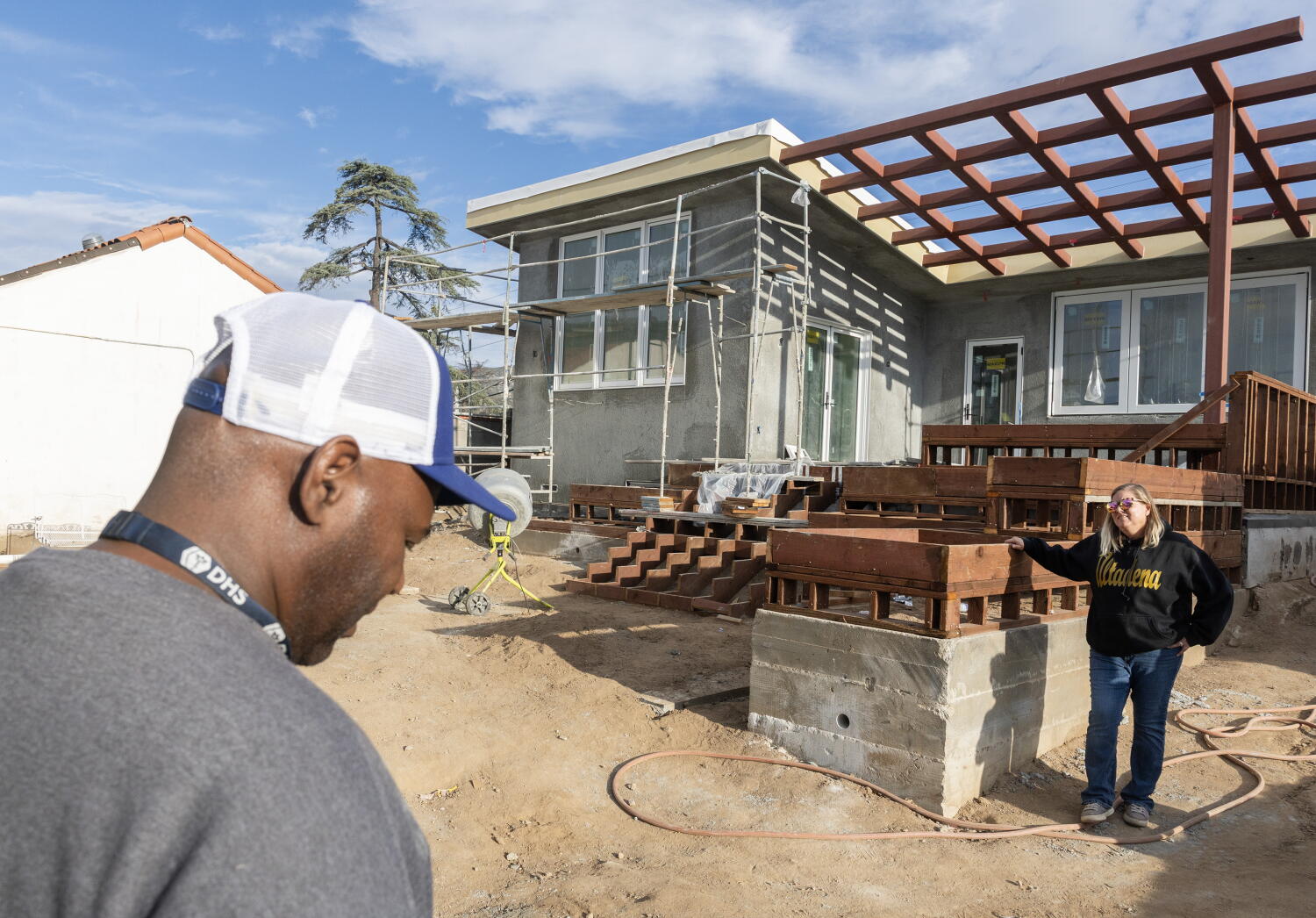
They love a tearjerker. Every time a megafire tears through the foothills of Southern California, legacy newspaper columnists descend on the ash to write the exact same story. You know the template. One family stays to rebuild their burned-out home out of grit and neighborhood pride. Another family takes the insurance check, packs the SUV, and moves away. The writer wraps the whole tragedy in a warm blanket of "lessons in resilience," celebrating the human spirit while completely ignoring the brutal math staring everyone in the face.
It is comforting fiction. It is also dangerously wrong.
When we treat post-fire recovery on a single Altadena block destroyed by the Eaton fire as a morality play about grit versus surrender, we miss the actual story. The person who takes the payout and leaves is not quitting on their community. In most cases, they are the only person on the block doing basic risk management. Meanwhile, the neighbor who vows to rebuild on the exact same footprint, under the exact same canopy of chaparral and Santa Ana wind tunnels, is often walking straight into a multi-year solvency trap disguised as civic virtue.
We need to stop calling stubbornness resilience. True resilience is adaptation, not repetition.
The Lie of the "We Will Rebuild" Narrative
After the January 2025 Eaton fire tore through Altadena and Pasadena, destroying thousands of structures and upending lives across the San Gabriel Valley foothills, the public script kicked in before the embers even cooled. Local coverage zeroed in on individual blocks—contrasting the resolute homeowner fighting to restore their piece of history with the exhausted neighbor cashing out and relocating.
The lazy consensus in journalism frames the stayer as the hero of the story. Leaving is framed as a loss, an unfortunate surrender to climate reality.
Look at the numbers instead of the sentiment.
Rebuilding a single-family home in Los Angeles County after a catastrophic wildfire is no longer a straightforward construction project. You are not just paying for lumber, drywall, and labor. You are stepping into a regulatory and financial meat grinder where costs routinely outpace standard replacement-cost insurance policies by hundreds of thousands of dollars.
Here is what the sentimental profiles leave out:
- Demand surge inflation: When thousands of homes burn simultaneously in a single metro area, local contractors, architects, and soil engineers vanish overnight. Material and labor costs spike by 30% to 50% within months. Your policy limit, calculated during a normal market, evaporates before the foundation is poured.
- Code upgrade gaps: Modern California building codes—specifically Chapter 7A Wildland-Urban Interface (WUI) standards—require ignition-resistant roofing, boxed eaves, tempered double-pane glass, and ember-resistant vents. Even with Ordinance or Law coverage, older Altadena homes built in the 1920s through 1950s carry massive hidden compliance costs that insurance adjusters fight tooth and nail to exclude.
- The carrying-cost bleed: Most policies cap Additional Living Expenses (ALE) at 24 or 36 months. In Los Angeles County, permitting, debris clearance, utility reconnection, and construction routinely drag past the three-year mark. Once ALE runs dry, you are paying full rent on an apartment while still paying the mortgage on an empty dirt lot.
I have watched families burn through their entire retirement savings trying to bridge the gap between what their insurer paid and what a custom rebuild actually costs in Southern California. They won the moral victory of staying on their block, and they lost their financial independence to do it.
What Fire Science Actually Says About the San Gabriel Foothills
To understand why rebuilding the same neighborhood in the same way is a losing bet, you have to look at the geography of Altadena. It sits directly against the steep, brush-choked walls of the San Gabriel Mountains. For decades, urban planners treated the Wildland-Urban Interface as a scenic amenity rather than an active combustion zone.
They were wrong.
Fire behavior researchers, including scientists at the Insurance Institute for Business & Home Safety (IBHS) and the USDA Forest Service, have demonstrated for years that wildland fires do not destroy suburban neighborhoods like a wall of lava rolling down a hill. They destroy neighborhoods through ember storms.
During a Santa Ana wind event—when dry, katabatic winds scream down the canyons at 60 to 80 miles per hour—millions of burning embers travel a mile or more ahead of the main fire front. Those embers land in gutters, under wooden decks, inside attic vents, and on dry mulch beds right against stucco walls. Once one house ignites, it becomes a massive radiant heat source that ignites the house ten feet next to it. The fire stops being a forest fire and becomes an urban conflagration.
Think about what this means for the lone homeowner who decides to rebuild on a devastated Altadena block.
You can spend $1.2 million building a concrete bunker with a Class A metal roof and zero-clearance landscaping. You can follow every single defensible space guideline down to the millimeter. It will not save your house if your neighbor ten feet away builds a standard wood-frame home with a cedar fence attached to the siding.
In dense foothill neighborhoods, fire risk is a collective vulnerability, not an individual choice. Rebuilding a single parcel without overhauling the density, materials, and defensible space of the entire block is like wearing a seatbelt in a car with no brakes. You feel safer, you look responsible, and the physics still win.
The Insurance Market Already Did the Math
If you want the most honest assessment of Altadena’s future, do not read a human-interest column. Read an actuarial table.
Private insurers have been fleeing California’s high-risk zip codes for years, pushing hundreds of thousands of homeowners onto the California FAIR Plan—the state’s insurer of last resort. The FAIR Plan was designed as a temporary safety net, not a permanent housing subsidy for high-hazard zones. It offers bare-bones fire coverage at eye-watering premiums, forcing homeowners to buy a separate "Difference in Conditions" policy just to get basic liability and water damage protection.
Let’s trace what happens to the homeowner who chooses to rebuild on that burned-out Altadena block:
- You finish construction after three years of stress, permitting delays, and out-of-pocket overruns.
- You apply for homeowners insurance on your brand-new, code-compliant house.
- Private carriers reject the address because their catastrophe models still score the canyon wind corridor and surrounding fuel load as extreme risk.
- You get trapped on the FAIR Plan, paying $8,000 to $15,000 a year for inferior coverage that still leaves you exposed if another wind-driven fire sweeps down the mountain.
- Your resale value takes a permanent hit because the next buyer cannot get a conventional mortgage without affordable insurance.
The neighbor who took the insurance payout, sold the lot, and moved to a lower-risk area bypassed every single one of those traps. They converted an illiquid, high-liability asset into cash while the market still had buyers willing to speculate on the land.
Answering the Questions Nobody Wants to Ask Out Loud
When disaster hits a beloved, historic community like Altadena—a place with deep generational roots, architectural character, and fierce local identity—people search for ways to make sense of the wreckage. Most of the questions they ask start from the wrong premise.
Is it worth rebuilding a house after a wildfire?
You are asking the wrong question. The real question is whether you have the liquidity to absorb a 40% cost overrun, survive three years of permitting limbo, and self-insure against future uninsurability. If you are sitting on substantial cash reserves, own the land free and clear, and view the rebuild as a consumption choice rather than an investment, go ahead. If you are stretching every dollar and banking on the rebuilt home to fund your retirement, rebuilding is a wealth-destruction machine.
Why do people move back to wildfire zones?
Attachment bias and sunk-cost fallacy. Humans tie their identity to physical places, especially neighborhoods with rich social fabric like Altadena. Leaving feels like admitting defeat, whereas staying feels like honoring what was lost. Furthermore, many homeowners misunderstand their insurance policies. They assume "replacement cost" means the insurer simply hands over a blank check to restore their exact life. By the time they realize the policy has hard sub-limits and depreciation holdbacks, they are already emotionally committed to staying.
What happens if you don't rebuild after a fire?
In most standard policies, if you choose not to rebuild on the original site, the insurer pays you Actual Cash Value (ACV) rather than full Replacement Cost Value (RCV). ACV deducts depreciation for the age and condition of the destroyed structure, which can shrink your payout significantly. However, many policies allow you to apply your replacement cost benefits toward buying an existing home in a different location. Cashing out and relocating does not automatically mean forfeiting your full claim—provided you hire a sharp public adjuster or insurance coverage attorney before signing a single release form.
Imagine a Scenario Where We Built for Reality Instead of Nostalgia
Imagine a scenario where post-fire recovery in Southern California wasn't driven by individual homeowners fighting separate battles against contractors and insurers.
Picture an entire burned block in Altadena forming a unified land-assembly collective before a single building permit is filed. Instead of rebuilding twenty separate 1940s-style lot layouts crammed side-by-side, the neighbors pool their insurance payouts and lot equity. They redesign the block with wider firebreaks, underground utilities, shared non-combustible perimeter walls, and clustered housing surrounded by irrigated, fire-resistant native buffers.
Because the entire block meets IBHS Wildfire Prepared Neighborhood standards, private insurers actually compete to underwrite the homes at normal rates. Construction costs drop by 20% because a single general contractor builds all the structures simultaneously using standardized, fire-hardened assemblies.
Does that happen in the real world? Almost never.
Why? Because American property law and post-disaster sentimentalism treat every quarter-acre lot as an isolated castle. We celebrate the lone pioneer hammering nails into their lot while the market around them quietly collapses.
The Unconventional Playbook for Fire Survivors
If you or someone you care about is staring at a charred foundation in the foothills right now, ignore the newspaper profiles. Ignore the politicians promising fast-tracked permits that never materialize on time. Follow a cold, disciplined strategy instead.
1. Audit your policy before you clear a single piece of ash
Do not hire a contractor first. Hire an independent public adjuster or a policyholder attorney who specializes in catastrophic wildfire claims. Insurers routinely undervalue debris removal, tree replacement, smoke damage to remaining structures, and code-upgrade endorsements. You cannot make a rational stay-or-go decision until you know the exact ceiling of your payout.
2. Price the "Buy Elsewhere" option immediately
Check your policy’s replacement cost portability clause. Most homeowners assume they have to rebuild on their dirt to get their full RCV payout. In California, Insurance Code Section 2051.5 explicitly protects your right to use replacement cost proceeds to purchase a home at another location—or rebuild elsewhere—without taking a depreciation haircut. Run the math on buying a turnkey home in a lower-risk zone versus spending three years managing a construction site.
3. Factor in the "Second Fire" probability
Fire ecologists are blunt about this: a burned hillside does not become immune to fire. Once chaparral burns, invasive grasses move in within two to three years. Grass dries out faster and ignites easier than old-growth brush. A neighborhood can burn again long before the trees grow back. Your financial plan has to survive not just this rebuild, but the next Santa Ana wind event five years down the road.
4. Admit the downside of walking away
Let’s be brutally honest about the trade-off. If you take the money and leave Altadena, you lose something money cannot buy. You lose the neighbors who checked on your elderly parents, the specific light hitting the San Gabriel peaks at dusk, and the irreplaceable culture of an integrated, historic community. Gentrification often follows disaster; when working- and middle-class families cash out, institutional investors and ultra-wealthy buyers scoop up the lots, permanently altering the soul of the town.
Leaving hurts. Pretending that staying is automatically virtuous hurts worse when it bankrupts you.
Stop Confusing Grit With Strategy
The journalist looking at a destroyed block wants a clean narrative arc: tragedy, endurance, renewal. Real life in the Wildland-Urban Interface is messier.
The family that leaves Altadena after the Eaton fire isn't lacking resilience. They recognized that the risk equation changed permanently, refused to throw good money after bad, and protected their family’s future. The family that stays isn't foolish—provided they go in with eyes wide open, surplus capital in the bank, and zero illusions about what it takes to survive in a fire corridor.
Stop measuring a community’s strength by how many people rebuild on the exact same spot. Measure it by how many people survive the aftermath with their savings, their sanity, and their future intact.