The media cycle has a predictable, exhausting rhythm. Every 29.5 days, newsrooms across the globe dust off the same "supermoon" templates, pair them with grainy long-lens photos from a local bridge, and tell you to look up in awe. This week, it’s the Worm Moon over Northern Ireland. The headlines are soft, poetic, and entirely devoid of substance. They treat a routine orbital alignment like a mystical visitation.
It is time to stop pretending these events are rare, and it is certainly time to stop calling them "Worm Moons" as if that carries some deep, universal weight. Don't forget to check out our earlier article on this related article.
If you stood in a field in County Antrim last night looking for a visual revolution, you were disappointed. What you saw was the moon. It was roughly 14% larger and 30% brighter than a micromoon—differences the human eye struggle to perceive without a side-by-side reference. The "Worm Moon" isn't a celestial phenomenon; it's a branding exercise.
The Semantic Trap of Folk Astronomy
The biggest lie in modern hobbyist astronomy is the insistence on using Farmer’s Almanac nicknames as if they are scientific classifications. The term "Worm Moon" supposedly refers to earthworms emerging from the thawing ground in March. It’s quaint. It’s pastoral. It’s also geographically illiterate. If you want more about the history of this, Refinery29 provides an excellent summary.
In the Southern Hemisphere, it’s autumn. There are no worms emerging in March in the suburbs of Melbourne or the plains of Argentina. Yet, global media outlets force this Northern Hemisphere-centric narrative onto a global audience. When we prioritize these nicknames over actual orbital mechanics, we trade literacy for "likes."
The moon doesn’t care about worms. It cares about syzygy.
$Syzygy$ is the straight-line configuration of three celestial bodies in a gravitational system. When the Sun, Earth, and Moon align, we get a full moon. When that alignment happens near perigee—the point in the moon's elliptical orbit where it is closest to Earth—we get what the media calls a "supermoon."
But even "supermoon" is a term coined by an astrologer, Richard Nolle, in 1979, not an astronomer. By adopting this language, "reputable" news sources are effectively laundering astrological terminology into the public consciousness. We aren't observing the heavens; we are participating in a 45-year-old marketing campaign.
The Photography Industrial Complex
Look at the photos circulating from Northern Ireland. You see the moon looming massive behind Scrabo Tower or the Harland & Wolff cranes. These images are impressive, but they are fundamentally dishonest representations of the human experience.
They rely on lens compression.
By using extreme telephoto lenses—300mm, 600mm, or even 800mm—and standing miles away from the foreground object, photographers make the moon appear unnaturally large relative to the landmark. It’s a classic optical trick. When you actually walk outside to see it for yourself, you find a small, white disc that you can cover with your thumbnail held at arm's length.
This creates a "spectacle gap." The public is promised a cinematic experience and delivered a mundane reality. I have seen amateur stargazers pack up their gear in frustration because the "Worm Moon" didn't look like the photos on their feed. We are setting the public up for a letdown by prioritizing the "epic shot" over the actual physics of the sky.
The Atmospheric Delusion
People often claim the moon looks "huge" when it is near the horizon. This isn't because of the "Worm Moon" status. It’s the Moon Illusion.
Your brain is a terrible measuring tool. When the moon is high in the sky, there are no reference points, so your brain perceives it as smaller. When it is near the horizon, tucked behind the Mourne Mountains or the Belfast skyline, your brain compares it to trees and buildings.
It is a cognitive bug, not a celestial feature.
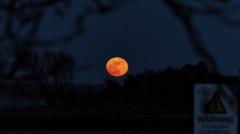
Furthermore, the orange or red hue people rave about in Northern Irish lunar photos isn't "magic." it’s pollution and moisture. Rayleigh scattering—the same reason the sky is blue—filters out shorter wavelengths of light (blue and violet) as the moonlight passes through a thicker layer of Earth's atmosphere at a low angle. The red and orange wavelengths pass through. You aren't seeing the moon's true face; you're seeing the result of air density and particulate matter.
Why "Wait for the Moon" is Bad Advice
The "lazy consensus" tells you to wait for these specific named moons to engage with the night sky. This is the exact opposite of how you should approach astronomy.
The full moon is actually the worst time to look at the moon through a telescope or binoculars.
When the moon is full, the sunlight hits it dead-on from our perspective. This washes out all the shadows. The craters, the mountains, and the rilles—the very things that make the lunar surface interesting—look flat and featureless. It’s like taking a photo of someone with a direct, harsh flash; all the character disappears.
If you want to actually see the moon, go out during the first quarter or last quarter. Look at the terminator line—the dividing line between the light and dark sides. That is where the shadows are long and the topography pops. You’ll see the jagged edges of the Apennine Mountains and the deep shadows of the Tycho crater.
But "Quarter Moon Over Belfast" doesn't get the same clicks as "Worm Moon," so the media ignores it. They prioritize a mediocre visual event because it has a catchy name, while ignoring the superior viewing opportunities that happen every other week.
The Gravity of the Situation
We also need to address the pseudoscience regarding the moon’s influence on human behavior. Every time a "supermoon" or a "Worm Moon" hits the news, "lunar effect" myths resurface. People claim emergency rooms get busier or crime rates spike.
I’ve looked at the data from hospital administrators and police departments over decades. The "Transylvania Effect" is a myth. A meta-analysis of over 30 studies published in the Psychological Bulletin found no correlation between the phases of the moon and "abnormal" behavior.
The only real physical impact a perigee full moon has on Earth is on the tides. During a perigee-syzygy event, the tidal range increases by a few inches—what we call "king tides." It’s an interesting gravitational quirk, but it’s a far cry from the life-altering event the headlines suggest.
Stop Looking for Magic and Start Looking for Math
The moon is an incredible, barren rock hurtling through space at 2,288 miles per hour. It is the reason Earth’s axis is stable enough to support life. It is a historical record of four billion years of cosmic bombardment.
Calling it a "Worm Moon" diminishes it. It turns a titan of the solar system into a bit of local folklore for the sake of a 24-hour news cycle.
If you want to be a real "insider" in the world of amateur astronomy, stop chasing the nicknames. Ignore the "Super Blue Blood Wolf Moon" nonsense.
- Learn the ecliptic: The path the moon and planets take across the sky.
- Understand libration: The slight "wobble" that allows us to see about 59% of the moon’s surface over time, even though it's tidally locked.
- Watch for occultations: When the moon passes in front of a star or planet. That is a far more impressive display of orbital precision than a slightly brighter-than-average Tuesday.
Stop letting the media tell you when to be impressed. The sky is doing something fascinating every single night, not just when the moon is close enough to have a brand name.
Put down the iPhone, ignore the "In Pictures" galleries, and go buy a decent pair of 10x50 binoculars. Look at the terminator line on a random Tuesday. You’ll see more detail and feel more awe than any "Worm Moon" hype could ever provide.
The universe isn't a gallery of "captured" moments. It’s a continuous, violent, and mathematical reality. Act accordingly.
Next time the headlines scream about a "Worm Moon," stay inside. Wait five days. Then go out and actually see the craters.