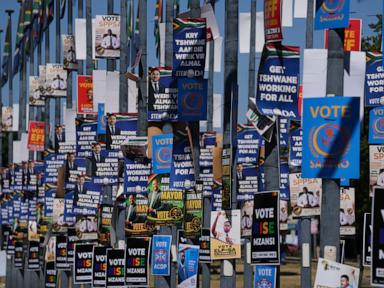
Every election cycle, the political press corps dust off the exact same headline. South Africans head to the polls in a crucial test for the ruling African National Congress. It is comfortable. It is predictable. And it completely misses the structural reality of how power actually operates on the ground in South Africa.
Mainstream political coverage treats municipal elections as a mid-term report card on national leadership—a simplified scoreboard tallying whether the ANC’s national vote share dips by two percentage points or five. That framing is a lazy consensus. It reduces intricate, hyper-local survival battles over water reticulation, electricity grids, and municipal procurement budgets into a simplistic national horse race. For another perspective, check out: this related article.
When analysts frame local government ballots purely as a "tough test for the ruling ANC," they obscure the real story: the collapse of single-party dominance at the municipal level has already happened, and the true crisis isn't who wins the plurality of votes—it's whether any coalition can keep the lights on and the taps running once the ballots are counted.
The Myth of the National Scoreboard
To understand why the "referendum on the ANC" narrative fails, look at the mechanics of South Africa’s local government electoral system. Unlike national and provincial elections, which use pure proportional representation, municipal elections operate on a mixed-member proportional system. Half of the seats in local and metropolitan councils are won directly by ward councillors through first-past-the-post races; the other half are allocated via party lists to ensure overall proportionality. Similar coverage regarding this has been published by The Washington Post.
This structural distinction matters enormously, yet national commentators routinely flatten it into a single national percentage.
Political analysts at institutions like the Institute for Security Studies (ISS) and the Electoral Institute for Sustainable Democracy in Africa (EISA) have repeatedly pointed out that aggregating local election results into a single national tally creates an optical illusion. A party can lose dramatic ground in major metropolitan hubs—Johannesburg, Tshwane, Ekurhuleni, Nelson Mandela Bay—while retaining overwhelming majorities across vast rural municipalities in the Eastern Cape, Limpopo, or Mpumalanga.
Conversely, a strong national percentage masks fatal vulnerabilities in the economic engines of the country. Gauteng alone accounts for roughly a third of South Africa's GDP. When the governing party drops below 50% in Gauteng’s metros, a comfortable majority in a rural district municipality does nothing to stabilize national investor confidence or urban infrastructure.
Furthermore, national aggregation ignores the most decisive variable in South African local politics: differential voter turnout.
Turnout Is the Real Opposition
In South African municipal elections, the largest political force is neither the ANC, the Democratic Alliance (DA), the Economic Freedom Fighters (EFF), nor any regional newcomer. It is stay-away voters.
Data from the Electoral Commission of South Africa (IEC) consistently demonstrates that local government elections suffer from substantially lower turnout than national elections. In the 2021 local government elections, voter turnout dropped to roughly 45.8% of registered voters—the lowest in South Africa's post-1994 democratic history. When you factor in the millions of eligible citizens who are not even registered to vote, fewer than a third of voting-age South Africans actually cast a ballot in municipal races.
Look at what happens when turnout plummets:
- Base mobilization overrides persuasion. Parties rarely win municipal wards by convincing opposition voters to switch sides. They win by preventing their own disillusioned supporters from staying home on election day.
- Proportional shifts distort reality. If the ANC loses vote share primarily because its traditional urban working-class voters stay home in protest over potholes and load-shedding—rather than defecting to opposition parties—the opposition's percentage share rises automatically without gaining a single net new voter.
- Hyper-local grievances dominate. A dispute over a ward councillor candidate list, a localized water outage, or an informal settlement upgrade triggers targeted boycotts or independent candidacies that have zero correlation with national ideological debates.
Framing this dynamic as a simple ideological verdict on the ANC misdiagnoses the patient. Voters aren't necessarily endorsing opposition manifestos; millions are withdrawing consent from the entire formal party apparatus.
Why Coalition Instability Is the Actual Story
If the standard media narrative is obsessed with whether the ANC falls below 50%, political practitioners who actually work inside municipal administrations know that crossing below 50% isn't the end of the crisis—it is the beginning of a much more complex administrative trap.
South Africa has no national legislative framework regulating municipal coalitions. When no single party secures an outright majority in a hung council, governance defaults to backroom horse-trading among parties with incompatible ideological foundations and competing patronage networks.
Consider the track record across South Africa's hung metropolitan municipalities since 2016, documented extensively by the South African Local Government Association (SALGA) and independent governance monitors like Good Governance Africa:
- Revolving-door leadership: Major metros like Johannesburg, Tshwane, and Nelson Mandela Bay have cycled through mayors at a dizzying pace. Every motion of no confidence freezes capital expenditure, stalls tender adjudications, and paralyzes senior administrative appointments.
- Kingmaker extortion: Because large parties refuse to form grand coalitions with one another due to national political calculations, small single-issue or regional parties holding 1% to 3% of council seats routinely extract disproportionate power—demanding mayoral chains, speaker positions, or lucrative executive committee portfolios in exchange for fragile confidence-and-supply agreements.
- Administrative politicization: In theory, the Municipal Finance Management Act (MFMA) separates political oversight (the mayor and council) from administrative execution (the municipal manager and chief financial officer). In practice, unstable coalitions turn senior administrative posts into political battlegrounds, driving out career engineers, accountants, and urban planners.
Imagine a scenario where an opposition coalition successfully unseats the ANC in a major metro by a razor-thin two-seat margin, relying on three micro-parties to pass its budget. Six months later, one micro-party demands control over a key infrastructure portfolio; when refused, it defects to vote with the opposition on a motion of no confidence. For four months, no budget adjustment can pass, maintenance contracts lapse, and water leaks go unrepaired. To the resident opening a dry tap, the party label on the mayor's door becomes entirely irrelevant.
Yet mainstream election previews treat the prospect of hung councils merely as an exciting political upset rather than what it actually is: an acute governance stress test that South Africa's institutional architecture is poorly equipped to absorb.
Dismantling the Common Misconceptions About Local Elections
When voters, investors, and international observers read superficial election coverage, they walk away asking the wrong questions. Let's look directly at the flawed premises embedded in standard election commentary—and the reality underneath them.
"Will losing municipal power force the ANC to reform?"
This assumption rests on the belief that electoral punishment automatically produces policy correction. History in South Africa suggests a far messier reality.
Political scientists studying liberation movements—including scholars like Roger Southall and Susan Booysen—have long documented how parties deeply embedded in state structures respond to electoral contraction. When patronage resources shrink because a party loses control of municipal procurement and appointments in major cities, internal factional competition intensifies rather than subsides.
Instead of uniting around technocratic service delivery reforms, rival factions fight harder over the remaining state resources in provinces and municipalities the party still controls. Electoral losses certainly create pressure for renewal, as ANC leaders themselves frequently acknowledge in internal organizational reports, but losses alone do not automatically dismantle entrenched local patronage networks.
"Do opposition-run municipalities automatically fix service delivery?"
Opposition parties campaign heavily on clean audits and superior management, pointing to municipalities like the City of Cape Town or Midvaal as proof of concept. Data from the Auditor-General of South Africa (AGSA) confirms that DA-governed municipalities in the Western Cape consistently achieve a higher proportion of clean financial audits than municipalities in other provinces.
However, extrapolating that record directly onto unstable multi-party coalitions in Gauteng or KwaZulu-Natal ignores two critical constraints:
- Clean audits measure compliance, not transformation. As former Auditor-General Kimi Makwetu and current Auditor-General Tsakani Maluleke have repeatedly emphasized, a clean audit means a municipality followed financial reporting rules and procurement regulations—it does not automatically mean poor communities received adequate housing, sanitation, or reliable transit.
- Legacy infrastructure debt cannot be fixed in one term. Decades of deferred maintenance on bulk water pipelines, electrical substations, and wastewater treatment works require tens of billions of rand in capital investment. No incoming administration—regardless of party—can reverse thirty years of infrastructure decay within a five-year municipal term while grappling with a shrinking ratepayer base and rising indigent household numbers.
"Are independent candidates and new micro-parties the solution?"
Disillusionment with established parties has sparked a surge in independent ward candidates and hyper-local civic movements. On paper, electing an independent neighbour accountable directly to street-level voters sounds like pure democratic renewal.
In practice, municipal governance exposes the harsh limits of independence. Under South Africa's current system, independent candidates can only contest ward seats—they cannot run on proportional representation lists unless they register a formal political party. Once elected to a 100-seat or 200-seat council, a lone independent councillor has no caucus, no research staff, no representation on key portfolio committees unless granted by larger blocs, and virtually zero leverage over the municipal budget process. Unless independents organize into disciplined civic blocs, they risk becoming isolated voices shouting into a partisan chamber.
What Actually Determines Whether a Municipality Works
If you strip away the national political theatre, the success or failure of a South African municipality comes down to three unglamorous, structural mechanics that rarely make campaign posters.
1. The Revenue Collection Spiral
Municipalities in South Africa are constitutionally mandated to fund the bulk of their operations through their own revenue—specifically property rates and surcharges on electricity and water sales. National Treasury transfers (the Equitable Share) only subsidize free basic services for indigent households.
When municipal infrastructure degrades, residents and businesses either default on bills in protest or defect from the grid entirely by installing rooftop solar and drilling boreholes. As paying customers exit the municipal utility model, the municipality loses the cross-subsidy revenue it uses to fund basic services for low-income areas. Less revenue means less maintenance; less maintenance drives more paying customers off the grid. Breaking that death spiral requires radical utility reform—ring-fencing electricity and water revenues so they cannot be raided to plug general administrative deficits—something few councils have had the political discipline to enforce.
2. The Cadre Deployment vs. Technical Capacity Bottleneck
South Africa's municipal crisis is overwhelmingly an engineering and financial management crisis masquerading as an ideological debate. Reports from the South African Institution of Civil Engineering (SAICE) have consistently highlighted a severe shortage of qualified civil engineers, town planners, and artisans inside local government.
When political parties prioritize political loyalty over technical competence in appointing municipal managers, CFOs, and heads of infrastructure, the consequences are immediate: conditional grants from National Treasury go unspent and are returned to the fiscus, maintenance budgets are diverted to bloated administrative payrolls, and basic project management collapses. Until councils insulate technical appointments from party interference, changing the ruling party merely swaps one set of political appointees for another.
3. Intergovernmental Coordination Failure
Local government does not operate in a vacuum. Many of the failures voters blame on local councillors—commuter rail collapse, provincial hospital backlogs, national grid load-shedding, bulk water dam shortages—sit partially or wholly under provincial or national entities like Eskom, Transnet, or regional water boards.
When a municipality is governed by an opposition coalition while the provincial and national governments are controlled by the ANC, intergovernmental cooperation frequently breaks down into jurisdictional finger-pointing. Conversely, when the same party governs all three spheres, party discipline often prevents municipal leaders from publicly holding failing state-owned enterprises accountable.
The Honest Reality About This Contrarian View
Challenging the "national referendum" narrative carries an obvious caveat: national politics and local politics in South Africa can never be completely divorced.
Municipal elections do function as an undeniable barometer of national political momentum. A sharp drop in the ANC's municipal vote share weakens the authority of its national leadership, emboldens internal rivals ahead of national elective conferences, and shapes how parties negotiate national coalitions. Dismissing the national implications entirely would be just as blind as obsessing over them exclusively.
Moreover, voters use local ballots strategically. For millions of South Africans frustrated by national corruption scandals or macroeconomic stagnation, a municipal election is the only immediate lever available to register protest against national leadership. You cannot tell a voter experiencing daily power cuts that their municipal ballot shouldn't be used to punish the national governing party.
How to Actually Read the Next Election Results
If you want to understand what is genuinely happening in South African politics on election night, ignore the national percentage ticker running across the bottom of television screens. Look at four specific indicators instead:
- Metro Coalition Durability, Not Just Vote Share: Watch whether any party or stable pre-election coalition secures a workable majority in Johannesburg, Tshwane, Ekurhuleni, eThekwini, and Nelson Mandela Bay. A 42% plurality that leads to another fractured, unstable council is a recipe for administrative paralysis, not political victory.
- Turnout in Traditional Strongholds: Compare ward-by-ward turnout in township and rural voting districts against previous cycles. Abstention rates among core voters tell you far more about long-term political realignment than marginal swings in suburban wards.
- Capital Expenditure Execution Rates: Look past campaign manifestos and check National Treasury's Section 71 municipal finance reports for the councils in question. Any incoming administration that fails to spend at least 85% to 90% of its infrastructure capital budget is failing at basic governance, regardless of its political rhetoric.
- The Fate of the Kingmakers: Track whether voters punish or reward the small regional parties that spent the previous term collapsing municipal coalitions for short-term cabinet posts.
South Africa's local elections are not a simple pass-or-fail exam for the ANC. They are a brutal, high-stakes stress test of whether constitutional local democracy can survive the transition from single-party dominance to fractured coalition politics before essential urban infrastructure gives out entirely.