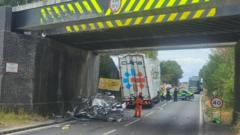
Every time another box truck peels its roof open like a sardine tin against the underside of a low-clearance railway overpass, the media circus spins up the exact same lazy narrative. The headlines scream about driver stupidity, local authorities throw their hands up in despair, and municipal committees start drafting proposals for expensive flashing lights, high-tech sensors, and aesthetic overhead warnings that cost taxpayers a fortune.
They are all asking the wrong question.
They look at a structure like the infamous Stuntney Road bridge or any of Britain's notorious low railway viaducts and see a design failure. They treat every impact as a systemic breakdown that demands intervention, engineering overhauls, and punitive measures against delivery drivers.
I have spent decades watching municipal authorities blow millions of pounds trying to outwit basic physics and human impatience with more paint, more signs, and more blinking LEDs. It never works. Because the premise itself is entirely backward.
The bridge isn't failing. The bridge is the ultimate stress test for an industry that refuses to read the manual.
The Lazy Consensus on Low Clearance
The mainstream narrative goes like this: professional drivers are getting lazier, GPS technology is leading people astray, and physical infrastructure needs to adapt to accommodate taller vehicles or warn distracted operators.
It sounds logical if you have never worked a day in logistics, fleet management, or civil engineering. But let us look at the actual mechanics of the problem.
Every single one of these bridges is marked with standardized regulatory signage miles before a driver reaches the hazard. The heights are documented in commercial navigation software, printed on height restriction maps, and taught during basic vocational training. When a 14-foot truck impacts a 10-foot-10-inch clearance, the root cause is never a lack of information. It is a structural failure of operational accountability.
Municipalities respond by installing hanging chains, laser tripwires, and massive LED boards that flash red. Drivers ignore them. Then councils suggest lowering the road surface or rebuilding the entire bridge at astronomical costs—a multi-million-pound engineering feat that causes months of commuter misery, all to protect a transport sector from its own refusal to plan routes properly.
We are treating a symptom while ignoring the economics of modern delivery schedules. When drivers are pushed to meet unrealistic delivery windows across congested urban networks, spatial awareness drops, route planning becomes secondary to brute-force navigation, and margins for error shrink to zero. Blaming the bridge is just an easy way to avoid fixing the dispatch office.
Why Clearance Protection is a Zero-Sum Game
Let us examine what happens when a local council actually invests in high-tech mitigation.
Imagine a scenario where a city spends half a million pounds installing an advanced optical detection system connected to traffic lights that turn red five hundred yards before the low bridge whenever an oversized vehicle approaches.
What happens? The truck stops. The driver backs up, blocking peak-hour traffic for an hour while trying to turn a forty-foot articulated lorry around on a narrow residential lane. The local residents still scream, traffic still gridlocks, and the fundamental problem—that an oversized vehicle entered an unauthorized corridor—remains entirely unsolved.
Physical barriers and electronic warnings do not change behavior; they merely relocate the bottleneck.
Civil engineering operates on strict safety factors. A railway bridge carrying commuter trains at seventy miles per hour cannot simply be raised on a whim because commercial transport companies keep building taller boxes. The railway line is the primary asset. The road underneath is secondary. If you raise the road, you alter the drainage gradients, disrupt utilities buried beneath the tarmac, and potentially compromise the abutments of the bridge itself.
The structural integrity of a century-old Victorian brick or steel viaduct is often remarkably resilient precisely because it is rigid. When a truck hits it, the kinetic energy is absorbed by the sacrificial aluminum roof of the truck, not the load-bearing masonry of the railway. In a grim, pragmatic sense, the bridge acts as a hard physical firewall protecting the rail network above from catastrophic multi-ton impacts that could derail a passenger train.
The Real Cost of Driver Complacency
Let us talk about accountability. In transport logistics, the cost of a bridge strike is externalized onto the public. The haulage company pays an insurance deductible, maybe fields a call from the Traffic Commissioner, and puts another driver behind the wheel by Monday morning. Meanwhile, thousands of commuters miss their trains, emergency services are delayed, and local taxpayers foot the bill for structural inspections.
We do not need smarter bridges. We need draconian regulatory consequences for the operators who dispatch vehicles without verified route clearances.
When a logistics firm treats bridge strikes as a cost of doing business rather than an operational catastrophe, infrastructure engineering becomes an unwilling participant in corporate negligence. No amount of yellow paint or overhead clearance bars will fix a corporate culture that prioritizes speed over statutory compliance.
If you want to stop the carnage, stop bailing out the companies whose drivers peel their roofs off. Suspend operating licenses on the second strike. Impose mandatory route audits for any fleet that records an impact. Watch how fast dispatchers start double-checking bridge clearances when their entire business model is on the line.
Dismantling the Myth of the Trap
People often ask: Why don't they just redesign these notorious bridges to eliminate the hazard entirely?
The question assumes that elimination is always economically and physically feasible. It ignores the reality of urban topography. Many of these routes were cut into dense Victorian streetscapes where property boundaries, subterranean utilities, and adjacent structures make grade separation virtually impossible without demolishing half a neighborhood.
Rebuilding a single railway overpass to gain two feet of clearance can easily run into tens of millions of pounds and shut down a vital rail artery for weeks. Spending public capital on such projects to accommodate a tiny fraction of negligent drivers is an egregious misallocation of resources.
The bridge is where it is. The height is what it is. The numbers are painted in black and yellow for anyone with a commercial driver license to read.
Stop treating infrastructure like a forgiving parent cleaning up after a reckless teenager. The bridge is an immovable fact of the landscape. It is time the transport industry learned how to measure twice and drive once.
The next time you see a headline about another truck caught under Britain's most bashed bridge, do not blame the masonry. Blame the system that taught the driver to look at a warning sign and think, I can probably squeeze under it.
They can't. And the roof will keep coming off until the industry finally learns the lesson the bridge has been teaching for decades.