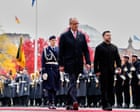
Mainstream foreign policy coverage suffers from an acute addiction to stagecraft. While cameras flash outside the Elysee Palace and diplomats release carefully laundered communiques about unwavering solidarity, the actual architecture of a European security settlement is being hammered out thousands of miles away in the Persian Gulf.
The lazy consensus in legacy media treats the G7 summit in Paris as the main event and the U.S.-mediated discussions in Abu Dhabi as a secondary sideshow. That framing gets geopolitics completely backward. One venue is built for press conferences and domestic political consumption. The other is built for transactional statecraft where leverage, energy flows, and hard territorial realities are traded without the performative baggage of Western electoral cycles. For a closer look into similar topics, we suggest: this related article.
If you want to understand how the war in Ukraine actually ends, stop listening to the speeches in Paris. Follow the backchannels in the Emirates.
The Illusion of Multilateral Consensus
Summitry is where urgent crises go to be diluted into lowest-common-denominator press releases. The G7 was designed in the 1970s as an informal fireside chat for finance ministers managing oil shocks and currency floats. Over five decades, it mutated into a bloated diplomatic circus where seven leaders spend three days negotiating commas in a thirty-page statement that nobody reads forty-eight hours later. For broader context on this issue, extensive analysis can be read on BBC News.
When reporters frame Paris as the nerve center of Western strategy on Ukraine, they confuse rhetorical alignment with operational capability. Issuing another pledge to support Kyiv "for as long as it takes" costs zero political capital in a press room. Delivering the industrial capacity, air defense interceptors, and fiscal liquidity required to sustain a high-intensity war of attrition is an entirely different matter.
The Gap Between Rhetoric and Munitions
Look at the hard math of European defense production versus the language coming out of Paris. You cannot fire a communique at a glide bomb. You cannot intercept a ballistic missile with a joint declaration.
I have watched European defense ministries burn billions in administrative overhead trying to standardize procurement rules while frontline brigades ration artillery shells. The structural bottleneck in Western support has never been a lack of diplomatic solidarity at G7 summits. It has been the brutal collision between just-in-time peacetime manufacturing and industrial-scale warfare.
Paris is where leaders go to project unity to their voters back home. It is a defensive posture designed to mask widening fractures over fiscal burden-sharing, frozen sovereign asset seizures, and the terrifying question of what happens when domestic budget deficits collide with open-ended military commitments.
Why Abu Dhabi Holds the Actual Leverage
Diplomatic breakthroughs rarely happen in the cities where the cameras are pointed. They happen in neutral jurisdictions that offer three non-negotiable assets: strict operational security, ideological agnosticism, and direct access to every party that actually matters.
The United Arab Emirates has systematically built itself into the premier clearinghouse for twenty-first-century conflict resolution. Unlike Geneva or Vienna, which carry the institutional weight and legal obligations of the European Union and the International Criminal Court, Abu Dhabi operates on pure, unadulterated pragmatism.
The Mechanics of Gulf Mediation
Why would Washington, Kyiv, and Moscow all send serious interlocutors to the Emirates while the G7 poses for family photos in France?
- Zero Jurisdictional Friction: High-ranking Russian officials cannot land in Paris without triggering immediate diplomatic crises or arrest warrants. In Abu Dhabi, intelligence chiefs, sovereign wealth directors, and special envoys can sit in the same hotel corridor without turning the logistics of arrival into an international incident.
- Proven Transactional Track Record: The UAE has already facilitated some of the largest prisoner exchanges of the conflict, moving thousands of combatants back across the front lines when formal diplomatic channels were completely dead. Trust in diplomacy is not built on shared values. It is built on repeatable execution.
- Energy and Capital Interdependence: Both Moscow and Washington rely on Gulf sovereign funds and energy ministries to manage global crude stability. When the host nation holds direct financial leverage over oil price caps, shadow fleet insurance, and reconstruction capital, both belligerents take the venue seriously.
When U.S. mediators convene talks in Abu Dhabi, they are not there to draft moralistic lectures. They are there to test the breaking points of each side's red lines.
Dismantling the "Nothing About Ukraine Without Ukraine" Dogma
Every time backchannel talks surface in the press, pundits immediately trot out the sacred mantra of Western diplomacy: Nothing about Ukraine without Ukraine.
It sounds noble. It makes for a great soundbite on cable news. It is also a fundamental misunderstanding of how proxy conflicts and great power wars conclude.
The Reality of Asymmetric Leverage
Kyiv fights the war, bleeds on the front lines, and holds the moral high ground. Washington and Brussels underwrite the Ukrainian state budget, supply the satellite intelligence, and manufacture the long-range strike systems that keep the front from collapsing. Pretending that the party paying the bills has no independent strategic interests is diplomatic theater.
In 1953, the Korean Armistice Agreement was signed without South Korean President Syngman Rhee's signature because Washington decided the war needed to end on a stabilized line. In 1973, Henry Kissinger negotiated the Paris Peace Accords directly with Le Duc Tho while South Vietnamese President Nguyen Van Thieu was largely presented with a fait accompli.
History shows that when a superpower funds a regional war, the superpower eventually negotiates the exit ramp. The U.S.-mediated discussions in Abu Dhabi reflect a cold realization in Washington: open-ended attrition favors the side with deeper manpower reserves and higher pain tolerance. Testing a freeze, a demilitarized zone, or a phased sanctions-relief mechanism in the Gulf is not a betrayal of Kyiv. It is an attempt to rescue a viable, sovereign Ukrainian state before demographic collapse makes recovery impossible.
The Trap of the "Unconditional Victory" Narrative
If you ask ten foreign policy analysts what victory looks like, nine will recite the maximalist position: full restoration of the 1991 borders, war crimes tribunals, and immediate NATO accession.
Let us strip away the wishful thinking and look at the operational reality on the ground.
Defining Real-World Terms
In classical military strategy, Carl von Clausewitz defined war as the continuation of politics by other means. When the political objective exceeds the military means available to achieve it, strategy collapses into delusion.
- Maximalist Deterrence: A posture that demands total capitulation from a nuclear-armed adversary before negotiations can even begin. In practice, this guarantees permanent war until one state implodes internally.
- Coercive Diplomacy: The synchronized use of battlefield pressure, targeted economic chokepoints, and credible off-ramps to compel an adversary to accept a suboptimal compromise.
The media coverage surrounding the G7 in Paris treats coercive diplomacy as a dirty word. Any mention of talks in Abu Dhabi is framed as "appeasement" or "fatigue." That binary framing—either total victory or total surrender—is intellectually bankrupt. Most modern wars end in messy, deeply unsatisfying armistices where neither side gets what it promised its public, yet both sides stop dying.
What the Critics Get Wrong About Backchannel Talks
To be clear, the Abu Dhabi track carries massive risks. Relying on opaque, bilateral, or trilateral backchannels outside formal alliance structures creates dangerous blind spots.
First, exclusion breeds paranoia. When European leaders in Paris realize that Washington is testing settlement frameworks in the Gulf without full consultation, transatlantic trust fractures. Europe is expected to pay for Ukraine's reconstruction and absorb millions of refugees; sidelining Paris, Berlin, and Warsaw from the core security architecture risks alienating the very allies needed to police a future ceasefire.
Second, Moscow excels at using parallel negotiations as a tactical weapon. Russian envoys have a long history of dangling the prospect of a ceasefire in neutral capitals simply to slow down Western weapons deliveries, sow division among NATO members, and buy time to reconstitute battered infantry divisions.
Third, any deal brokered without ironclad, automated enforcement mechanisms is just a pause button. A piece of paper signed in Abu Dhabi means nothing if there is no tripwire force, no satellite verification regime, and no automatic snap-back of crippling secondary sanctions the moment a single artillery shell crosses the line of contact.
Acknowledging these pitfalls does not invalidate the Abu Dhabi track. It proves why the talks need rigorous, unsentimental execution rather than moralizing from the sidelines.
How to Read the Geopolitical Signal Through the Noise
If you are an investor, a defense analyst, or simply a citizen trying to separate real geopolitical movement from political theater, stop tracking summit communiques. Watch the leading indicators that actually move markets and front lines.
- Watch Sovereign Asset Mechanics, Not Pledges: When G7 leaders talk about using frozen Russian central bank assets, look at whether they are touching the principal or merely skimming the windfall interest. Skimming interest signals they are keeping the principal intact as a bargaining chip for the negotiating table in places like Abu Dhabi.
- Track Energy Infrastructure Strikes: A sudden, unexplained pause in Ukrainian drone strikes against Russian oil refineries—or a reciprocal drop in Russian strikes on Ukrainian power grids—is the clearest proof that backchannel talks have produced a tacit de-escalation agreement.
- Monitor Envoy Seniority: Ignore statements from foreign ministers, whose job is public messaging. Pay attention when intelligence directors, national security advisors, and sovereign wealth chiefs quietly overlap in Gulf capitals.
- Follow Secondary Sanctions Enforcement: When Washington suddenly tightens or loosens treasury enforcement on Emirati, Turkish, or Chinese intermediary banks, it is calibrating the exact economic pressure needed to force concessions at the negotiating table.
The Hard Truth About How This Ends
Great power diplomacy is not a morality play. It is an ugly, asymmetric negotiation over territory, security buffers, and economic survival.
The G7 in Paris will deliver exactly what it was engineered to produce: inspiring speeches, firm handshakes, and a unified front for the evening news. It will make Western audiences feel resolute while changing zero facts on the ground in the Donbas.
Meanwhile, in quiet, air-conditioned suites in Abu Dhabi, American, Ukrainian, and Russian interlocutors are confronting the brutal arithmetic of a war that neither side can win outright and neither side can afford to lose. The future of European security will not be decided by the leaders standing in front of the microphones in France. It will be decided by the pragmatists willing to trade in the dark in the Emirates.