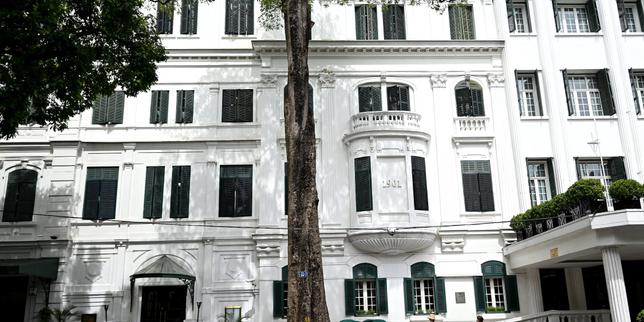
Every travel editor with a press pass and a penchant for colonial nostalgia is currently hyperventilating over the 125th anniversary of the Sofitel Legend Metropole Hanoi. They call it a timeless sanctuary. They swoon over the wrought-iron balconies, the whitewashed French facade, and the ghost of Charlie Chaplin sipping gin fizzes in the Bamboo Bar.
They are selling you a fairy tale. And worse, they are completely missing the actual reason this property survives while a hundred other "historic" grand dames across Southeast Asia have crumbled into irrelevance or tourist-trap mediocrity.
If you book a room at the Metropole expecting an authentic slice of 1901 Indochina, you are going to be disappointed—and out six hundred dollars a night. The lazy consensus in luxury travel journalism treats heritage hotels like museums where history is preserved under glass. In reality, a 125-year-old hotel that operates like a museum goes bankrupt. The Metropole is not a monument to the past; it is a ruthless, masterfully engineered commercial machine that weaponizes selective memory to command the highest Average Daily Rate (ADR) in Northern Vietnam.
The Lie of "Unbroken" Heritage
Let’s look at the timeline the PR brochures gloss over with poetic vagueness. Opened in 1901 by André Ducamp and Gustave-Émile Dumoutier, the Grand Hôtel Métropole was indeed the pinnacle of French colonial swagger. Graham Greene wrote The Quiet American here. Somerset Maugham stayed here.
Then came 1954.
After the French defeat at Dien Bien Phu, the newly formed Democratic Republic of Vietnam nationalized the property. It wasn't a five-star luxury playground for the next three decades. Renamed the Thong Nhat (Reunification) Hotel, it functioned as a state-run guesthouse for diplomats, journalists from the Eastern Bloc, and official delegations. During the American War, air-raid sirens wailed across Ngo Quyen Street, and guests—including Joan Baez and Jane Fonda—scrambled down into a cramped concrete bomb shelter beneath the courtyard while B-52s flew overhead.
By the late 1980s, when the Doi Moi economic reforms opened Vietnam to foreign investment, the building wasn't a pristine jewel box. It was a dilapidated, leaky, state-managed relic with failing plumbing and peeling paint.
When Pullman (later absorbed by Accor) stepped in to renovate and reopen the property in 1992, they didn't just dust off the furniture. They gutted, rebuilt, and fundamentally reimagined the asset. Calling the Metropole "125 years of unbroken luxury" is marketing fiction. What you are actually experiencing is a 34-year-old modern luxury hospitality operation wearing a brilliantly tailored 1901 costume.
Why Nostalgia Is a Terrible Business Model
I’ve watched hospitality groups blow tens of millions of dollars trying to replicate the "Metropole magic" across Asia and Europe. They buy a crumbling colonial mansion, restore the original crown molding, hang black-and-white photos of dead poets in the lobby, and wait for the high-net-worth travelers to roll in.
Two years later, their occupancy rates are bleeding out, and they are discounting rooms on third-party booking sites.
Why? Because wealthy travelers do not actually want to live like it’s 1901. In 1901, Hanoi had no air conditioning, questionable sanitation, mosquito-borne fevers, and zero soundproofing against the chaos of street traffic.
True luxury hospitality requires an inverse relationship between aesthetic authenticity and operational modernity. The visual shell must whisper history, while the mechanical gut must scream 2026 engineering.
Here is what the travel writers miss when they praise the Metropole’s "old-world charm":
- Acoustic Isolation: Hanoi’s French Quarter is an assault of motorbike horns and street-level commerce. The Metropole’s survival depends entirely on modern acoustic glazing and heavy structural insulation that completely erases the city outside—the exact opposite of an "authentic" historical experience.
- Climate Control Engineering: Managing humidity in Northern Vietnam without destroying antique woodwork or triggering mold in historic masonry requires industrial-grade HVAC systems hidden behind faux-vintage grilles.
- The Two-Wing Strategy: Notice how the Metropole splits its inventory between the Historical Wing and the Opera Wing (added in 1996 and recently renovated). The Opera Wing exists because modern corporate and luxury leisure travelers demand floor plates, ceiling heights, and bathroom layouts that 1901 architecture physically cannot accommodate.
If the Metropole had prioritized historical purity over modern comfort, it would be a three-star curiosity today. Its genius lies in knowing exactly which parts of history to fake and which parts to bury under concrete and copper piping.
The Bomb Shelter Pivot: Turning Trauma into Revenue
The clearest proof of the Metropole’s commercial brilliance isn’t the French pastries at Le Beaulieu; it’s the concrete bunker beneath the Bamboo Bar.
For decades after the war ended in 1975, that bomb shelter was sealed, flooded, and forgotten. It was an inconvenient reminder of a brutal conflict—bad for the breezy, romantic colonial aesthetic luxury brands prefer to sell.
In 2011, maintenance crews rediscovered it while renovating the bar. A lesser management team would have quietly poured concrete over it or turned it into wine storage. Instead, the Metropole’s leadership recognized a massive shift in luxury consumer psychology. Ultra-high-net-worth travelers were growing bored of thread counts and marble bathrooms. They wanted experiential scarcity—access to something money alone couldn't buy on the open market.
They pumped out the water, preserved the rusted light fixtures and graffiti, and turned a Cold War survival bunker into a private, guide-led historical tour exclusively for in-house guests.
Think about the mechanics of that move. You cannot buy a ticket off the street to see that bunker. You have to pay the room rate. By turning a damp concrete cellar into an exclusive artifact, the hotel created an emotional moat that no newly built Four Seasons or Capella in Hanoi can ever duplicate. Capella Hanoi, designed by Bill Bensley just blocks away, is an astonishing piece of theatrical luxury, dripping with opera memorabilia. Yet Capella had to invent its backstory from scratch. The Metropole owns the actual real estate where history happened, and it monetizes that friction brilliantly.
What You Should Actually Ask Before Booking
When travelers research the Metropole for its 125th anniversary, they ask the wrong questions. Let’s dismantle the standard "People Also Ask" queries you’ll find clogging up search engines.
"Is the Historical Wing better than the Opera Wing?"
This is a false binary based on brochure photos. If you are a light sleeper or traveling with bulky luggage, the Historical Wing can feel cramped, and the creaking timber floors above you will remind you that wood transmits vibration. The Historical Wing buys you atmosphere, darker hallways, and proximity to the old courtyard. The Opera Wing buys you better soundproofing, brighter rooms, and superior bathroom ergonomics. Book the Historical Wing for a two-night romantic splurge; book the Opera Wing if you are actually working or staying five nights.
"Is the Metropole still the best hotel in Hanoi?"
Define "best." If you measure best by physical hardware, modern spa facilities, and room square footage, newer entrants like the Capella Hanoi or the JW Marriott (out in the new business district) beat it on paper. Even the renovated Hilton Hanoi Opera offers cleaner modern lines. You do not stay at the Metropole for the best room hardware in Vietnam. You stay there for social gravity. In Hanoi, the Metropole remains the living room of the diplomatic corps, visiting heads of state, and old-money families. You are paying for who else is sitting in the lobby, not just the chair you’re sitting on.
"Should I visit during the 125th-anniversary celebrations?"
Frankly, no—unless you enjoy paying peak surge pricing for gala dinners and dodging lobby crowds. Anniversary years in luxury hospitality are notorious for inflated rates, heavy corporate buyouts, and staff stretched thin by VIP events. The physical renovations completed ahead of the 125th milestone will still be fresh next year, when the hype dies down and service ratios normalize.
The Dark Side of Colonial Nostalgia
We also need to address the elephant in the courtyard—one that French luxury magazines routinely tiptoe around with cowardly euphemisms.
Celebrating "125 years of French elegance" in the capital of a nation that fought a bloody, catastrophic war to expel French colonial rule is an inherent contradiction. For decades, luxury hotels across Asia traded on a sanitized, sepia-toned fantasy of empire—pith helmets, ceiling fans, and silent local staff serving gin and tonics to European elites.
That aesthetic has a shelf life, and it is expiring fast. Younger Asian luxury travelers—who now represent the fastest-growing demographic in regional hospitality—do not look at 1901 Indochina with romantic longing. To them, it isn't "the good old days."
The Metropole has survived this cultural shift better than most because it slowly pivoted from being a French hotel in Hanoi to a Hanoian institution with French bones. The integration of Vietnamese culinary heritage alongside classic French gastronomy, the honoring of wartime history via the Path of History tour, and the elevation of Vietnamese leadership within the property’s operational ranks aren't just nice PR gestures. They are survival mechanisms. Any heritage property in Asia that clings exclusively to colonial cosplay will be dead within twenty years.
How to Actually Experience the Metropole Without Getting Fleeced
If you want to understand why this 125-year-old machine still dominates Hanoi without falling for the tourist traps, ignore the standard concierge itinerary.
- Skip the overpriced afternoon tea in Le Club. It’s fine, it’s pretty, and it’s packed with influencers taking forty-five minutes to photograph a scone. Instead, sit at the Bamboo Bar by the pool at 5:30 PM on a Tuesday. Order a classic gin-based cocktail, watch the dusk settle over the courtyard, and observe the quiet choreography of the staff. That is where the hotel’s real rhythm lives.
- Do not book an entry-level room in the Historical Wing. Entry-level rooms in century-old footprints are always compromised by structural columns, awkward window placements, or proximity to service corridors. If you can’t afford at least a Grand Luxury room or a suite in the historic building, move over to the Opera Wing where the floor plans are uniform and predictable.
- Take the Path of History tour—and ask hard questions. The in-house historians know far more than the sanitized script they give to casual guests. Ask them about the 1954 transition, the diplomatic intrigues of the 1970s, and the 2019 Trump-Kim summit held right inside the property. The Metropole’s real value isn't its plasterwork; it’s the sheer volume of geopolitical collisions that occurred within its walls.
The Verdict on 125 Years
The Sofitel Legend Metropole doesn't deserve your reverence because it survived 125 years. Plenty of buildings survive 125 years; mostly, they become drafty municipal offices or dusty provincial museums.
It deserves respect because it mastered the hardest trick in modern business: convincing the world it is an unchangeable monument while constantly rebuilding itself behind the curtain. Stop worshipping the fairy tale of 1901, look at the ruthless precision of the operation running beneath it, and judge the hotel for what it actually is—the sharpest commercial survivor in Southeast Asian hospitality.