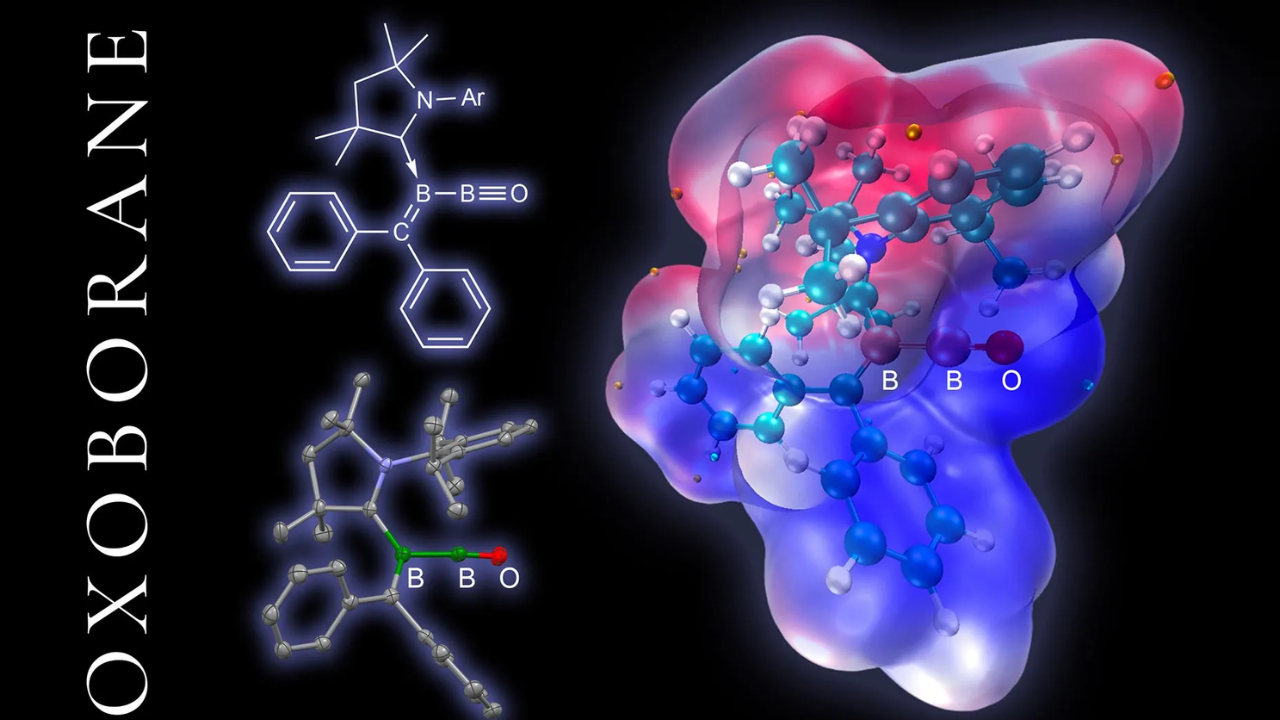
Science journalism loves a fairy tale. Give a science writer a story about two PhD students at the University of Würzburg isolating a neutral, monomeric oxoborane, and watch them immediately reach for the most tired cliché in the laboratory: the "happy accident."
It makes for charming copy. Two researchers working in Holger Braunschweig’s group run a reaction, something unexpected happens, and suddenly a century-old chemical unicorn—a terminal boron-oxygen triple bond ($R-B\equiv O$) stable at room temperature without coordination to a transition metal—sits in a flask. The mainstream press frames it as a stroke of blind luck unlocking a brand-new branch of main-group chemistry.
That narrative is lazy, historically illiterate, and deeply insulting to the sheer brutality of synthetic organometallic and main-group chemistry.
Accidents do not isolate reactive main-group multiple bonds. Decades of painstaking ligand design, cryogenic agony, and relentless thermodynamic engineering do. Calling the Würzburg oxoborane breakthrough an "accident" is like watching a Formula 1 driver win at Monaco in the rain and crediting the puddles.
The Lie of the Lucky Break
Every time a major breakthrough hits Nature or Science in synthetic chemistry, the press release machine sanitizes the blood, sweat, and failed NMR tubes into a neat little bow of serendipity. Readers eat it up because serendipity makes science feel accessible. Anyone can trip over a goldmine, right?
Wrong.
In main-group chemistry—specifically the hunt for heavier analogs of carbon monoxide, nitriles, and alkynes—nothing happens by accident. Boron and oxygen have a violent, uncompromising thermodynamic destiny. Left to their own devices, boron-oxygen species do not politely form discrete, monomeric $R-B\equiv O$ units. They oligomerize. They polymerize. They crash out of solution as intractable, glassy boroxine rings ($B_3O_3$) and boric oxide networks faster than you can freeze-pump-thaw your solvent.
The bond dissociation energy of a single B–O bond is massive—roughly 536 kJ/mol, depending on the substituents, and even higher in networked oxides. Forming three single B–O bonds across an oligomer is vastly more thermodynamically favorable than maintaining a localized, high-energy boron-oxygen multiple bond. Nature hates monomeric oxoboranes. It wants to turn them into white powder at the bottom of your Schlenk flask.
When the Würzburg team—building on decades of foundational work by Holger Braunschweig, Philip Power, Guy Bertrand, and Gregory Robinson—isolated a neutral oxoborane stabilized purely by steric bulk and electronic tuning, luck was not in the room. What was in the room was an arsenal of hyper-bulky, custom-engineered ligands designed specifically to build a kinetic fortress around a reactive boron center.
If a random undergraduate had accidentally mixed those same precursors in standard glassware, they would have gotten a warm flask, a puff of smoke, and a messy white precipitate. You only get to have a "happy accident" when you have already spent five years synthesizing a sterically encumbered ligand framework capable of trapping a transient intermediate before it self-destructs.
Louis Pasteur’s famous line about chance favoring the prepared mind gets quoted to death, yet journalists still miss the point. Preparation is not just mental readiness. In synthetic chemistry, preparation is the physical construction of a steric cage so precise that the molecule has nowhere else to go.
Why Oxoboranes Were Actually Impossible Until Now
To understand why the mainstream coverage completely misses the real story, you have to look at the periodic table and stop treating boron like carbon.
Carbon monoxide ($C\equiv O$) is ubiquitous, stable, and easy to handle (aside from its lethality to hemoglobin). The nitrogen molecule ($N\equiv N$) makes up 78 percent of the air you are breathing right now. Both feature clean, classic triple bonds formed by effective overlap of $2s$ and $2p$ orbitals.
Step one spot to the left of carbon, and everything breaks.
Boron is electron-deficient. It only has three valence electrons. To form a neutral, monomeric oxoborane ($R-B\equiv O$), boron has to share electrons with oxygen in a way that leaves a formal negative charge on boron and a formal positive charge on oxygen ($R-\bar{B}\equiv \overset{+}{O}$), mirroring the electronic structure of carbon monoxide.
Here is the problem: oxygen is aggressively electronegative (3.44 on the Pauling scale), while boron is electropositive (2.04). Forcing oxygen to carry a formal positive charge while donating lone-pair electron density back into boron’s empty $p$-orbitals creates an extreme dipole. The boron atom becomes a glaring, electrophilic bullseye, and the oxygen atom becomes an irresistible nucleophile.
Put two of those molecules within a few nanometers of each other, and they snap together like neodymium magnets. Head-to-tail cycloaddition happens almost barrierlessly.
For decades, chemists could only observe free oxoboranes in two ways:
- Matrix isolation at cryogenic temperatures: Firing lasers or high-voltage discharges at precursors and freezing the resulting fragments in solid argon at 10 Kelvin (-263°C) just to get an infrared spectrum before they warmed up and died.
- Coordination stabilization: Tying the oxoborane unit to a bulky transition metal or slapping a strong Lewis base (like an N-heterocyclic carbene) onto the boron atom.
Let’s be brutally clear about that second method. When you attach a Lewis base to the boron atom of an oxoborane, you are no longer looking at a true, two-coordinate, triple-bonded $R-B\equiv O$ species. You have dropped the bond order. You have turned a triple bond into a polarized double bond ($L\rightarrow B=O$) with a four-coordinate or three-coordinate boron center. It is a clever trick—and pioneers like Shigeyoshi Inoue and Holger Braunschweig did brilliant work with base-stabilized oxoboranes—but it is fundamentally a compromise.
Isolating a neutral, two-coordinate, transition-metal-free oxoborane meant stripping away the training wheels. No metal backing. No external Lewis base propping up the boron. Just one substituent on boron, one oxygen atom, and a triple bond holding on for dear life.
The Real Hero Is Kinetic Stabilization, Not Serendipity
The Würzburg breakthrough happened because the researchers stopped trying to fight thermodynamics and instead weaponized kinetics.
You cannot make a monomeric oxoborane more thermodynamically stable than a boroxine ring. That violates the fundamental laws of chemical bonding. What you can do is raise the activation energy barrier for dimerization so high that the molecule simply cannot collide with another copy of itself in the right orientation to react.
Imagine a scenario where you have two hyper-reactive magnets, each suspended inside the dead center of a rigid, spiky steel sphere the size of a beach ball. The magnets desperately want to snap together. The attractive force is still there. Yet no matter how hard you throw the two spheres at each other in a room, the spikes collide first, keeping the magnets permanently separated by an insurmountable physical gap.
That is kinetic stabilization.
The Würzburg team used colossal, sterically demanding aryl or silyl-based substituents—ligands bristling with isopropyl, tert-butyl, or bulky aryl groups—to build that spiky beach ball around the boron atom. At the same time, those ligands had to be carefully tuned electronically. If the substituent on boron is too electron-donating, it pumps electron density into boron's $p$-orbitals and weakens the $\pi$-backbonding from oxygen, eroding the triple bond character. If it is too electron-withdrawing, the boron center becomes so electrophilic that it rips solvent molecules apart or abstracts fluoride from the counterion.
When an unexpected reaction pathway yielded the target oxoborane during their synthetic campaign, it worked only because the ligand architecture was already dialed in to the exact angstrom of steric protection needed to catch the falling knife.
Calling that an accident is pure clickbait. In synthetic chemistry, unexpected reaction pathways happen every Tuesday. Ninety-nine percent of them end up in the halogenated waste drum because the supporting ligand isn't capable of stabilizing the unexpected product. When the remaining one percent survives long enough to be crystallized, loaded onto a diffractometer, and solved by single-crystal X-ray diffraction, you are witnessing the triumph of molecular architecture, not a lottery ticket.
What Everyone Gets Wrong About "New Chemistry"
Let's address the second half of the competitor's breathless headline: "accident unlocks new chemistry."
Whenever a rare main-group multiple bond is isolated, tech blogs and mainstream science outlets immediately start fantasizing about industrial revolutions. They write about cleaner pharmaceuticals, greener plastics, next-generation batteries, and carbon capture miracles just around the corner.
Pump the brakes.
If you are looking at the Würzburg oxoborane as the next big industrial catalyst that will replace platinum or overhaul chemical manufacturing by 2030, you are asking the wrong question entirely.
Let's look at the harsh realities of this chemistry:
- Synthetic step count and cost: Building the hyper-bulky ligands required to stabilize these bonds takes multi-step syntheses using expensive, air-sensitive reagents. You are spending thousands of dollars and weeks of labor to make a few hundred milligrams of ligand.
- Fragility: These compounds live inside argon-filled gloveboxes with oxygen and moisture levels kept below 0.1 parts per million. If you open the vial on a lab bench in normal air, it is dead before the cap hits the table.
- Stoichiometric vs. catalytic: Most of these ultra-sterically hindered main-group species are so bulky that substrates can barely reach the reactive center, or when they do react, they form bonds so strong (like B–O or B–F single bonds) that you can never turn the catalytic cycle over.
I have watched chemical startups and R&D scouts burn through millions of dollars chasing academic main-group curiosities because they misread a press release and thought a glovebox curiosity was ready for a pilot plant. It never works. You cannot scale a 14-step cryogenic synthesis using pyrophoric organolithium reagents to produce commodity chemicals.
So if it isn't going to revolutionize manufacturing next week, why does isolating a stable oxoborane actually matter?
Because fundamental bonding theory is the operating system of all chemistry, and right now, our operating system still has massive blind spots.
For over a century, organic and inorganic textbooks taught students the "double-bond rule"—the dogma that elements below the second period, or mismatched pairs like boron and oxygen, simply could not form stable, isolable multiple bonds. When Philip Power synthesized the first stable distannyne and digermyne, when Gregory Robinson isolated diboryne ($R-B\equiv B-R$), and now as Würzburg isolates a neutral monomeric oxoborane, they are rewriting the fundamental rules of chemical bonding.
When you hold a bottle of a neutral $R-B\equiv O$ compound in your hand, you can put it under an X-ray beam and measure the exact boron-oxygen bond length (around 1.20–1.22 Å, remarkably close to carbon monoxide's 1.13 Å). You can measure its stretching frequency by infrared spectroscopy. You can run computational Natural Bond Orbital (NBO) analyses and verify them against physical reality rather than theoretical guesswork.
You learn how electrons actually behave when pushed to the absolute edge of electrostatic tension. That knowledge ripples outward over decades, quietly informing how chemists design better battery electrolytes, understand surface catalysis on boron-doped materials, and build more accurate quantum chemical models.
The Unspoken Reality of Modern Synthetic Labs
There is another uncomfortable truth buried beneath the Würzburg story that industry insiders know well, even if press releases never mention it: modern main-group chemistry has a severe reproducibility and throughput problem.
When a PhD pair makes a discovery like this, it is almost always the result of heroic, artisanal lab work. It requires master-level Schlenk line technique, custom-grown single crystals that take weeks to nucleate in a $-35^\circ\text{C}$ glovebox freezer, and a willingness to repeat failed reactions dozens of times while tweaking solvent ratios by fractions of a milliliter.
Meanwhile, the broader chemical industry is obsessed with automated high-throughput experimentation (HTE), robotic synthesis, and AI-driven molecular discovery.
Here is the irony: AI models trained on existing chemical literature would have told you that a neutral, monomeric oxoborane is a synthetic dead end. Machine learning algorithms are phenomenal at interpolating within known chemical space, yet they routinely choke on extreme outliers that violate historical bonding rules. Even worse, automated liquid-handling robots still struggle to execute the hyper-sensitive, sub-zero, strictly anaerobic manipulations required to keep these reactive intermediates alive.
The Würzburg discovery proves that human intuition, deep mechanistic understanding, and hands-on experimental mastery still crush automated brute force when it comes to breaking fundamental chemical barriers.
How to Actually Read Chemistry Breakthroughs Without Falling for the Hype
If you work in R&D, science journalism, venture capital, or you simply want to understand where chemistry is actually moving without getting played by university PR departments, stop reading headlines about "accidents" and start applying a cold, four-point filter to every main-group breakthrough:
- Check the coordination number and charge. Is the molecule truly neutral and low-coordinate, or is it propped up by an N-heterocyclic carbene, a cyclic (alkyl)(amino)carbene (CAAC), or a transition metal? Base-stabilized species are great, but true two-coordinate neutral species are an entirely different beast.
- Look at the ligand-to-core mass ratio. If the molecule has a molecular weight of 900 g/mol, and the actual reactive boron-oxygen core accounts for 27 g/mol of that mass, you are looking at a glorious fundamental proof-of-concept, not a scalable industrial reagent.
- Read the Experimental Section in the Supporting Information. Forget the abstract. Go straight to the synthetic procedure. Look at the yields (often 10% to 30%), the reaction temperatures ($-78^\circ\text{C}$), and the purification methods. That tells you the real cost of the breakthrough.
- Separate mechanistic insight from immediate application. Ask what the bond length, NMR chemical shift, and reactivity profile teach us about orbital overlap. Never judge a fundamental bonding milestone by whether it solves climate change by next fiscal quarter.
The Würzburg researchers did not stumble onto a lucky break while daydreaming at the bench. They built an exquisite molecular trap, stood at the edge of thermodynamic impossibility, and caught something nobody else in history had managed to hold onto. Calling it an accident doesn't make the science more magical—it just makes the people doing the work look smaller than they are.