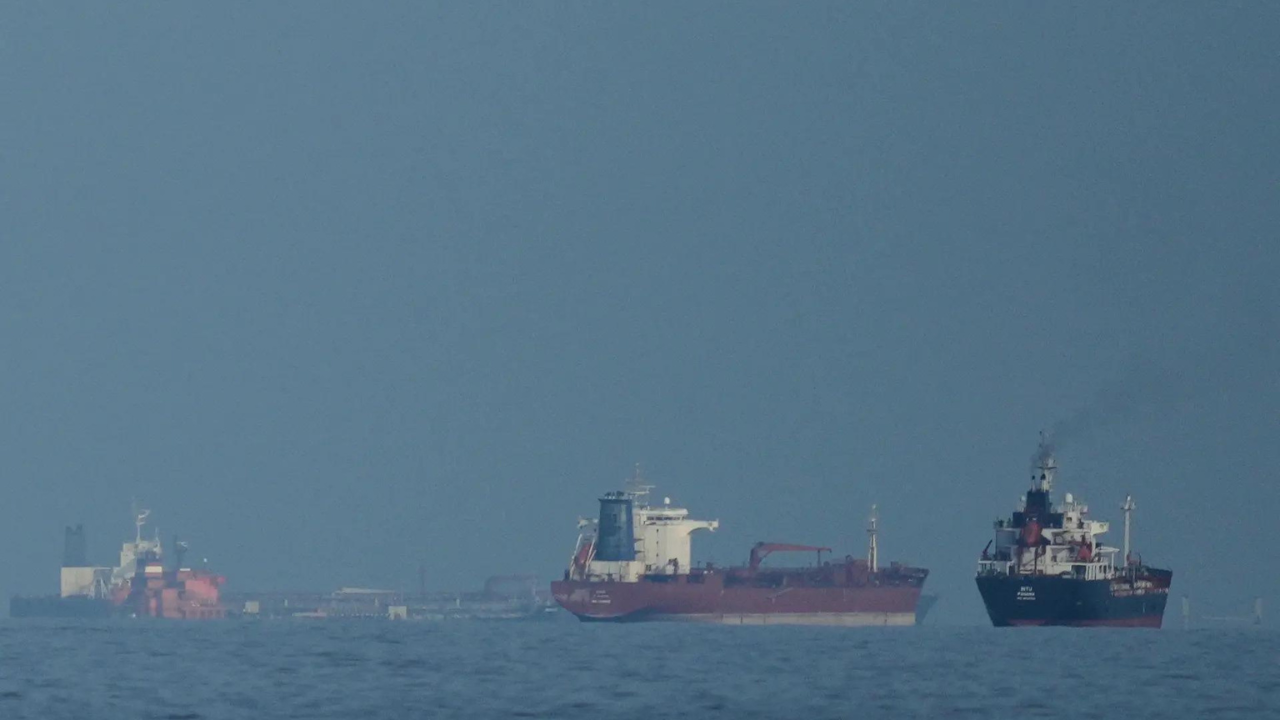
The Strait of Hormuz functions as the singular most critical node in the global energy supply chain, facilitating the transit of approximately 21 million barrels of oil per day. While political rhetoric often frames control of the waterway as a binary state of "open" or "closed," the operational reality is a spectrum of risk and cost-prohibitive insurance premiums. Iran’s claim of "full control" is not a statement of conventional naval dominance, but an assertion of the ability to initiate an asymmetric denial event that exceeds the mitigation capacity of international maritime security forces.
The Geometry of the Chokepoint
The Strait of Hormuz is roughly 21 miles wide at its narrowest point, but the shipping lanes consist of two two-mile-wide channels separated by a two-mile buffer zone. This geographic constraint creates a predictable, low-maneuverability environment for Ultra Large Crude Carriers (ULCCs).
Control in this context is defined by three distinct operational layers:
- Sensory Dominance: The ability to maintain persistent surveillance of every hull entering the Persian Gulf. Iran utilizes a network of coastal radar stations, unmanned aerial vehicles (UAVs), and signals intelligence outposts on islands like Abu Musa and the Greater and Lesser Tunbs.
- Kinetic Reach: The saturation of the waterway with redundant strike options. This includes land-based anti-ship cruise missiles (ASCMs), fast-attack craft (FAC) capable of swarming, and sophisticated bottom-tethered mines.
- Legal Friction: The exploitation of the "right of transit passage" under the United Nations Convention on the Law of the Sea (UNCLOS). By asserting environmental or security violations, a coastal state can create "legal chokepoints" that serve as precursors to physical intervention.
The Asymmetric Swarm Logic
Conventional naval doctrine relies on the Aegis Combat System and similar integrated defenses to intercept high-velocity threats. However, the Iranian "deadly vortex" strategy relies on volume over individual platform sophistication. The cost-exchange ratio favors the disruptor.
- The Saturation Point: A single Arleigh Burke-class destroyer possesses a finite number of Vertical Launch System (VLS) cells. If 50 low-cost explosive motorboats and 20 drones are deployed simultaneously, the defensive system faces "target saturation." The mathematical probability of a single "leaker" hitting a tanker becomes nearly certain.
- The Mine Paradox: Sea mines are the most cost-effective tool for maritime denial. The mere suspicion of an unmapped minefield effectively closes a strait because commercial insurers (Lloyd’s of London) will immediately withdraw coverage for the region. Modern "smart mines" can be programmed to ignore small patrol vessels and detonate only under the acoustic or magnetic signature of a large tanker.
Economic Elasticity and the Premium of Fear
The global market does not react to the physical blockage of oil; it reacts to the anticipation of blockage. This is the "Fear Premium."
The Cost Function of Disruption
A full closure of the Strait would remove roughly 20% of the world's liquid petroleum consumption from the market. The resulting price shock is non-linear. Because oil demand is inelastic in the short term—meaning consumers cannot easily switch energy sources overnight—a 20% supply drop can lead to a 100% or 200% price increase.
The Insurance Bottleneck
Most analysis focuses on the military aspect, but the financial aspect is the true kill-switch. When a region is declared a "War Risk Area," the cost of Protection and Indemnity (P&I) insurance spikes. If the risk reaches a certain threshold, insurers refuse to provide "hull and machinery" coverage. Without insurance, a vessel cannot dock at international ports. Consequently, Iran can "close" the Strait without firing a single missile simply by creating a high-enough risk profile that the commercial fleet grounds itself.
Strategic Redundancies and Their Limits
Regional actors have attempted to bypass the Strait of Hormuz via pipelines, but these alternatives are insufficient to replace the waterway’s volume.
- The East-West Pipeline (Saudi Arabia): Capable of moving approximately 5 million barrels per day to the Red Sea. While significant, it handles less than a quarter of the total volume transiting Hormuz.
- The Abu Dhabi Crude Oil Pipeline (UAE): Connects fields to the port of Fujairah, bypassing the Strait. Its capacity is roughly 1.5 million barrels per day.
These pipelines are static infrastructure and remain vulnerable to cyber-attacks or long-range drone strikes. The dependency on the Strait remains a structural vulnerability of the global economy that cannot be engineered away in the current decade.
The Proxy Layer and Plausible Deniability
Iran’s strategy of "full control" often manifests through proxies rather than direct IRGC (Islamic Revolutionary Guard Corps) actions. This creates a "gray zone" conflict where attribution is difficult.
- UAV Proliferation: Providing long-range one-way attack drones to regional allies allows for strikes on shipping far from Iranian shores, diluting the focus of Western naval coalitions.
- GPS Spoofing: Electronic warfare units can broadcast false GPS signals, leading commercial tankers into Iranian territorial waters where they can be legally seized for "violating maritime boundaries."
Defensive Limitations of Naval Coalitions
International task forces, such as Operation Prosperity Guardian or the International Maritime Security Construct (IMSC), face a fundamental logistics problem: the escort-to-vessel ratio.
Thousands of ships pass through the Strait monthly. It is mathematically impossible to provide a close-in destroyer escort for every tanker. Defensive forces must rely on "area defense," which is inherently reactive. The attacker holds the "first-mover advantage," choosing the time, location, and method of the strike.
Furthermore, the environmental impact of a ULCC being sunk in the shallow, ecologically sensitive waters of the Persian Gulf would create a secondary crisis. A massive oil spill would foul desalination plants across the Arabian Peninsula, turning an energy crisis into a humanitarian water crisis.
The Shift Toward Multi-Domain Denial
As naval technology evolves, the Iranian approach has shifted toward integrating cyber and space-based capabilities.
- AIS Manipulation: By hacking the Automatic Identification System (AIS) of various vessels, a disruptor can create "ghost ships" on radar, confusing maritime traffic and increasing the risk of collisions in the narrow channels.
- Satellite Incapacitation: Disrupting the commercial satellite links that tankers rely on for real-time weather, navigation, and communication with fleet owners effectively blinds the modern merchant marine.
Structural Implications for Global Trade
The "deadly vortex" rhetoric serves as a signaling mechanism to the West regarding the cost of sanctions or military escalation. It highlights that the global economy is built on a foundation of "just-in-time" delivery that assumes safe passage through a handful of narrow waterways.
The Strait of Hormuz is not a gate that can be locked; it is a system of complex interdependencies. Control is exercised not through occupation, but through the credible threat of systemic collapse.
The operational directive for global energy stakeholders is to transition from a strategy of "protection" to one of "diversified resilience." This involves the rapid expansion of strategic petroleum reserves (SPR) in consuming nations and the acceleration of the "hydrogen economy" or localized power generation to decouple national security from the transit of molecules through a 21-mile-wide gap.
Strategic planners must operate under the assumption that the Strait is already contested space. The traditional era of unchallenged maritime hegemony in the Persian Gulf has been replaced by a state of permanent low-intensity friction. The most effective response is not an increase in naval tonnage, but a radical shortening of supply chains to reduce the "kinetic footprint" of essential resources. If the threat of a vortex is to be neutralized, the target—the global reliance on this specific geographic point—must be removed.