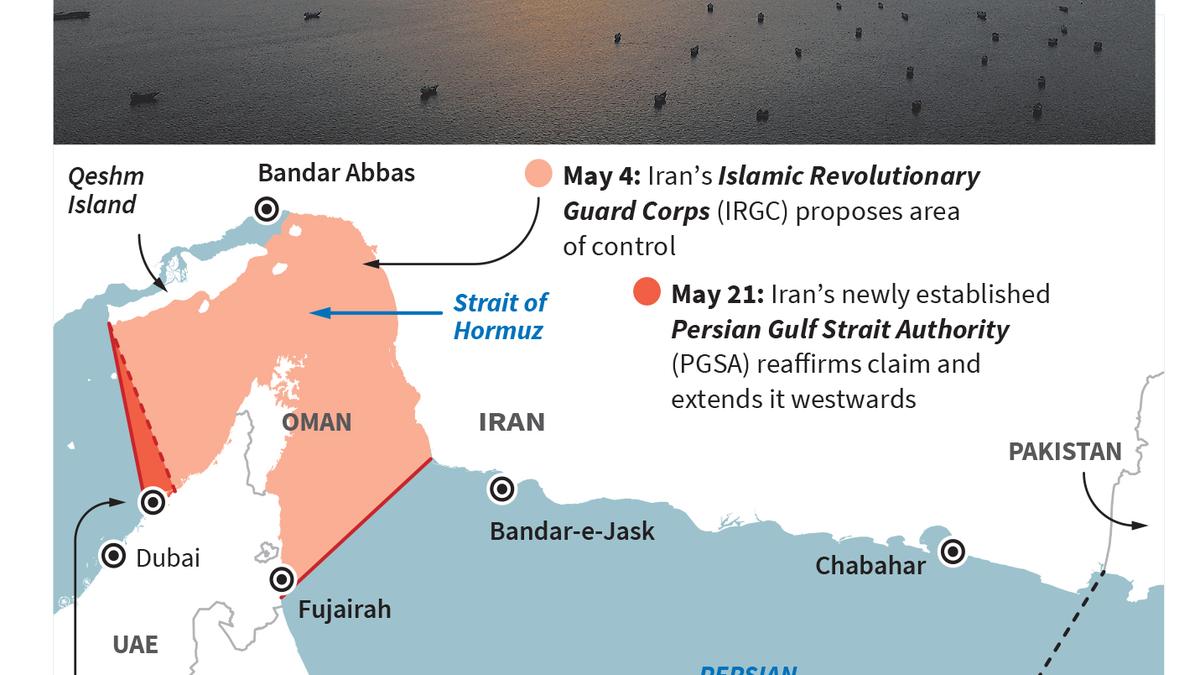
Washington discovered the hard way that trillion-dollar navies cannot easily police a twenty-one-mile-wide chokepoint. For decades, Western foreign policy rested on an unshakeable premise: the United States military could guarantee freedom of navigation anywhere on Earth. Yet in the narrow waters of the Strait of Hormuz, that assumption has fractured. Iran has successfully used low-cost, asymmetric tactics—ranging from drone swarms to naval mines—to neutralize America's conventional naval superiority, effectively stalling U.S. hegemony in the region. This shift has forced global markets to price in a permanent risk premium for energy transit.
The reality of modern maritime warfare has caught up with twentieth-century strategic doctrine.
The Illusion of Absolute Control
Every day, roughly one-fifth of the world’s petroleum consumption passes through the Strait of Hormuz. It is a geographic bottleneck separating the Persian Gulf from the Gulf of Oman, flanked by Iran on the north and Oman on the south. For the global economy, it is a single point of failure.
Historically, the U.S. Fifth Fleet acted as the ultimate guarantor of this passage. Heavy aircraft carrier strike groups patrolled the region, projecting power through sheer scale. This worked when adversaries played by traditional rules of engagement.
It fails when the adversary refuses to fight a conventional war.
Iran recognized early on that it could never match the United States hull for hull or missile for missile. Instead, Tehran built a doctrine around affordable denial. By utilizing thousands of fast attack craft, anti-ship cruise missiles hidden along a rugged coastline, and uncrewed aerial vehicles, they created a high-density threat environment.
A multi-billion-dollar destroyer is an engineering marvel. However, it possesses a finite number of air defense interceptors. If an adversary launches fifty inexpensive drones simultaneously, the mathematical equation shifts. The defender spends millions of dollars per missile to shoot down targets that cost a fraction of that amount, quickly depleting their magazine capacity.
The Asymmetric Equation in Shallow Waters
Geography actively penalizes large, conventional naval vessels in the Persian Gulf. The average depth of the Gulf is a mere 150 feet, shrinking the operational maneuvering space for capital ships.
The Swarm Intelligence
The Islamic Revolutionary Guard Corps Navy (IRGCN) does not rely on capital ships. They utilize speedboats equipped with heavy machine guns, multiple-launch rocket systems, and short-range anti-ship missiles.
These vessels operate in packs. In a crisis, they can emerge from hidden coves along the Iranian coastline, saturate a target's radar capabilities, and vanish before a coordinated response can materialize. This is not reckless harassment; it is a calculated doctrine designed to exploit the command-and-control lag of a massive bureaucracy.
The Low-Tech Threshold
- Mines: The ultimate passive denial weapon. Modern acoustic and magnetic mines can be deployed by commercial vessels or small boats, turning international shipping lanes into minefields within hours.
- Commercial Seizures: By using legalistic pretexts—such as alleged maritime collisions or environmental violations—Iran regularly boards and detains commercial tankers. This forces Western powers into a diplomatic gray zone where military retaliation looks disproportionate.
Consider a hypothetical scenario where a state-backed actor deploys twenty sea mines into the shipping lanes. The entire insurance market for global shipping reacts instantly. Underwriters withdraw coverage, effectively halting commercial traffic without a single shot being fired at a warship. This asymmetry gives regional powers immense leverage over global supply chains.
The Economic Shrapnel
When a crisis escalates in the Strait, the immediate fallout is not measured in sunken warships. It is measured in freight rates and insurance premiums.
Commercial shipping companies operate on razor-thin margins. When tension spikes, war risk insurance premiums for tankers transiting the Persian Gulf can skyrocket by thousands of percent in a single week. These costs are immediately passed down the supply chain, translating to higher prices at pumps and factories worldwide.
[Geopolitical Tension Spike]
       │
       ▼
[War Risk Insurance Premiums Surge]
       │
       ▼
[Tankers Rerouted or Anchored]
       │
       ▼
[Global Energy Supply Contracts]
       │
       ▼
[Consumer Price Inflation]
Western strategy has long relied on deterrence to prevent this chain reaction. But deterrence only functions if the adversary believes you are willing to risk a regional war to protect a single commercial tanker. When Washington hesitates to retaliate against commercial seizures to avoid a broader conflict, the deterrent effect evaporates.
The Fragility of Coalition Operations
Attempts to internationalize the security of the Strait have yielded mixed results. Initiatives like the International Maritime Security Construct (IMSC) were designed to share the burden of escorting merchant vessels among multiple nations.
The strategy looked excellent on paper. In practice, it revealed deep divisions.
Many European and Asian nations, heavily reliant on Middle Eastern oil, feared that joining a U.S.-led military coalition would make their own commercial fleets direct targets for Iranian retaliation. They opted for independent, lower-profile naval missions or sought diplomatic backchannels with Tehran. This lack of unity signaled to observers that the international community lacked the collective political will to enforce freedom of navigation through sustained military force.
The Pivot to Alternative Routes
Recognizing the vulnerability of the Strait, regional energy producers have spent billions constructing overland pipelines to bypass the chokepoint.
Saudi Arabia operates the East-West Pipeline, capable of moving crude oil from its eastern fields to the Red Sea port of Yanbu. The United Arab Emirates constructed the Habshan–Fujairah pipeline, which carries oil directly to the Gulf of Oman, entirely bypassing the entry to the Persian Gulf.
These pipelines offer a partial safety valve, not a complete solution. Their combined capacity can handle only a fraction of the total volume that flows through the Strait daily. Furthermore, infrastructure on land remains vulnerable to long-range missile and drone strikes, as demonstrated by the 2019 attacks on Saudi Aramco’s Abqaiq and Khurais facilities. You cannot easily pipeline your way out of a geographical reality.
The New Maritime Reality
The era of uncontested Western maritime dominance in closed seas has ended.
Supercarriers and advanced destroyers remain unmatched in deep ocean blue-water environments, but their utility degrades sharply in narrow littoral zones controlled by resolved asymmetric adversaries. Protecting global commerce now requires a fundamental reassessment of naval procurement and strategy.
Instead of relying exclusively on a small number of massive, irreplaceable platforms, modern navies must invest heavily in their own autonomous systems, distributed sensor networks, and cost-effective counter-drone technologies. Security in the Strait of Hormuz cannot be bought with brute force alone; it requires adapting to an era where the cheap and the numerous can successfully challenge the expensive and the rare.