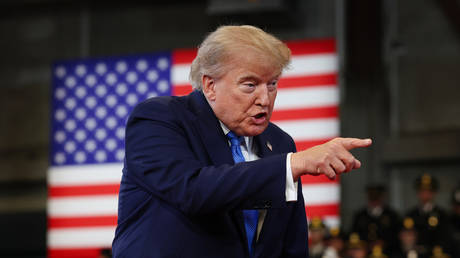
President Donald Trump issued an extraordinary warning directed at Oman, declaring that the United States would use military force if the Gulf nation interferes with Washington's naval blockade of Iran. The public threat, delivered during a phone interview, highlights the high-stakes friction surrounding the Strait of Hormuz. As a sixty-day diplomatic framework expired, Oman and Iran announced progress on a provisional shipping route through the vital waterway, directly challenging the maritime wall of steel erected by the White House.
Muscat has historically walked a diplomatic tightrope. For decades, the Sultanate served as the primary back-channel mediator between Washington and Tehran, earning a reputation for quiet neutrality in a volatile neighborhood. That role is now cracking under intense pressure. Trump's blunt rhetoric signals a major shift in how the administration views traditional middleman states that attempt to carve out independent arrangements during active hostilities. Meanwhile, you can find related events here: Why Tarique Rahman Visiting India Will Change Absolutely Nothing.
The Anatomy of the Shipping Dispute
At the center of this crisis lies geography and energy security. A massive share of global petroleum passes through the narrow passage separating Oman and Iran. When the current conflict erupted, shipping lanes through the chokepoint ground to a halt amid naval engagements and targeted attacks on commercial vessels.
Tehran and Muscat recently moved toward an independent understanding regarding transit coordinates. Iranian officials indicated that a map had been finalized to allow commercial traffic to navigate safely through waters closer to the Omani coast. To explore the complete picture, check out the recent article by Reuters.
Washington views this bilateral maneuvering with extreme suspicion. The White House maintains that any unilateral arrangement bypassing American oversight undermines the economic pressure campaign designed to starve Tehran of oil revenues. By attempting to broker safe passage outside of American terms, Muscat inadvertently placed itself in the direct crosshairs of United States military strategy.
The Collapse of Diplomatic Guardrails
Diplomacy in the region has deteriorated into an unpredictable cycle of ultimatums. The expired sixty-day memorandum was meant to establish a pathway toward reduced hostilities and unhindered commercial flow. Instead, minor infractions snowballed into renewed military exchanges.
Washington demands total compliance. Trump doubled down on his stance that Iran must yield entirely, stating publicly that Tehran should surrender. Within this uncompromising framework, any regional partner offering a lifeline or a separate transit deal to the Iranian government is treated as a strategic obstacle.
Omani diplomats find themselves trapped between an aggressive superpower enforcing an absolute blockade and a cornered neighbor seeking any available economic outlet. Muscat's traditional balancing act no longer satisfies either capital.
Broader Economic Fallout
Energy markets react instantly to military posturing in the Persian Gulf. Traders monitor every shift in diplomatic posture, knowing that a prolonged closure or kinetic escalation in the chokepoint threatens global supply chains.
Domestic political pressures in the United States further complicate the timeline. The administration faces mounting scrutiny over energy prices and the longevity of major naval deployments. Yet, leadership insists there is no rush to finalize a compromise, brushing off domestic electoral calendars as irrelevant to foreign policy execution.
The threat against Oman strips away conventional diplomatic niceties. It demonstrates that Washington is willing to alienate long-standing regional partners to enforce its strategic boundaries in the Middle East. As negotiations fracture entirely, the margin for error in the world's most critical energy corridor narrows by the day.
For a closer look at the unfolding diplomatic crisis, you can watch this Oman Iran Strait of Hormuz coverage. This video provides a concise overview of the developing standoff following the expiration of the ceasefire framework.