India’s refusal to condemn Russia’s invasion of Ukraine is not an act of diplomatic indecision, nor is it a Hamlet-style existential crisis of "to be or not to be." It is a calculated, multi-variable optimization problem solved through the lens of structural realism. While Western commentators frequently frame New Delhi’s abstentions at the United Nations as moral equivocation or nostalgic loyalty to a Cold War patron, Indian policymakers are executing a precise risk-mitigation strategy. To understand India’s position, one must discard ideological binaries and examine the three hard constraints governing New Delhi’s statecraft: legacy defense dependency, energy-driven macroeconomic stability, and continental containment against China.
The Architecture of Strategic Autonomy
Standard geopolitical commentary often confuses India’s current doctrine of multi-alignment with its historical policy of non-alignment. Non-alignment was a defensive posture adopted by a weak post-colonial state seeking to avoid entrapment in superpower proxy wars. Multi-alignment is an offensive, transactional strategy employed by a rising power to extract maximum utility from competing geopolitical blocs simultaneously. If you liked this article, you should look at: this related article.
Under this framework, India treats bilateral relationships as isolated portfolios rather than interconnected ideological commitments. New Delhi deepens defense interoperability with the United States through the Quadrilateral Security Dialogue (Quad) and foundational military agreements (LEMOA, COMCASA, BECA), while simultaneously maintaining deep transactional ties with Moscow. In Indian strategic thought, aligning fully with Western sanctions would yield immediate, catastrophic domestic costs while offering zero binding security guarantees against India's primary adversary: the People’s Republic of China.
Variable One The Legacy Defense Lock-In
The first constraint preventing an Indian rupture with Moscow is operational readiness. For decades, the Soviet Union and subsequently the Russian Federation served as India’s primary arms supplier, providing systems that Western powers either refused to sell or priced beyond India’s capital expenditure limits. While India has aggressively diversified its defense procurement over the past decade—shifting new contracts toward the United States, France, and Israel, alongside domestic manufacturing initiatives—the installed base of the Indian Armed Forces remains overwhelmingly Russian-origin. For another perspective on this development, check out the latest coverage from The Washington Post.
This creates an acute path dependency governed by three operational realities:
- Fleet Sustainment and Spare Parts: Approximately 60 to 70 percent of India’s active military hardware—including Sukhoi Su-30MKI fighter jets, T-90S main battle tanks, Kilo-class submarines, and AK-203 assault rifles—requires continuous Russian supply chains for maintenance, repair, and overhaul (MRO). A sudden diplomatic break would ground air squadrons and immobilize armored divisions within months.
- Strategic Deterrence Systems: India’s nuclear triad and high-end area denial capabilities rely directly on Russian technical cooperation. The lease of nuclear-powered attack submarines (SSN) and the ongoing delivery of the S-400 Triumf air defense systems are non-substitutable assets in the short to medium term. Western alternatives like the Patriot or THAAD systems do not integrate seamlessly into India’s existing command-and-control architecture without massive capital reinvestment and multi-year training delays.
- The Two-Front War Contingency: India maintains a permanent posture for a simultaneous conflict with Pakistan and China along contested, high-altitude borders. Unlike European nations that enjoyed a post-Cold War peace dividend, India faces active kinetic skirmishes along the Line of Actual Control (LAC) in Ladakh. New Delhi cannot afford a capability gap during a multi-year transition away from Russian hardware while Chinese forces remain mobilized on its northern frontier.
Variable Two Macroeconomic Insulation and Energy Arbitrage
The second driver of India’s policy is domestic economic survival. As a developing economy with a per capita income under $3,000 and an import dependency exceeding 80 percent for its crude oil requirements, India is hyper-sensitive to global commodity shocks. When Western sanctions disrupted global energy markets in 2022, Brent crude spiked above $120 per barrel. For India, every $10 increase in the price of a barrel of oil widens its current account deficit by roughly 0.4 to 0.5 percent of GDP, triggers imported inflation, and weakens the rupee.
New Delhi’s decision to dramatically scale up purchases of discounted Russian Urals crude was a textbook application of price-elastic energy arbitrage. Prior to 2022, Russian oil accounted for less than 2 percent of India’s total crude imports. Within eighteen months, Russia became India’s single largest oil supplier, occasionally exceeding 35 to 40 percent of total import volume.
This mechanism delivered two distinct macroeconomic benefits:
- Domestic Inflation Suppression: Securing crude at discounts ranging from $10 to $30 per barrel below global benchmarks allowed Indian state-owned refiners to absorb price volatility without passing catastrophic fuel costs onto a price-sensitive electorate.
- Global Market Stabilization: By absorbing displaced Russian barrels that would otherwise have been shut in, India effectively prevented a global supply crunch that would have driven oil prices past $150 per barrel. Indian private refiners processed this discounted crude into diesel and jet fuel, exporting refined products back to European markets—an outcome quietly tolerated by Western treasuries seeking to keep global inflation in check while starving the Kremlin of maximum revenue via price caps.
Variable Three The Sino-Russian Axis and Continental Containment
The most misunderstood element of India’s posture is its geopolitical calculus regarding Beijing. Western strategists argue that Russia’s invasion of Ukraine parallels Chinese aggression in the Indo-Pacific, suggesting India should join a unified democratic front to deter authoritarian expansionism. Indian strategists reach the exact opposite conclusion based on geographic proximity and balance-of-power theory.
India’s overarching grand strategic objective is to prevent the consolidation of a unipolar Asia dominated by China. Pushing Russia entirely into Beijing’s orbit accelerates the exact outcome New Delhi seeks to avoid. If Western sanctions isolate Moscow completely, Russia becomes a junior resource-vassal to China.
In a hypothetical Sino-Indian border war, a Moscow wholly dependent on Beijing for economic survival would be forced to halt spare parts shipments to India, share Indian military technical specifications with the People's Liberation Army (PLA), and veto pro-Indian resolutions at the United Nations Security Council. By maintaining diplomatic and economic engagement with Moscow, India preserves a critical wedge between Russia and China. New Delhi’s objective is to ensure Russia retains enough strategic options outside of Beijing so that Moscow remains neutral—or at least non-hostile—in a future Sino-Indian crisis.
Furthermore, India views Russia as an indispensable continental counterweight in Eurasia. From stabilizing Central Asia to managing security dynamics in Afghanistan and Iran, Russia’s presence prevents China from establishing an uncontested hegemony over the Eurasian landmass.
The Mechanics of India's Diplomatic Signaling
To manage the friction between its Western partnerships and its Russian dependencies, India employs a calibrated diplomatic signaling mechanism. Rather than issuing blanket endorsements or condemnations, New Delhi disaggregates its messaging across three distinct channels:
- Multilateral Abstentions: At the UN General Assembly and Security Council, India consistently abstains on resolutions targeting Russia. However, the accompanying Explanations of Vote (EoVs) are carefully drafted to emphasize the UN Charter, respect for territorial integrity, and sovereignty—coded language meant to signal to Western partners that India does not endorse border revisions by force, particularly given its own territorial disputes with China and Pakistan.
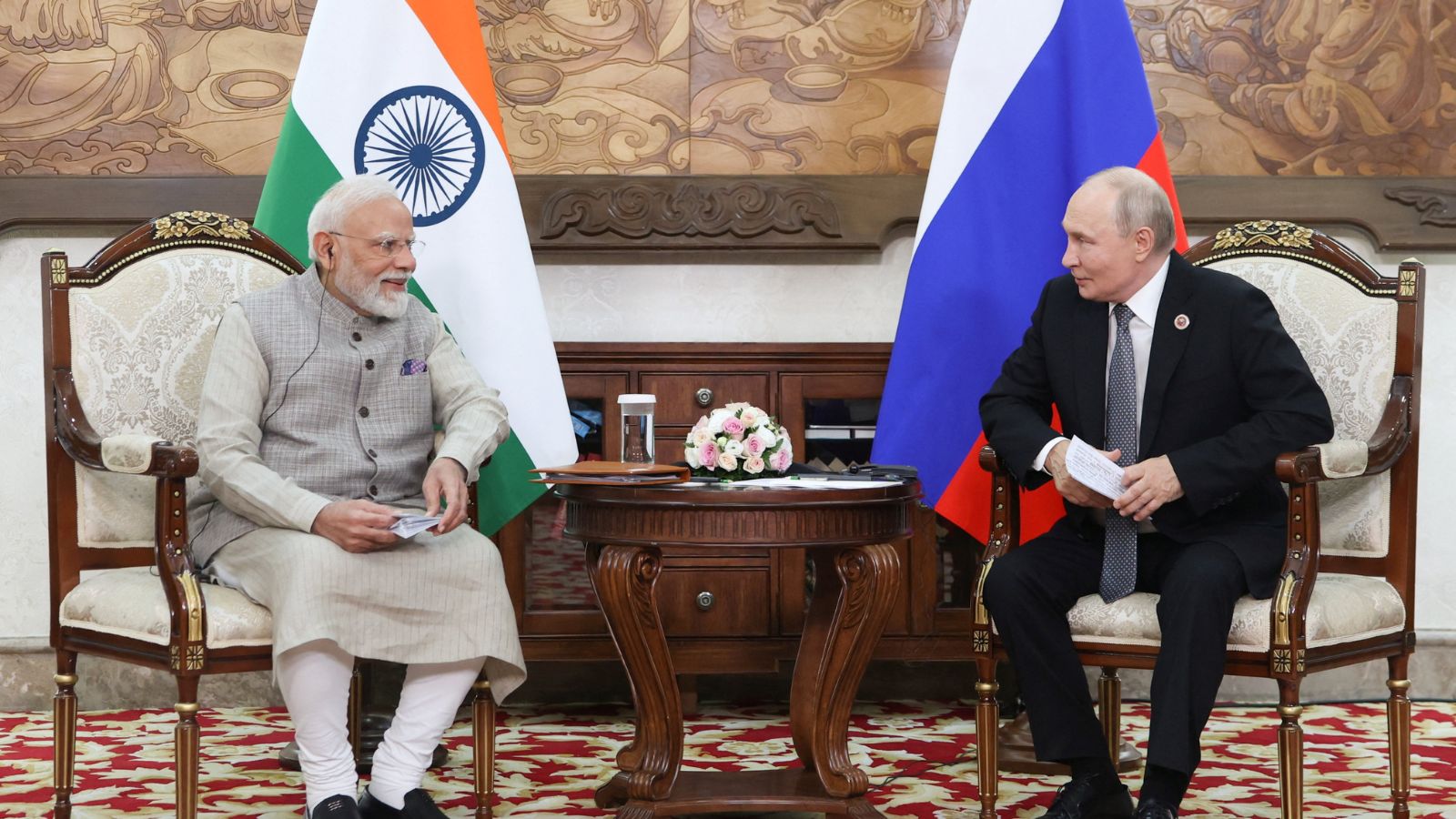
- Bilateral Restraint: In direct engagements, Indian leadership avoids public confrontation while applying private pressure. Prime Minister Narendra Modi’s public statement to Vladimir Putin in Samarkand in September 2022—that "today's era is not an era of war"—was a rare, deliberate public signal designed to pacify Western frustration while framing India as a voice for Global South stability.
- Non-Alignment with Secondary Sanctions: India refuses to recognize unilateral sanctions imposed by the US or the EU, adhering strictly to UN-mandated sanctions. Consequently, New Delhi has built alternative payment mechanisms—using Indian Rupees, UAE Dirhams, and Chinese Yuan—to settle bilateral trade with Moscow outside the SWIFT financial messaging system, insulating Indian banks from Western secondary sanctions.
Structural Vulnerabilities in the Indian Model
While India’s multi-alignment strategy has successfully maximized short-term economic and security gains, it is not a frictionless equilibrium. The strategy faces three structural vulnerabilities that threaten its long-term viability:
- The Deteriorating Reliability of the Russian Defense Industrial Base: The prolonged attrition of the Ukraine war has exposed severe capacity constraints within Russia’s military-industrial complex. Moscow is prioritizing its own frontline replenishment over export commitments, resulting in documented delays in the delivery of remaining S-400 batteries and spare parts to India. Russia’s technological edge is also eroding due to Western export controls on microelectronics, making Russian weapons platforms increasingly inferior to Western and Chinese equivalents.
- The Rupee-Ruble Settlement Bottleneck: Bilateral trade between India and Russia has become severely lopsided. India imports massive volumes of Russian oil and fertilizers while exporting very little in return. Because the Russian Ruble is not freely convertible and Indian Rupees cannot be easily repatriated or spent globally, Russian exporters have accumulated billions of dollars' worth of stranded Rupees in Indian Vostro accounts. Without a viable mechanism to clear this trade deficit, the financial plumbing supporting bilateral trade faces recurring gridlock.
- Erosion of Western Goodwill: While Washington and Brussels have tolerated India’s posture due to their own need to balance China, patience is finite. India’s refusal to align on Ukraine reinforces perceptions among certain factions in the US Congress and European parliaments that India is an unreliable fair-weather partner. This limits the ceiling on high-end technology transfers—such as jet engine manufacturing and advanced semiconductor fabrication—that Western nations are willing to share with New Delhi.
Strategic Execution Going Forward
India will not abandon its posture of calculated neutrality, because the structural incentives driving it remain unchanged. However, to prevent its current tactical wins from hardening into long-term strategic liabilities, New Delhi must execute a deliberate, phased transition over the next five years.
First, India must accelerate the de-risking of its defense supply chain without triggering an abrupt rupture with Moscow. This requires ring-fencing existing Russian platforms for localized maintenance—forcing Russian defense firms to transfer manufacturing and spare-parts production to Indian joint ventures—while directing 100 percent of new capital acquisition budgets toward indigenous defense production and Western/Israeli systems.
Second, New Delhi must institutionalize its role as the voice of the Global South to convert diplomatic abstention into active geopolitical capital. By framing its Ukraine policy around food, fuel, and fertilizer security for developing nations, India transforms a defensive posture into a leadership platform, compelling both Western powers and Russia to court New Delhi for diplomatic legitimacy.
Finally, India must operationalize the de-dollarized trade corridor with Russia by expanding Indian exports in pharmaceuticals, engineering goods, and electronics to absorb the stranded Rupee balances, while simultaneously integrating the International North-South Transport Corridor (INSTC) through Iran to bypass Western-controlled maritime chokepoints. New Delhi’s position is neither moral failure nor strategic confusion; it is the cold execution of national interest in an anarchic international system, and it will persist until the underlying balance of power in Asia fundamentally shifts.