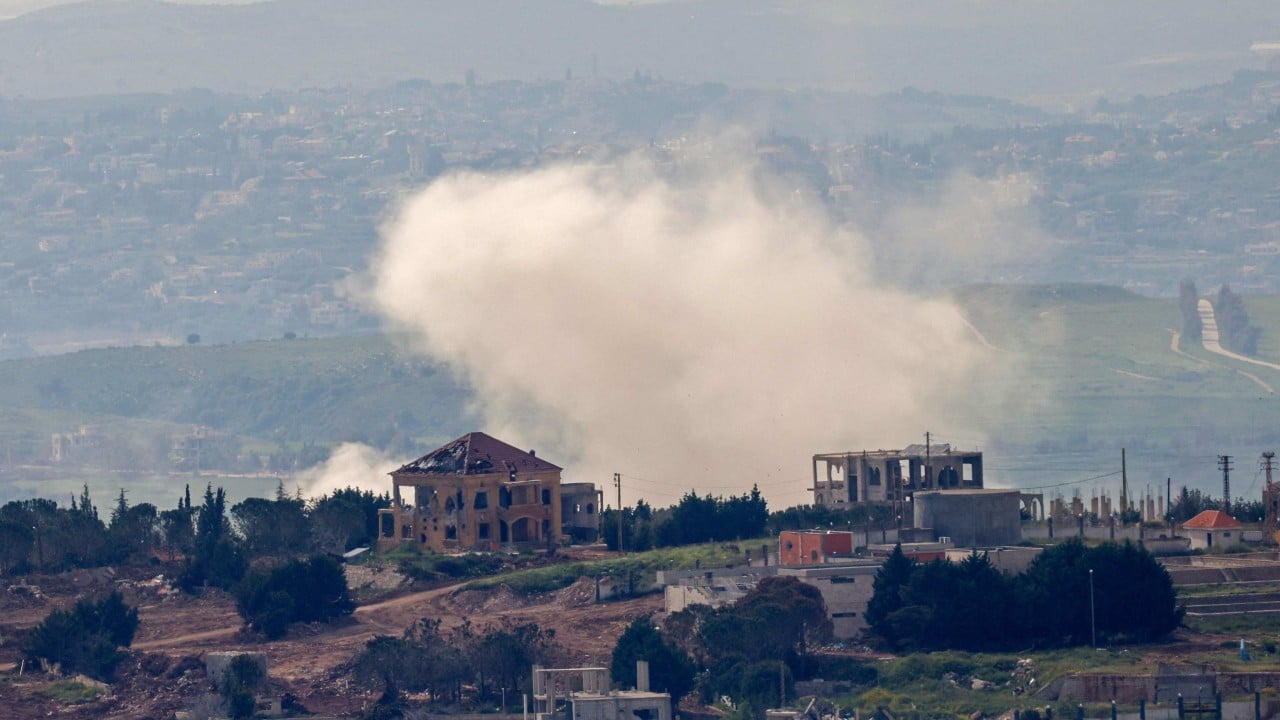
The current surge in kinetic activity between Israeli forces and northern actors in Lebanon functions as a reset of regional deterrence boundaries rather than an isolated tactical engagement. To understand the trajectory of this conflict, one must abandon the narrative of reactionary skirmishes and evaluate the situation through the lens of Deterrence Theory and the Security Dilemma.
The Deterrence Equation
Israel operates under a specific strategic framework where national security is a function of perceived credible force. The efficacy of this deterrence can be expressed as:
$D = C \times P$
In this formula, $D$ represents the level of deterrence, $C$ signifies the cost imposed upon the adversary for aggression, and $P$ represents the probability of that cost being enforced.
For the past year, the perceived cost of low-level, continuous strikes against Israeli northern communities has remained within an acceptable risk tolerance for Hezbollah. When the adversary perceives that the cost of aggression is lower than the cost of restraint, deterrence fails. The recent escalation ordered by Prime Minister Benjamin Netanyahu serves to artificially inflate the $C$ variable. By shifting from a defensive posture to an offensive, preemptive strike model, the Israeli defense establishment is signaling a structural change in the rules of engagement. The goal is to move the adversary's cost-benefit analysis from a net-positive to a net-negative.
The Security Dilemma Mechanics
This escalation triggers a classic Security Dilemma. When State A (Israel) takes measures to increase its security—such as conducting preemptive strikes on launch sites and command infrastructure—State B (or the non-state actor, Hezbollah) views these actions as existential threats rather than purely defensive measures.
State B then increases its own force posture to counter the perceived threat. This cycle creates a recursive loop. The intensity of this conflict is dictated by how each side interprets the "red lines" of the other. Hezbollah calculates that they can maintain an attrition war, exhausting Israeli political will and economic resources without triggering a full-scale regional conflagration. Israel calculates that failure to re-establish dominance in the north will result in the permanent displacement of its citizenry, which represents a failure of state sovereignty.
The conflict is not currently driven by a desire for total territorial conquest, but by the negotiation of the "status quo ante." The strikes serve as the language of this negotiation.
Operational Objectives and Limitations
The Israeli tactical approach focuses on three core pillars:
- Denial of Strategic Depth: By striking deep into Lebanese territory, Israel forces Hezbollah to move assets further from the border, limiting the effective range and response time of their tactical units.
- Resource Exhaustion: The sustained targeting of command-and-control nodes is designed to degrade the adversary’s ability to coordinate complex, synchronized offensives.
- Political Signaling: Within the domestic Israeli sphere, the cabinet must demonstrate that the "north" remains a priority. The kinetic output is, in part, a response to internal political pressure to address the abandonment of the northern border.
However, this approach faces significant limitations. The primary constraint is the absence of a "knockout blow" capability against a decentralized, asymmetric actor embedded within a civilian population. Because Hezbollah does not utilize static, traditional military infrastructure, traditional bombardment yields diminishing returns. The intelligence requirement to sustain these strikes—detecting, tracking, and neutralizing mobile assets—requires a level of persistent surveillance and rapid-response capability that is resource-intensive and prone to fatigue over extended timelines.
The Cost of Asymmetric Attrition
The Israeli economy and the military reserve system are designed for short, decisive conflicts. Conversely, the strategic logic of an asymmetric, non-state actor like Hezbollah relies on prolonged engagement. They measure success by the duration of the conflict and the internal division caused within the opponent’s society.
The disparity in these operational goals creates a strategic mismatch. If Israel pursues a path of escalation to resolve the northern security issue, it risks being drawn into an "endless war" scenario where the cost of military operations outweighs the tangible security gains. Each strike, while tactically successful, may serve to validate the adversary's narrative of resistance, effectively recruiting more personnel and bolstering the adversary's domestic legitimacy.
Strategic Forecast
The equilibrium point of this conflict remains elusive. A return to the pre-escalation status quo is now functionally impossible, as the threat perception on both sides has been fundamentally altered.
The trajectory points toward a sustained period of "managed escalation." Expect the following structural developments:
- Targeting Precision vs. Volume: The focus will shift away from indiscriminate volume toward high-value target (HVT) liquidation. The ability to decapitate the organizational hierarchy of the adversary will become the primary metric of success for Israeli intelligence agencies.
- Technological Interdiction: The deployment of advanced electronic warfare and counter-unmanned aerial system (C-UAS) technology will become more prominent, as both sides attempt to degrade the other's situational awareness without escalating to full-scale conventional warfare.
- Diplomatic Realignment: The cessation of hostilities will not arrive through a battlefield victory but through a brokered buffer agreement. This will require the implementation of a neutral monitoring force capable of enforcing the demilitarization of the border zone—a condition that has historically failed to hold.
The strategic play for the coming months is not total victory, but the establishment of a new, albeit fragile, ceiling on the level of permitted aggression. Any actor—state or otherwise—that miscalculates this new ceiling will trigger the transition from tactical escalation to regional conventional war. The success of current policy depends entirely on whether the adversary accepts this new, higher cost-of-aggression threshold or chooses to test its validity. The next thirty days will provide the data to confirm if deterrence has been successfully reset or if the region has entered a phase of permanent, low-intensity conflict.