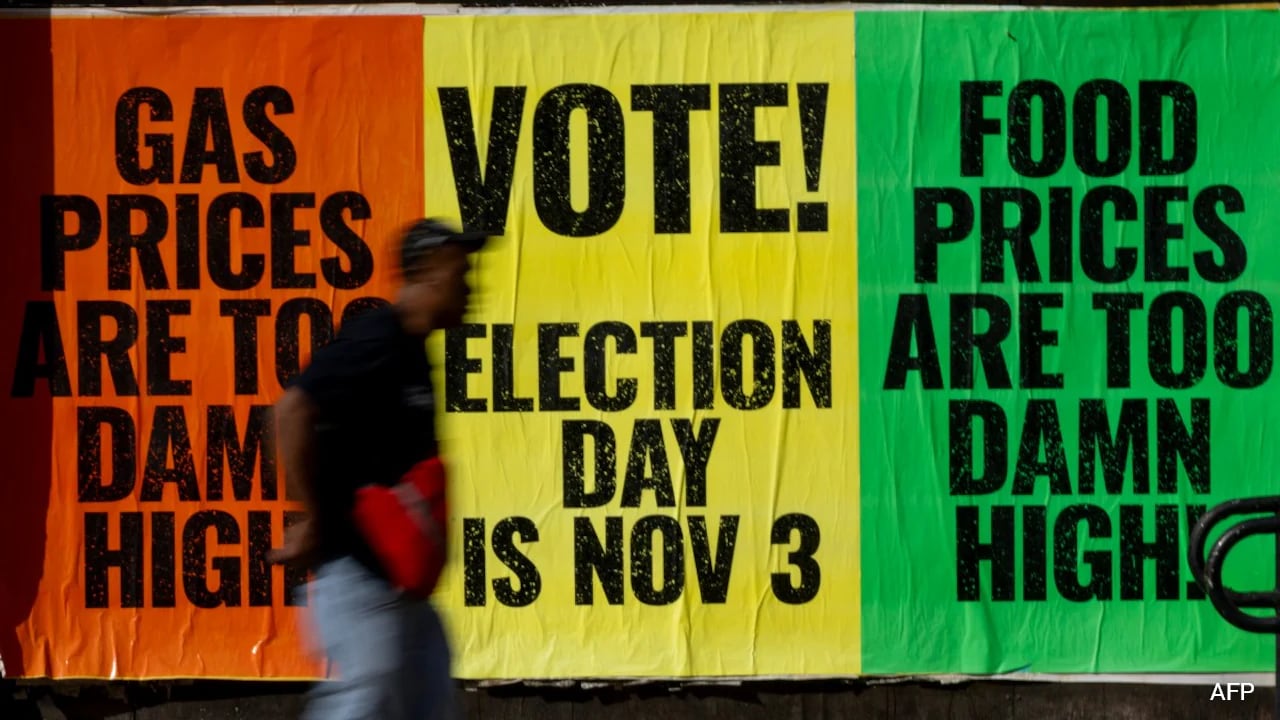
Populist movements survive on a strict transactional exchange between a leader and a disaffected electorate, yet Donald Trump’s recent messaging reveals a structural breakdown in that alignment. When an operator known for acute political instincts prioritizes personal grievances over the material anxieties of marginal voters, the result is not merely a communications misstep—it is a misallocation of political capital that alienates the exact swing demographics required to hold a governing coalition together.
Standard political commentary frames this behavior as an inexplicable lapse in judgment, calling it "tone-deaf" for a figure who built a brand on reading crowd sentiment. That diagnosis misses the underlying mechanics. Political messaging operates like an attention economy with a fixed budget. Every public appearance, rally digression, and social media broadcast consumes finite bandwidth. When that bandwidth shifts from external economic friction to internal personal vindication, the opportunity cost compounds rapidly among low-propensity and median voters.
The Mechanics of Populist Alignment
To understand why a shift toward self-referential messaging degrades political performance, one must separate the core mechanics of populism from personality-driven politics. Classical populism relies on an asymmetric framing: a unified, virtuous public pitted against an entrenched, self-serving institutional elite. In this model, the leader acts as a proxy. The leader’s personal battles only retain political utility if the electorate perceives those battles as direct extensions of their own struggles.
This proxy mechanism operates through three specific conditions:
- Shared Adversary Identification: The target of the leader’s rhetoric must be an institution or policy apparatus that the voter already blames for tangible stagnation, such as inflation, regulatory overreach, or trade displacement.
- Proportionality of Grievance: The time spent discussing an issue must roughly correlate with its impact on the average household balance sheet.
- Future-Oriented Resolution: The rhetoric must connect past failures to a concrete corrective mechanism rather than remaining trapped in retrospective score-settling.
When Trump focuses on personal legal battles, past election mechanics, or interpersonal slights from former staffers, the proxy relationship fractures. To a core base of committed partisans, these topics reinforce a narrative of institutional persecution. To the broader electorate—specifically suburban moderates, independent ticket-splitters, and economically stressed working-class voters—the messaging signals an inversion of priorities. The leader ceases to be an instrument of the voter’s will and instead demands that the voter become an instrument of the leader’s vindication.
The Cost Function of Self-Referential Messaging
In campaign operations and political communications, every message carries both an acquisition value and a retention value. Hardline partisan rhetoric maximizes retention among the base, ensuring high enthusiasm and reliable turnout among the most committed 30 to 35 percent of the electorate. However, national and statewide majorities require expanding beyond that floor.
Self-referential grievance exhibits a sharply negative elasticity among undecided voters. The cost function manifests across three distinct operational failures:
- Issue Displacement: Media ecosystems operate on conflict and novelty. When a candidate introduces an erratic, personal tangent during an event ostensibly scheduled to address inflation, energy costs, or border enforcement, press coverage naturally gravitates toward the deviation. The disciplined economic contrast disappears from the evening news cycle, replaced by coverage of internal party friction or personal complaints.
- Cognitive Fatigue Among Low-Information Voters: The median voter does not track daily political minutiae. They consume political information in brief, fragmented bursts during the final months of a cycle. If those isolated impressions consist of retrospective complaints about events from four or eight years prior, the candidate appears anchored to the past rather than equipped to manage future volatility.
- Demobilization of Reluctant Allies: Coalitions include pragmatic voters who dislike a candidate’s personal style but tolerate it in exchange for specific policy outcomes, such as deregulation, judicial appointments, or tax policy. Prolonged, undisciplined focus on personal grievances raises the psychological cost of supporting that candidate, increasing the likelihood that these pragmatic allies abstain rather than cast a reluctant vote.
Why Shrewd Operators Lose Message Discipline
Observers often express surprise when a leader with a documented history of dominating media cycles suddenly loses control of their narrative framing. In organizational behavior and political strategy, this phenomenon is neither rare nor mysterious. It stems from structural shifts inside a leader’s immediate decision-making environment.
The first driver is information echo insulation. As political movements mature, senior advisors who push back against unproductive impulses are frequently replaced by loyalists whose primary incentive is maintaining proximity to the principal. When the internal feedback loop rewards validation over friction, no mechanism exists to halt a losing rhetorical strategy before it reaches a public microphone.
The second driver is the rally feedback distortion. Large-scale political rallies act as skewed focus groups. The attendees self-select for maximum ideological intensity. When a speaker tests a personal grievance before an audience of ten thousand ardent supporters, the immediate acoustic feedback—cheers, applause, and visible enthusiasm—creates a false positive. The speaker interprets high-intensity approval from a non-representative sample as broad market validation. What works inside an arena often fails in a swing-district living room, yet the immediate emotional reward of the crowd overrides abstract polling data.
The third driver is cognitive load and threat response. High-stakes legal jeopardy and continuous institutional opposition trigger defensive psychological postures. Under sustained pressure, human decision-making narrows, prioritizing immediate self-defense and status preservation over long-term strategic positioning. For a political principal facing personal existential threats, treating a policy speech as a secondary concern is a rational individual response, even though it functions as a destructive collective strategy for the broader movement.
Historical Precedents of Coalition Fracture
This divergence between principal self-interest and coalition maintenance has predictable outcomes across modern political history. Whenever a dominant political figure subordinates the material platform to personal preoccupations, the surrounding coalition absorbs the structural damage.
During the final phase of the Nixon administration, the White House communications apparatus became entirely consumed by Watergate defense strategies. Even as the administration attempted to pivot back to foreign policy achievements and domestic economic management, the principal’s fixation on enemies lists and media grievances hollowed out the silent majority coalition that had delivered a landslide victory in 1972. Congressional allies found themselves forced to defend personal conduct rather than legislative outcomes, accelerating legislative paralysis.
A similar dynamic occurs in corporate governance when a founder-CEO refuses to transition from disruptive startup tactics to institutional stewardship. The exact traits that allowed the founder to break into the market—obsessive focus on slights, refusal to delegate, and unilateral messaging—become liabilities once the enterprise requires broad stakeholder trust. Shareholders tolerate erratic behavior during periods of hyper-growth, just as voters tolerate rhetorical excess during periods of economic disruption, provided the core value proposition remains intact. Once the focus shifts from external market execution to internal ego defense, institutional confidence erodes.
The Structural Limitations of Message Correction
Political consultants routinely prescribe simple remedies for candidate drift: stick to the teleprompter, stay on economic talking points, and avoid unscripted Q&A sessions. In practice, these tactical interventions rarely hold when the underlying incentives remain unchanged.
Enforcing discipline from the outside fails because modern political communication is decentralized. Even if a candidate delivers a disciplined twenty-minute speech on manufacturing or healthcare, a single unscripted remark at the podium or a late-night social media post immediately resets the public narrative. Furthermore, audiences possess acute sensitivity to inauthenticity. When an improvisational populist reads a sanitized, consultant-written script, the delivery often lacks the cadence and conviction that attracted supporters in the first place. Stripping away the unscripted edge removes the primary differentiator, leaving a generic political product that excites neither the base nor the center.
The limitation of modern campaign strategy is that no tactical packaging can permanently disguise a strategic misalignment between what the candidate wants to talk about and what the electorate needs solved.
The Necessary Strategic Recalibration
To arrest coalition erosion and restore populist leverage, campaign leadership must stop treating message discipline as a stylistic constraint and instead restructure the rhetorical framework around voter utility.
First, every personal grievance must be systematically translated into an institutional critique that directly implicates the voter’s material well-being. If the legal system, media apparatus, or administrative state is criticized, the argument cannot terminate at how unfairly the principal has been treated; it must immediately pivot to how those same mechanisms are deployed against ordinary citizens, small businesses, and local communities. The principal must function strictly as a case study of a broader systemic failure, never as the sole victim.
Second, campaign scheduling must reduce reliance on high-intensity partisan rallies in favor of controlled, issue-specific environments—such as factory floors, energy facilities, and roundtable discussions with affected workers. Changing the physical environment alters the immediate acoustic feedback loop, forcing the speaker to calibrate arguments for skeptical or pragmatic listeners rather than preaching to a self-selected choir.
Third, messaging architecture must enforce a strict ratio of retrospective complaint to prospective action. For every unit of time spent diagnosing past institutional failures, three units must be dedicated to specific, verifiable mechanisms for future economic relief. Without this structural rebalancing, the campaign will remain trapped defending the personal grievances of one individual while surrendering the governing majority to an opposition that only needs to appear marginally more focused on the public’s actual problems.