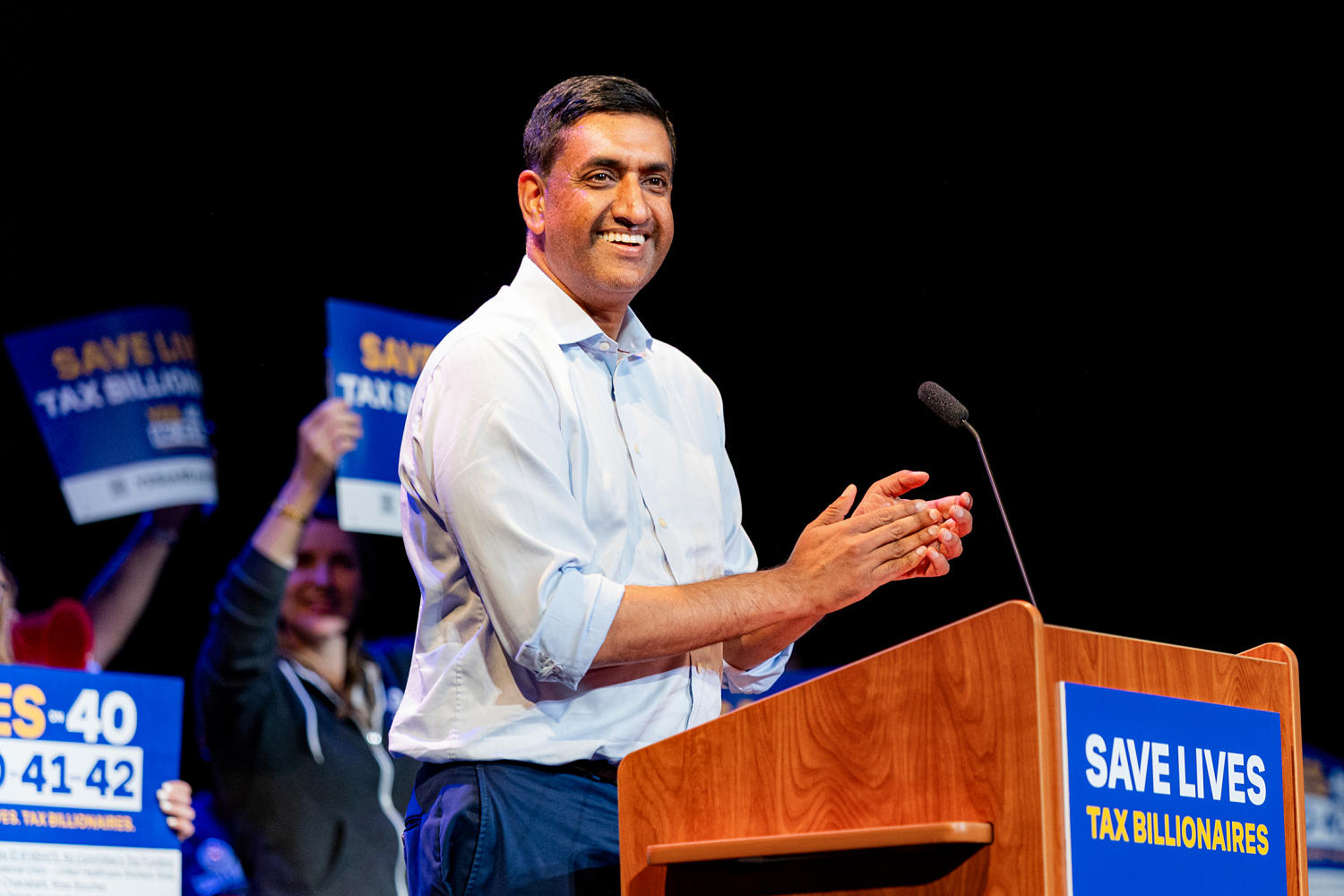
The emergence of a draft movement for Representative Ro Khanna ahead of the 2028 presidential election is not an organic grassroots uprising, nor is it an immediate declaration of candidacy. It is an asymmetric option-value play designed to capture ideological market share within the Democratic Party while shifting the capital-raising costs onto third-party political action committees. By operating through an independent draft committee rather than an exploratory committee, Khanna’s allies bypass standard Federal Election Commission (FEC) soft-wall constraints, test cross-coalitional messaging in early primary states, and build a proprietary donor database without triggering formal candidate-status liabilities.
To understand the viability of this maneuver, political strategists must strip away standard campaign rhetoric and evaluate the operation through three structural lenses: regulatory arbitrage, coalition geometry, and the capital-efficiency curve of modern presidential primaries. Meanwhile, you can find similar events here: The Paper Graveyard in the Weeds and the Lives Left Unanswered.
Regulatory Arbitrage and the Draft Committee Model
In federal campaign finance law, the distinction between an exploratory committee and an independent draft organization is operationalized through the concept of "testing the waters." Under FEC regulations (11 CFR 100.72 and 100.131), an individual who establishes an exploratory committee is strictly bound by contribution limits and disclosure requirements, and any funds raised or spent immediately count toward the threshold that triggers formal candidacy. Once that threshold is crossed, the individual must file a Statement of Candidacy (FEC Form 2) within 15 days, subjecting their congressional campaign funds, travel schedules, and media appearances to presidential-level scrutiny.
A draft committee operates outside this direct attribution loop, provided there is zero coordination between the committee and the prospective candidate. This creates a structural buffer with four distinct operational advantages: To understand the full picture, we recommend the excellent analysis by Associated Press.
- Uncapped Capital Aggregation: Unlike a candidate-authorized committee, which is restricted to hard-dollar individual contributions (indexed for inflation per election cycle), an independent expenditure-only committee—commonly structured as a Super PAC—can accept unlimited contributions from individuals, corporations, and labor unions. Draft organizers use this mechanism to secure seed capital from high-net-worth Silicon Valley donors and progressive bundlers before a single primary debate is scheduled.
- Asymmetric Liability: If the draft effort fails to gain traction in early polling or struggles to secure institutional endorsements in states like South Carolina, New Hampshire, or Michigan, the prospective candidate absorbs zero direct reputational damage. Khanna can disavow the effort as unauthorized enthusiasm while retaining his safe House seat in California’s 17th Congressional District.
- List Acquisition and Arbitrage: The primary deliverable of any early-stage draft PAC is not delegate acquisition; it is data generation. By running targeted digital acquisition campaigns around hot-button economic and foreign policy issues, the draft committee builds a high-propensity donor file. Under FEC rules, a candidate cannot simply receive this list for free once they declare, as that constitutes an illegal in-kind contribution. However, the candidate’s eventual campaign can rent or purchase the list at fair market value, effectively outsourcing the high-risk customer acquisition cost (CAC) to the draft entity.
- Media Narrative Injection: Mainstream political journalism treats the formation of a draft committee as a concrete news peg, allowing surrogates to book national television segments and place op-eds that frame the prospective candidate as a serious national contender. This elevates name recognition from a regional baseline to a national tier at a fraction of the cost of paid broadcast media.
The primary limitation of this regulatory structure is the strict prohibition on coordination. If draft operatives communicate strategy, polling data, or scheduling preferences with Khanna or his congressional staff, the FEC can reclassify the PAC’s expenditures as coordinated in-kind contributions, triggering severe financial penalties and legal exposure. Therefore, the draft campaign must rely on public signals—reading Khanna’s floor speeches, Substack essays, and cable news appearances as proxies for direct instruction.
Coalition Geometry and the Post-2024 Democratic Fracture
Every presidential primary is an exercise in coalition assembly across distinct, often competing ideological and demographic blocs. Following the 2024 electoral cycle, the Democratic Party faces an acute structural deficit: the erosion of working-class support across racial lines, paired with deep internal divisions over industrial policy, technological regulation, and foreign intervention.
Khanna’s positioning attempts to solve this multi-variable equation by bridging two factions that traditionally operate in mutual hostility: the populist progressive left and the techno-optimist capital class.
The Progressive Populist Anchor
Khanna’s legislative brand is heavily indexed to the Sanders wing of the party. He co-chaired Bernie Sanders’ 2020 presidential campaign and maintains consistent alignment with progressive priorities: Medicare for All, tuition-free public college, aggressive antitrust enforcement, and a non-interventionist foreign policy doctrine. In a crowded primary field, this baseline provides immediate credibility with the party's activist base, small-dollar online donors, and anti-war constituencies. These voters are high-turnout participants in early primary contests and caucuses, making them essential for surviving the initial winnowing phase of the calendar.
The Silicon Valley Capital Bridge
Simultaneously, Khanna represents the heart of Silicon Valley. Unlike traditional progressive populists who treat the technology sector as an adversarial monopoly to be dismantled, Khanna advocates for "progressive capitalism." He argues that domestic manufacturing revival, artificial intelligence development, and cryptocurrency innovation are essential engines for working-class wealth creation, provided they are paired with strong labor protections and geographic diversification away from coastal hubs.
This dual alignment creates a unique strategic profile, yet it introduces severe internal friction.
- The Donor-Base Tension: High-net-worth venture capitalists and tech executives who support Khanna’s opposition to heavy-handed AI regulation or punitive capital gains taxes frequently oppose his alignment with progressive labor unions and wealth-tax advocates.
- The Purity Test Vulnerability: Conversely, the progressive activist base enforces strict ideological orthodoxy. Any perceived accommodation to corporate tech interests or venture capital networks triggers immediate backlash from progressive media ecosystems and grassroots organizers, risking the erosion of his primary base before he can expand outward.
To survive this friction, the draft campaign must execute a messaging strategy rooted in economic nationalism. By framing technological investment and domestic industrial policy—such as the CHIPS and Science Act—as direct mechanisms to rebuild deindustrialized communities in the Rust Belt, Khanna’s allies attempt to unify tech capital and blue-collar labor against a common adversary: offshoring and corporate financialization.
The Capital-Efficiency Curve of Early Primary Operations
Running a viable national presidential campaign requires crossing a massive capital threshold long before the first votes are cast. In the modern media environment, candidates must fund two parallel operations: a high-burn digital acquisition engine to build a recurring small-dollar donor base, and a physical ground infrastructure in early-state jurisdictions.
Early draft campaigns operate at the steepest point of the capital-efficiency curve. Because the campaign lacks an official candidate, it struggles to convert casual political observers into recurring monthly donors—the financial lifeblood of modern Democratic campaigns pioneered by ActBlue. Small-dollar donors give emotionally to specific individuals, not abstract exploratory committees.
The Burn-Rate Trap
If a draft committee spends aggressively on digital advertising to acquire email addresses and phone numbers, it faces a high risk of negative return on ad spend (ROAS). Without the candidate actively headlining rallies, delivering viral debate moments, or sending personalized fundraising appeals, the conversion rate from lead to donor remains depressed.
To avoid burning through seed capital prematurely, an effective draft operation must follow a disciplined, phased allocation model:
- Phase One: Elite Network Consolidation. Capital is deployed toward high-touch, low-volume organizing—hosting private dinners, policy roundtables, and salons in major donor hubs (San Francisco, New York, Boston, Chicago) alongside key labor leaders and state party chairs. The objective is securing soft commitments from bundlers who can deliver maximum legal contributions the moment an official campaign launches.
- Phase Two: Earned Media Amplification. Rather than buying expensive digital ads, the draft PAC funds rapid-response communications teams and policy white papers designed to insert Khanna’s framework into national news cycles. Every time a major economic indicator drops or a foreign policy crisis emerges, the draft group pushes surrogates onto cable news and podcasts to position Khanna as the intellectual architect of the party’s alternative path.
- Phase Three: Targeted Early-State Infrastructure. Only after securing a baseline of elite commitments does the organization deploy capital into early primary states. This involves hiring seasoned state directors and field organizers in key battlegrounds—specifically targeting union halls, community colleges, and local media markets in states like Pennsylvania, Michigan, Wisconsin, and Nevada.
Historical Precedents and Failure Modes
Draft movements in American presidential politics have a high failure rate because they often confuse elite enthusiasm or niche activist fervor with broad electoral viability. Analyzing past cycles reveals the exact structural failure modes that Khanna’s allies must navigate.
The "Draft Warren" Benchmark (2014–2015)
The most successful modern Democratic draft effort was the "Ready for Warren" movement organized by MoveOn.org and Democracy for America ahead of the 2016 cycle. That campaign successfully raised millions of dollars, hired field staff in Iowa and New Hampshire, and demonstrated massive grassroots demand for an economic populist alternative to Hillary Clinton.
However, the movement revealed a critical vulnerability: a draft committee cannot force a candidate to run, nor can it control the strategic timing of the broader field. When Elizabeth Warren declined to enter the race, the organizational energy fractured, ultimately migrating to Bernie Sanders. For Khanna’s allies, the lesson is clear: infrastructure built by a draft PAC is liquid. If Khanna hesitates past the optimal filing window—typically Q1 or Q2 of the year preceding the election— rival candidates occupying adjacent ideological lanes will absorb the donors and staff the draft committee worked to organize.
The "Draft Beto" Illusion (2018–2019)
Following Beto O'Rourke’s narrow Senate loss in Texas in 2018, a massive wave of media-driven draft enthusiasm propelled him into the 2020 presidential primary. The draft phase generated immense national profile and immediate fundraising surges. Yet, once O'Rourke officially entered the race, the campaign collapsed within months.
The failure occurred because the draft movement was built on aesthetic appeal and media hype rather than a durable policy architecture or a distinct coalition lane. When forced to compete on a debate stage against candidates with deeper institutional roots and sharper ideological profiles, the candidate had no defensive moat. Khanna’s draft allies are attempting to avoid this trap by anchoring their effort in concrete policy frameworks—specifically economic patriotism and technological revitalization—rather than personality-driven branding.
The Competitive Field and Lane Congestion
A presidential primary is never run in a vacuum; it is a zero-sum battle for finite resources—donors, endorsers, media oxygen, and votes—against a specific slate of rivals. For a Ro Khanna candidacy to move from a draft concept to a viable delegate-winning operation, it must clear three distinct competitive hurdles within the Democratic field.
The Institutional Heavyweights
Governors and senior administration officials—figures with proven executive track records in swing states or large donor bases—hold a massive structural advantage in institutional endorsements and mainstream electability arguments. Voters traumatized by general election losses frequently prioritize perceived "safe" executive experience over legislative ideological innovation. Khanna, as a House member who has never won a statewide race, faces a steep credibility gap regarding executive management and general election viability in swing districts.
The Adjacent Progressive Contenders
Khanna does not hold a monopoly on the progressive lane. To consolidate the left, his allies must outmaneuver sitting senators, prominent progressive governors, and younger charismatic figures who possess higher national name recognition and deeper ties to legacy civil rights and labor organizations. In a multi-candidate field, if two or three candidates split the progressive vote, an establishment-aligned candidate can easily win pluralities in early states and lock down the delegate count before the convention.
The Media Attention Economy
Modern primaries are dictated by attention capture. Candidates who dominate social media algorithms, podcast ecosystems, and cable news chyrons command free media worth tens of millions of dollars. Khanna has invested heavily in this infrastructure over the past several years, maintaining one of the most aggressive media schedules in Congress, appearing frequently on conservative networks like Fox News alongside progressive outlets and long-form podcasts. The draft campaign must weaponize this existing media footprint, converting passive viewers into active political participants.
Strategic Execution for the Draft Operation
To transition from a speculative press release into a decisive force in the 2028 Democratic primary, the draft committee must abandon conventional political consulting playbooks and execute a disciplined, asymmetric growth strategy.
First, the organization must immediately establish a clear ideological wedge that separates Khanna from both traditional centrist Democrats and orthodox socialist progressives. The messaging must center on productive capacity: arguing that the Democratic Party has spent too much time focused on wealth redistribution and regulatory restriction, and not enough time on abundance, domestic manufacturing, and technological dominance. This gives elite tech donors a rational self-interest in funding the movement while giving working-class voters in deindustrialized counties a tangible economic promise.
Second, the draft PAC should bypass traditional broadcast television consultants entirely during the pre-announcement phase. Every dollar raised must be allocated toward two high-leverage assets: proprietary voter data acquisition in early-state working-class precincts, and long-form digital media distribution (podcasts, YouTube, regional talk radio) where voters spend hours engaging with ideas rather than consuming 30-second attack ads.
Finally, the draft leadership must enforce a strict timeline with hard go/no-go metrics. If the committee cannot secure measurable polling traction (reaching at least high single digits in early primary state surveys) and lock down commitments from at least three major national labor unions or influential state-level political machines within nine months of launch, the operation should wind down. Lingering in the race without clear coalition growth will deplete donor goodwill and permanently box Khanna into the role of a niche ideological commentator rather than a viable national executive.