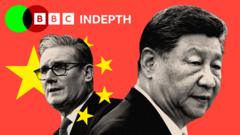
The resumption of high-level diplomatic contact between London and Beijing represents a calculated pivot from ideological insulation toward a model of managed economic interdependence. While surface-level analysis focuses on the optics of specific meetings, the underlying mechanics are driven by three distinct structural pressures: the UK’s post-Brexit search for non-EU growth vectors, China’s need to neutralize the "de-risking" narrative within the G7, and the inescapable gravitational pull of global supply chains in green technology and digital infrastructure.
The Geopolitical Cost Function of Decoupling
The previous British stance of "principled distance" faced a diminishing rate of return. For a mid-sized power with a service-heavy economy, the cost of total systemic divergence from the world’s second-largest economy began to outweigh the security premiums such a policy provided. China views the UK not as a monolith, but as a specific node within the Western alliance that is uniquely vulnerable—and therefore uniquely receptive—to bilateral economic stabilization.
To understand the Chinese strategic calculus, one must map the Triple-Filter Model they apply to UK relations:
- The Security Filter: Does the UK’s participation in AUKUS or its alignment with US export controls on semiconductors represent an existential threat to Chinese "Dual-Use" capabilities?
- The Capital Filter: Can the City of London remain a primary offshore hub for RMB internationalization and a source of liquidity for Chinese state-linked enterprises?
- The Diplomatic Filter: Can the UK be leveraged as a "rational" voice within the G7 to dilute the more hawkish consensus emerging from Washington?
Beijing perceives the UK’s recent outreach as a tacit admission that the "Integrated Review" goals—specifically the Tilt to the Indo-Pacific—cannot be sustained without a functional relationship with the region’s primary hegemon.
The Bifurcated Trade Architecture
Trade between the two nations is currently trapped in a structural paradox. While political rhetoric often targets "dependency," the actual data suggests a deep-rooted integration that is difficult to untangle without significant inflationary shocks. The UK’s imports from China are heavily concentrated in telecommunications equipment, data processing machines, and increasingly, the components required for the UK’s Net Zero transition.
The power dynamic is asymmetrical. The UK exports services—financial, educational, and legal—which are high-value but easily substituted or restricted by Chinese regulatory shifts. Conversely, China exports the physical hardware and rare-earth processed materials that form the backbone of the UK’s future energy grid.
The Dependency Ratio in Strategic Sectors
- Critical Minerals: China controls over 80% of the global processing capacity for lithium, cobalt, and graphite. Any UK strategy to localize battery production (e.g., via "gigafactories") remains physically dependent on Chinese upstream monopolies.
- Academic Capital: The UK higher education sector relies on Chinese international students for roughly 25% of its total tuition revenue in certain Russell Group institutions. This creates a "revenue-hostage" scenario where institutional financial health is tied to diplomatic stability.
- FinTech and Green Finance: London remains a global leader in ESG (Environmental, Social, and Governance) standards. Beijing requires this expertise to "green-wash" its Belt and Road Initiative projects and attract Western institutional capital into its domestic bond markets.
The Multi-Vector Influence Strategy
China’s approach to the UK visit is built on the "Great Wall of Bureaucracy." By engaging in high-level ministerial talks, they force the UK government to coordinate across various departments—the Foreign, Commonwealth & Development Office (FCDO), the Department for Business and Trade (DBT), and the Treasury. Each of these entities has conflicting KPIs (Key Performance Indicators).
The Treasury prioritizes FDI (Foreign Direct Investment) and market access for British banks. The FCDO prioritizes human rights and regional security. The DBT prioritizes export volumes. Beijing exploits these internal frictions. By dangling the carrot of "market access" in front of the Treasury, they effectively create internal lobbyists within the British Cabinet who will argue for a softened stance on security or human rights to protect economic interests.
This is not a "reset" in the traditional sense; it is a Re-synchronization. Beijing understands that the UK cannot fully break from the US security umbrella. Therefore, the goal is not to flip the UK into a pro-China camp, but to foster a "strategic autonomy" where London hesitates to join US-led sanctions or technology bans.
The Technological Fault Lines: From 5G to AI
The most significant friction point remains the "Frontier Technology" sector. The removal of Huawei from the UK’s 5G core was a watershed moment that China views as a reversible error or at least a mistake not to be repeated in the realm of Artificial Intelligence.
China’s AI strategy involves setting global standards. By engaging with the UK—a country with a highly respected regulatory and scientific ecosystem—China seeks to co-author the rules of the road for AI governance. If they can align British and Chinese standards on AI ethics or safety, they create a regulatory bloc that challenges the more restrictive American approach.
The Cost of Regulatory Divergence
If the UK aligns too closely with US export controls (such as the CHIPS Act restrictions), it risks being shut out of the Chinese hardware market. However, if it diverges from the US, it risks losing access to high-end American intellectual property and security cooperation. This "Middle Power Trap" defines the current diplomatic mission. The UK is attempting to navigate this by defining a very narrow "Security Box"—a small list of technologies that are off-limits—while keeping the rest of the economic relationship "Business as Usual."
The Strategic Playbook for the Next 24 Months
The success of this diplomatic re-engagement will not be measured by joint communiqués or "deals" signed in the Great Hall of the People. It will be measured by the UK’s ability to execute a Diversified Dependency Strategy.
- Upstream Resource Security: The UK must finalize trade agreements with "Tier 2" mineral providers (Australia, Canada, Chile) to reduce the leverage China holds over the UK’s green transition. Without this, diplomatic engagement is merely a negotiation of terms for surrender.
- Service Sector Reciprocity: London must demand tangible, legal certainties for British firms operating in China, particularly in the insurance and data sectors, rather than accepting vague promises of "opening up."
- Intelligence-Led Investment Screening: The National Security and Investment (NSI) Act must be applied with surgical precision. The goal is to allow Chinese capital into non-sensitive infrastructure while maintaining a total block on sectors involving quantum computing, synthetic biology, and advanced semiconductors.
The UK's visit is a recognition that the "Cold War" analogy is flawed. Unlike the Soviet Union, China is the primary trading partner of most US allies. The "something bigger" that China sees in this visit is the fragmentation of the Western economic consensus. For Beijing, every handshake in London is a crack in the wall of containment. For London, it is an attempt to manage an inevitable decline in relative power by securing the best possible terms in a Sinocentric century.
The strategic imperative for the UK is to maintain a "Cold Peace." This involves maximum economic cooperation in low-risk sectors while simultaneously building a "Fortress UK" in critical technology and data. The risk is that the "Security Box" is perpetually shrinking as more technologies become dual-use, eventually leaving the UK with no choice but to pick a side—a scenario the current diplomatic flurry is desperately trying to delay.