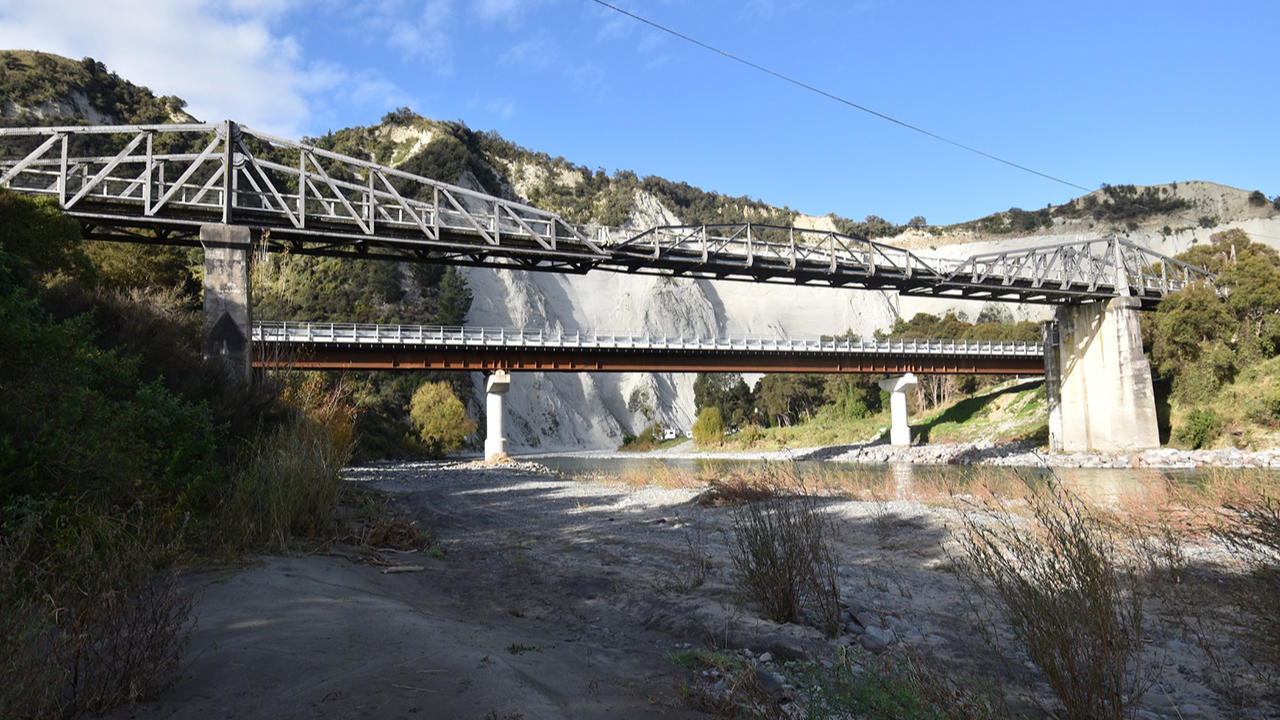
Infrastructure depreciation is rarely a linear function of time; rather, it is governed by a discontinuous step-change in load requirements, regulatory safety thresholds, and maintenance cost inflation. When physical assets reach their terminal utility capacity, asset owners face a binary economic optimization choice: replacement or functional repurposing. The preservation of the 1904 Mangaweka Cantilever Bridge across New Zealand’s Rangitīkei River offers a clean operational case study in asset reallocation, revealing how structural redundancy and localized community value can alter standard capital depreciation curves.
Deconstructing the mechanics of this asset lifecycle requires examining the primary variables that dictate whether a piece of civil infrastructure is demolished or retained when a modern successor is commissioned.
The Engineering Constraints of Flood-Prone Geographies
Civil engineering in dynamic river environments is fundamentally an exercise in hydrodynamic risk mitigation. Braided or steep-gradient rivers present high flood velocities and shifting scour profiles that make midstream pier placement structurally hazardous.
In the case of the Mangaweka crossing, the engineering strategy relied on a steel cantilever configuration. By anchoring the structure on solid abutments and utilizing cantilever arms, designers eliminated the need for vulnerable midstream piers. This design decision introduced two distinct operational characteristics:
- Bending Moment Distribution: Cantilever bridges handle structural loads by transferring weight back to primary support towers and anchors, which places severe stress on the tension members and holding-down bolts.
- Hydraulic Clearance: Removing piers from the primary active channel prevents debris accumulation and log-jams during flood events, drastically lowering hydrodynamic lateral load spikes.
The limitation of this architecture is its finite dead-load to live-load ratio. Built at the dawn of the 20th century to carry localized agricultural traffic, horses, and early motor vehicles, the structure's load-bearing capacity was inherently bound by the metallurgical limits of early structural steel and timber decking systems. As gross vehicle mass (GVM) limits for commercial transport climbed through the mid-to-late 20th century, the bridge operated under an increasingly restricted structural envelope.
The Capital Expenditure Threshold and Functional Bifurcation
The standard lifecycle cost analysis for aging infrastructure dictates a replacement threshold: when the net present value (NPV) of ongoing maintenance, load-rating restrictions, and repair interventions exceeds the capital expenditure (CapEx) required to build a modern, high-capacity parallel asset, the legacy asset is decommissioned and dismantled to eliminate residual liability.
The economic failure of standard demolition logic in this instance stems from three variables:
- Sunk Liability Mitigation: Demolishing a 141-meter steel truss bridge across a deep river gorge carries significant deconstruction and environmental remediation costs. Leaving the asset in place often minimizes immediate capital outflow compared to active removal.
- Demand Segmentation: Rather than forcing a single asset to serve mutually exclusive user classes (heavy freight versus non-motorized recreation), the commissioning of a modern upstream or adjacent heavy-duty crossing allows for the functional bifurcation of traffic.
- Asset Class Reclassification: Transitioning a heavy infrastructure asset from a state highway or district vehicular link to a slow-travel pedestrian and cyclist corridor resets its maintenance profile. Live loads drop from tens of tonnes of commercial freight to negligible human foot traffic, near-zeroing structural fatigue rates.
[Legacy Asset Under High Load]
       │
       ▼ (Capacity Exceeded)
[CapEx Decision: Demolish vs. Retain]
       ├──> Demolition Path: High immediate extraction cost + liability clearance
       └──> Dual-Asset Path: Modern heavy bypass + low-load pedestrian conversion
The Quantifiable Drivers of Heritage Valuation
Heritage designation is frequently misconstrued as a purely sentimental exercise. In economic and municipal planning terms, designation functions as a regulatory barrier against premature asset liquidation, protecting non-monetary externalities such as regional identity, historical engineering continuity, and tourism pull.
The Mangaweka structure represents New Zealand's sole surviving steel cantilever road bridge. This creates absolute supply scarcity. In asset valuation frameworks, extreme scarcity converts a functional depreciation liability into an inelastic cultural asset.
When regional authorities evaluated the corridor, the preservation calculus factored in the preservation of technological lineage. The bridge serves as a physical archive of early 20th-century public works methodology—utilizing early concrete pier foundations paired with fabricated steel trusses.
Strategic Playbook for Legacy Infrastructure Retention
For municipal asset managers and regional authorities overseeing aging civil inventories, the Mangaweka paradigm establishes a repeatable protocol for evaluating end-of-life structures:
- Perform Dual-Path Net Present Value Modeling: Calculate the comparative cost of complete site clearance versus structural containment and load-class downgrading. Include environmental remediation and disposal fees in the demolition column.
- Audit Structural Redundancy: Identify whether the structural system possesses latent safety factors that make low-load (pedestrian, cyclist, utility-line carrier) repurposing viable without requiring expensive seismic or metallurgical retrofits.
- Isolate Freight Vectors: Separate heavy industrial transport vectors onto modern alignments designed for current axle-load standards, insulating fragile heritage assets from dynamic fatigue damage.
- Institutionalize Cross-Jurisdictional Maintenance Accords: Legacy boundary bridges often suffer from administrative neglect due to shared or disputed territorial responsibilities. Establish clear maintenance SLAs between neighboring districts prior to structural handover to prevent deferred maintenance decay.