The operational validation of fully reusable, super-heavy launch vehicles hinges on solving a multi-variable control problem under extreme thermal and kinetic constraints. When media outlets report that a test vehicle "sticks the landing," they obscure the actual engineering mechanisms that dictate success or failure in aerospace design. Evaluating a flight test requires stripping away superficial milestones and measuring performance against the underlying cost function of mass fraction, impulse dynamics, and thermal protection system resilience.
SpaceX operates under an iterative hardware-rich testing philosophy that treats structural destruction not as a catastrophic failure, but as a high-value empirical data acquisition phase. To understand the trajectory of the Starship program, one must analyze the physical barriers that separate suborbital hops from operational orbital recovery.
The Aerodynamic and Thermal Boundary Layer
Reentry physics imposes severe limitations on vehicle geometry and materials. At velocities exceeding Mach 25, kinetic energy conversion creates a plasma sheath around the spacecraft, pushing stagnation temperatures past 1,500 degrees Celsius. The primary engineering challenge involves managing heat flux across dynamic control surfaces without incurring a prohibitive dead-weight penalty from thermal protection systems.
Traditional aerospace manufacturing relies on rigid, mechanically fastened ceramic tiles that require extensive manual refurbishment between flights. Starship utilizes an active transpiration cooling concept coupled with hexagonal silica-based tiles pinned to a stainless steel skin. Stainless steel offers a distinct metallurgical advantage over aluminum-lithium alloys: higher creep resistance at elevated temperatures and a predictable yield strength degradation curve.
During atmospheric entry, the vehicle executes a high-angle-of-attack belly flop. This orientation maximizes cross-sectional atmospheric drag, bleeding off orbital velocity efficiently while distributing thermal loads across the windward side. The structural failure modes observed in early iterations typically stem from localized boundary-layer transitions. When turbulent flow bypasses aerodynamic seals around movable flaps, hot gas impingement compromises secondary structural members. Solving this requires continuous refinement of tile bonding patterns and real-time angle-of-attack adjustments via onboard guidance computers.
The Dynamics of Propulsive Deceleration and Catch Architecture
Recovering a first-stage booster or an upper-stage ship requires executing a terminal velocity nullification maneuver in a localized gravitational field. This process, known as a landing burn, demands extreme thrust-to-weight ratios and sub-second gimbal response times from full-flow staged combustion engines.
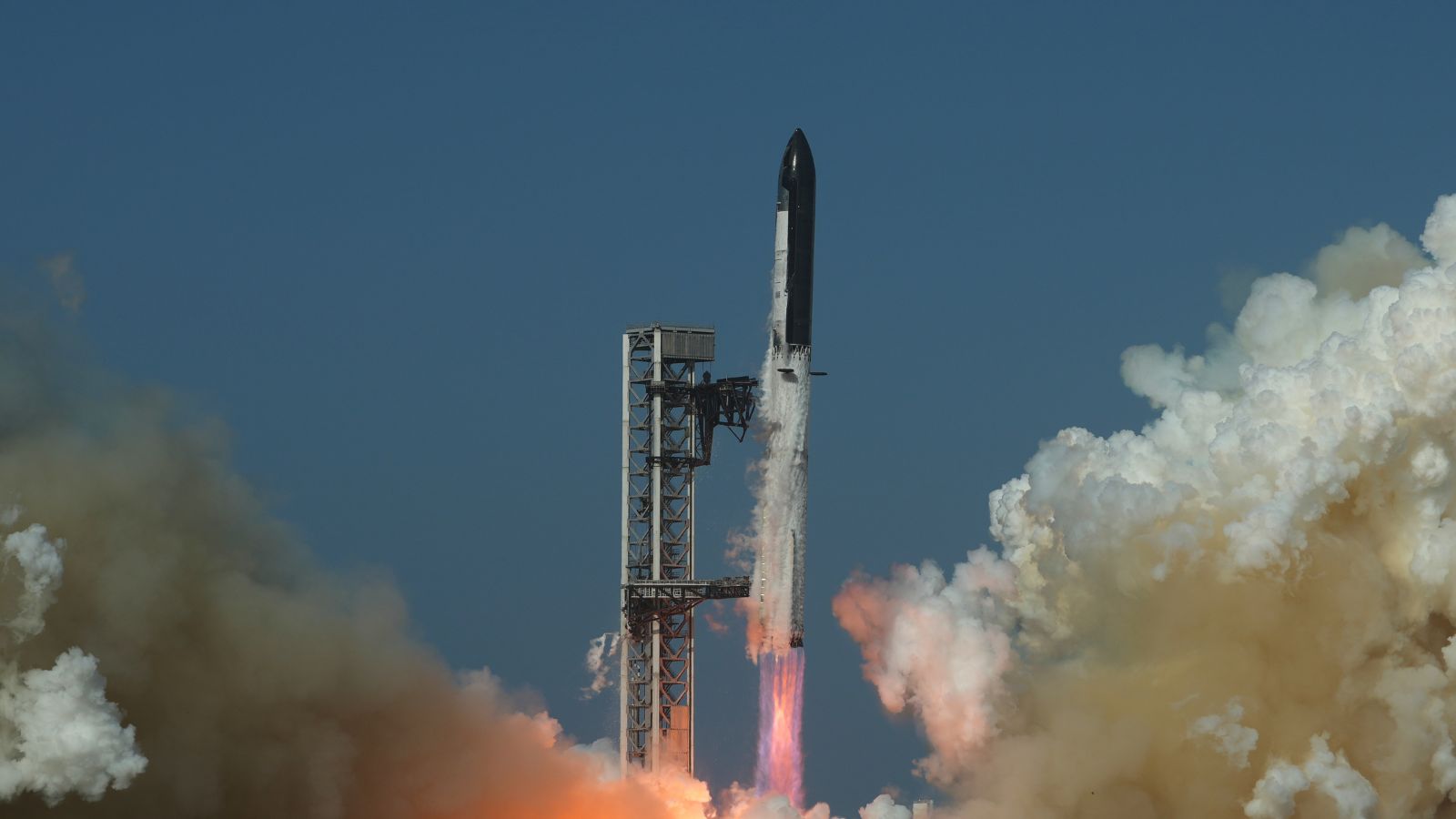
The transition from a water splashdown to mechanical tower capture—colloquially termed the chopstick catch—shifts the margin of error from kilometers to millimeters. A splashdown forgives spatial drift because the ocean surface acts as an unbounded energy sink. Conversely, tower capture requires the booster to match lateral wind vectors and vertical velocity vectors precisely as it enters the capture zone of the launch mount.
[Orbital Insertion]
       │
       ▼
[High-Alpha Reentry] ──> (Thermal Flux Management)
       │
       ▼
[Flip Maneuver] ───────> (Dynamic Inertia Vectoring)
       │
       ▼
[Terminal Burn] ───────> (Thrust Vector Control & Gimbaling)
       │
       ▼
[Tower Capture] ───────> (Millimeter-Level Spatial Convergence)
The physical variables governing this phase include:
- Propellant Slosh Dynamics: Unsettled liquid propellant in low-g environments creates center-of-mass instability during the flip maneuver.
- Engine Restart Reliability: Raptor engines must ignite reliably under transient pressure conditions after a cold-space coast phase.
- Guidance Latency: Sensor fusion algorithms must reconcile inertial measurement unit drift with optical tracking data faster than the control loop frequency.
When a booster experiences a hard splashdown due to an under-performing relight sequence, the root cause is rarely a single component failure. It is typically a systemic vulnerability in the fluid feed lines or filter blockages caused by cryogenic thermal contraction.
The Economics of Mass Fraction and Payload Optimization
The ultimate viability of any launch architecture is dictated by the Tsiolkovsky rocket equation, where payload mass fraction is exponentially sensitive to structural efficiency and specific impulse ($I_{sp}$).
$$\Delta v = I_{sp} g_0 \ln \frac{m_0}{m_f}$$
To achieve a fully reusable system capable of trans-lunar or interplanetary transit, the dry mass of the vehicle must remain exceptionally low relative to its propellant load. Every kilogram added for landing legs, hydraulic actuators, or redundant thermal protection strips away payload capacity to orbit.
SpaceX eliminates dedicated landing legs on the Super Heavy booster entirely, transferring the structural mass penalty from the flight vehicle to the ground infrastructure of the launch tower. By utilizing the booster's existing grid fins and lift points for structural interception, the dry mass fraction improves. This design choice trades ground-segment complexity for flight-vehicle performance, illustrating a fundamental shift in systems engineering economics.
Scaling this architecture to support high-cadence commercial operations requires addressing the propellant transfer bottleneck in low Earth orbit. Because a single Starship cannot reach the lunar surface and return without refueling, orbital cryo-transfer efficiency dictates the timeline of deep-space exploration. Boil-off rates of liquid methane and liquid oxygen during multi-day orbital loiters represent the next major physics barrier that engineering teams must quantify and solve.
Strategic Operational Outlook
The transition from developmental testing to operational maturity depends on eliminating failure modes in transient phases—specifically stage separation, in-space relights, and terminal velocity arrest. As flight rates increase, the empirical feedback loop compresses, allowing software-driven control systems to adapt to aerodynamic anomalies faster than traditional bureaucratic validation cycles permit.
The measure of progress is not the survival of a single hull, but the statistical convergence of flight telemetry toward nominal predictive models. Eliminating variance in Raptor engine ignition sequences and perfecting high-altitude flap sealing will dictate when routine multi-orbit missions transition from theoretical projections to standard operational cadence.