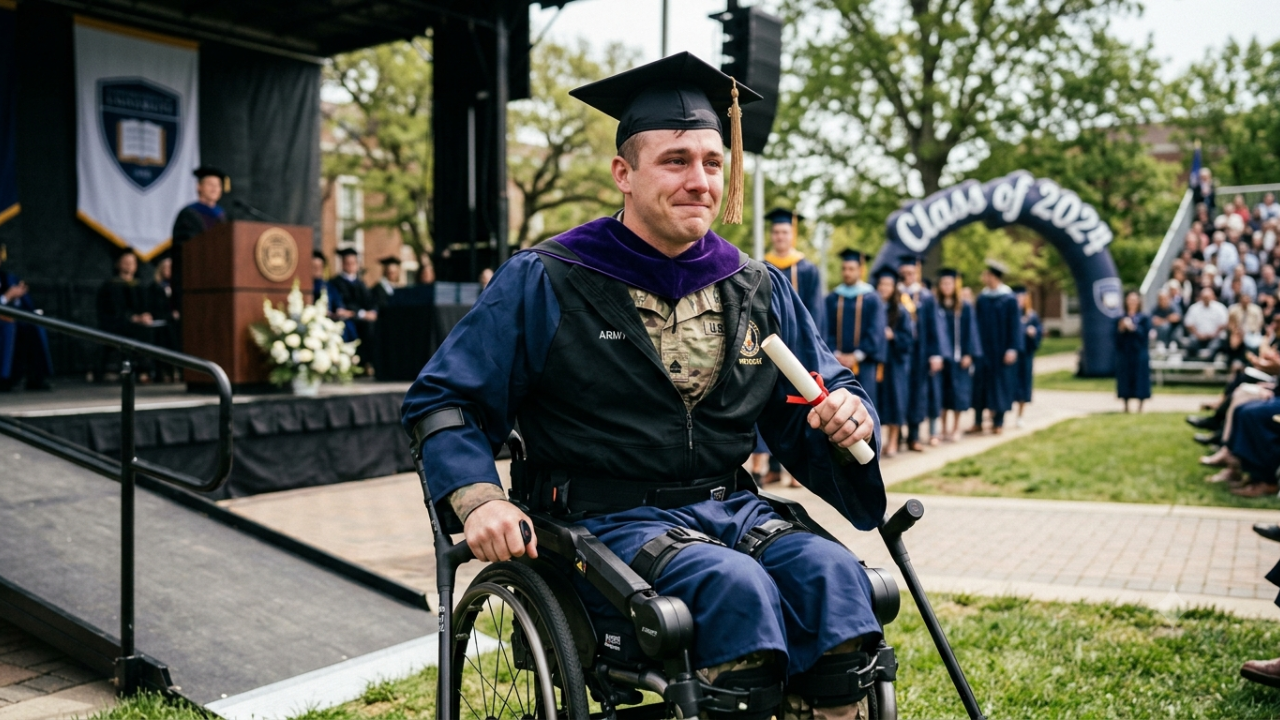
Severe traumatic injury introduces an immediate discontinuity in human performance, forcing an abrupt reallocation of biological, psychological, and institutional capital. When an individual sustains a paralyzing crash, the disruption is not merely personal; it triggers a multi-year optimization problem involving acute medical stabilization, neurological adaptation, resource reallocation, and eventual functional reintegration. Media narratives typically reduce this transition to a binary emotional arc—tragedy followed by inspirational triumph. This framing obscures the rigorous, systematic mechanics required to bridge a seven-year performance gap. True recovery from profound motor impairment functions as an engineering challenge governed by resource constraints, institutional friction, and the limits of neuroplasticity.
The Triad of Institutional Friction
Reintegration after a spinal cord injury requires navigating a fragmented network of medical, legal, and educational systems. Each node in this network imposes friction that demands explicit strategic management by the individual and their support infrastructure.
The acute medical phase prioritizes survivability and structural stabilization. This phase operates under strict clinical efficiency metrics, minimizing mortality and preventing secondary spinal cord damage. However, the transition from acute care to long-term rehabilitation exposes the first major structural failure in institutional support: the continuity gap. Once acute stabilization concludes, the responsibility for maintaining functional momentum shifts heavily to the patient.
Financial durability constitutes the second point of friction. Long-term care costs associated with paralysis scale exponentially with the degree of motor deficit. These costs encompass specialized durable medical equipment, home modification, continuous pharmaceutical management, and ongoing physical therapy. In the absence of robust insurance coverage or legal settlements, individuals must absorb these overheads while their immediate earning capacity sits at zero. This creates a severe liquidity crisis that routinely halts educational or career pursuits before they can be initiated.
Educational and institutional accessibility forms the third vector of friction. Higher education infrastructure is historically optimized for able-bodied throughput. Physical campus navigation, housing accommodations, and testing formats require constant negotiation with bureaucratic compliance offices. When a veteran or civilian attempts to return to an academic environment after a multi-year hiatus, they do not just face cognitive re-entry; they face an operational matrix that treats accessibility as an accommodation rather than a baseline design parameter.
Quantifying the Seven-Year Gap
A seven-year latency period between an acute crash and degree completion is not an arbitrary timeline. It reflects the mathematical realities of physiological adaptation and institutional pacing.
During the first 24 months, physiological equilibrium takes precedence. The body adapts to altered autonomic nervous system regulation, spasticity management, and secondary complications such as pressure injuries or urinary tract infections. Cognitive load during this period is consumed entirely by survival and baseline autonomy management. High-level executive functioning, required for complex academic or professional tasks, remains constrained by chronic pain and sleep architecture disruption.
Years three through five typically represent the stabilization and skill-acquisition phase. Occupational therapy during this window focuses on compensatory strategies, mastering adaptive technologies, and optimizing wheelchair kinematics for daily transit. If an individual intends to return to higher education, this is the period where foundational prerequisites must be re-established.
Years six and seven mark the execution phase. Academic reintegration rarely occurs at full capacity immediately. Course loads are throttled to match physical stamina and cognitive bandwidth constraints. The timeline stretches because throughput is bounded by physical fatigue limits that do not apply to non-disabled peers. Recognizing this constraint allows for a realistic appraisal of productivity rather than measuring progress against standard academic pacing models.
Neuroplasticity and Cognitive Re-tooling
The human brain maintains structural adaptability following spinal cord transection, but this adaptation is not an automatic recovery process. It requires deliberate cognitive and physical re-routing.
When motor pathways are severed, the sensory-motor cortex undergoes functional reorganization. Phantom limb sensations, neuropathic pain, and altered proprioceptive feedback demand continuous neural processing overhead. To succeed in an academically rigorous environment under these conditions, an individual must develop advanced cognitive compensation techniques. These include specialized assistive software for transcription, screen reading, and dictation, which replace manual note-taking and exam execution.
The cognitive load theory of disability dictates that every physical action requiring conscious mediation—such as maintaining posture or managing spasms—consumes working memory capacity that would otherwise be allocated to problem-solving and critical analysis. Successful re-entry into complex intellectual domains depends on offloading these physical maintenance tasks to automation, personal assistants, or optimized physical positioning. Until that offloading reaches steady state, academic performance remains vulnerable to cognitive fatigue.
The Economics of Post-Injury Re-entry
Re-entering the workforce or higher education system after catastrophic trauma alters an individual's lifetime economic profile. The traditional human capital model assumes a continuous upward trajectory of skill acquisition and earnings. Paralysis induces a sharp downward reset of net worth and earning potential, followed by a high-variance recovery curve.
Investing in a university degree under these conditions represents a high-risk capital allocation decision. The direct costs include tuition and specialized assistive technology. The indirect costs include foregone earnings and the permanent overhead of disability management. The expected return on this investment must justify the upfront expenditure of physical energy and financial capital.
For veterans, institutional programs such as veteran vocational rehabilitation offset direct educational costs, but they do not eliminate the opportunity cost or the physical toll of commuting, campus navigation, and sustained seated posture. The economic viability of the degree depends entirely on selecting a field where remote work capability, high intellectual leverage, and digital output minimize the impact of physical limitations.
Operational Execution for Long-Term Adaptation
Mitigating the long-term impact of catastrophic motor impairment requires a disciplined framework focused on bottleneck reduction and redundancy.
- Audit all daily physical and operational routines to identify energy sinks, replacing manual interventions with automated tools or delegated labor wherever possible.
- Establish formal redundancy protocols for academic and professional deliverables, ensuring that hardware failures, health flare-ups, or transportation breakdowns do not result in catastrophic project failure.
- Decouple academic pacing from institutional norms, structuring course loads around verified physical stamina thresholds rather than arbitrary semester benchmarks.
- Secure long-term financial predictability by ring-fencing medical contingency funds, separating operational living expenses from health-related capital requirements.
Resilience in the wake of severe trauma is not a psychological trait; it is a structural property of the systems an individual builds around themselves. By treating recovery as an optimization problem constrained by physical realities rather than an emotional journey defined by inspirational narratives, the path from catastrophic crash to institutional reintegration becomes a predictable, manageable sequence of engineering challenges.