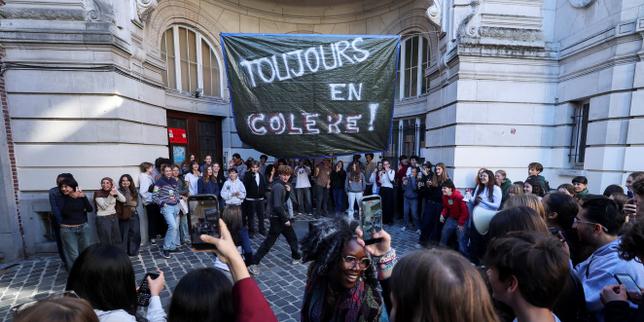
Every few years, the streets of Brussels, Liège, and Charleroi echo with the same familiar roar. High school students pour out of classrooms, flare smoke grenades, block tram lines, and chant slogans against educational reforms, grading systems, or budget cuts. The mainstream press breathlessly reports on the fourth wave of strikes, the minor clashes with local police, the shattered bus shelter glass, and the breathless interviews with teenage union reps speaking about social justice.
The coverage treats these protests as a vital pulse check on youth democracy. That framing is lazy, comfortable, and completely wrong.
These demonstrations are not a grand manifestation of youth political awakening. They are a carefully choreographed safety valve designed to let teenagers blow off steam while the actual mechanisms of systemic educational failure remain entirely untouched. The kids are marching for the wrong reasons, against the wrong people, using methods handed down to them by union bureaucrats who treat classrooms like chess pawns.
If you want to understand why French-speaking Belgium continues to struggle with educational mobility, dropout rates, and structural underfunding, you have to stop looking at the kids throwing smoke bombs and start looking at the adults handing them out.
The Manufactured Ritual of Belgian Student Unrest
Let us look past the romanticized images of teenagers scaling statues in Place de la Monnaie. The mechanics of a Belgian student mobilization follow a predictable script. A policy adjustment is announced regarding exam weighting, curriculum restructuring, or administrative consolidation within the Wallonia-Brussels Federation. Within forty-eight hours, youth wings of traditional trade unions and political factions mobilize networks through encrypted chat apps. Placards appear, printed on professional-grade cardstock that high schoolers certainly did not purchase with pocket money.
By day four, the movement reaches peak friction. A handful of skirmishes break out near metro stations. The interior minister issues a stern statement about public order. The education minister agrees to a round table discussion with student delegates that changes nothing of substance.
This is not rebellion. It is a ritualized pressure release.
The lazy consensus in mainstream reporting is that these kids are fighting the system. The reality is that the system welcomes them. A localized riot that disrupts public transit for three hours costs the political establishment nothing. It provides the illusion of a vibrant democratic debate while shielding the structural behemoth of Belgium's compartmentalized educational networks from genuine reform.
Who Actually Benefits When Classrooms Empty
To understand why these protests achieve zero structural victories, you have to look at the unique architecture of French-speaking Belgian education. Unlike centralized systems, the system is governed by a historical mosaic of subsidized free networks, official public networks, and a complex web of ideological pillars that have survived since the nineteenth century.
When students protest against a "fourth wave of administrative burden" or general austerity, their anger is diffused across a labyrinth of competing school boards, municipal authorities, and community councils. There is no single villain to target, no CEO's office to occupy, and no clear executive responsible for the macro-budget.
Adult union organizers know this. They funnel adolescent energy into safe, theatrical dead ends. Directing thousands of sixteen-year-olds to march against nebulous budget cuts keeps them from asking harder questions about why school funding disproportionately rewards legacy institutions over under-resourced technical and professional tracks.
The students think they are striking for equality. In practice, they are providing political cover for institutional inertia. The schools that fail disadvantaged youth the most do not change their pedagogical approaches because kids blocked a tramway in Namur. They simply wait out the afternoon, lock the gates, and resume business as usual the next morning.
The Missing Nuance in the Drop-Out Crisis
The media loves to frame these movements around passion and civic duty. They ignore the grim mathematics happening inside the classrooms the other 365 days a year.
French-speaking Belgium has one of the highest grade-retention rates in the developed world. Long before students reach the age of street protests, thousands are quietly funneled down a track of academic failure, labeled as remedial, and dropped out of the system with diminished prospects. That structural sorting machine does not bother union leaders. It does not generate dramatic television footage. It operates in silence, bureaucratically destroying social mobility while the adults argue over administrative minutiae.
When teens march against "violence" or "inequality" without understanding the underlying structural segregation of their own school network, they are acting as foot soldiers for a status quo that feeds on their ignorance. They are protesting the symptom while the disease remains protected by collective bargaining agreements.
What Real Disruption Looks Like
If the youth of French-speaking Belgium genuinely wanted to break the system that exploits them, they would abandon the street theater. They would demand total transparency on how educational subsidies are allocated between elite grammar schools and neglected vocational centers. They would audit the administrative bloat that consumes funding meant for classroom resources. They would strike not for four days of media attention, but until the archaic compartmentalization of their school networks is dismantled in favor of merit-based equity.
Until then, expect a fifth wave, a sixth wave, and a seventh wave. Expect the same broken glass, the same hand-wringing editorials, and the same absolute lack of change.
The revolution will not be televised because it is too busy being managed by the people you are paying to fight. Stop watching the marchers. Look at who is holding the megaphones from the sidelines.


