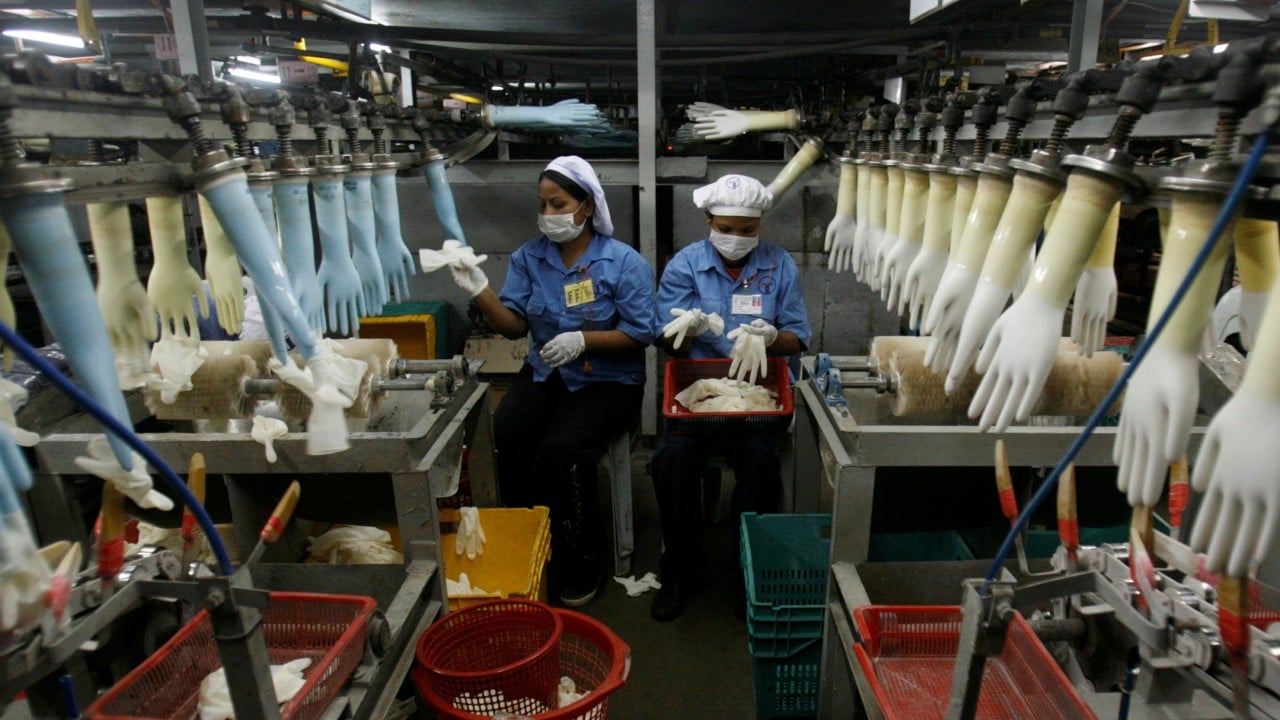
The current 40% price hike in medical-grade nitrile and latex gloves by Malaysian manufacturers is not an isolated pricing fluctuation but a structural failure of the "Just-in-Time" procurement model when applied to high-frequency medical consumables. When a handful of regional players control 65% to 70% of global output, a localized increase in labor costs or raw material shortages creates a bullwhip effect that multiplies across the international healthcare system. This analysis deconstructs the mechanics of the current shortage, the economic levers used by manufacturers, and the systemic vulnerabilities that leave hospital balance sheets exposed to aggressive price adjustments.
The Triad of Price Inflation
The 40% price increase is driven by three distinct but intersecting pressures: labor regulation, raw material volatility, and the "Lagging Demand Trap."
- Labor Arbitrage Reversal: Malaysian manufacturers are facing rigorous international scrutiny regarding labor practices. The transition to ethical recruitment and higher minimum wages represents a permanent shift in the cost floor. Unlike temporary energy spikes, these are structural expenses that cannot be optimized away through traditional manufacturing efficiencies.
- Nitrile Butadiene Rubber (NBR) Feedstock Costs: The synthesis of nitrile requires butadiene and acrylonitrile. As petroleum prices fluctuate, the input costs for synthetic polymers rise. Because manufacturers operate on thin margins, they pass these costs directly to the buyer through dynamic pricing contracts that favor the seller.
- The Lagging Demand Trap: During periods of perceived stability, hospitals reduce inventory to minimize holding costs. When a supply contraction hits, these institutions enter the spot market simultaneously, creating a demand spike that allows manufacturers to prioritize high-margin, short-term orders over long-term contractual obligations.
The Cost Function of Medical Consumables
To understand why a 40% increase in a single item disrupts hospital operations, one must look at the Total Cost of Protection (TCP). Gloves represent a low-cost, high-volume item that serves as a non-negotiable barrier to clinical activity.
The mathematical reality of the hospital supply chain is that gloves are a "Zero-Elasticity Consumable." A surgeon cannot perform an operation with 0.5 gloves, nor can they substitute them with a cheaper, non-sterile alternative without violating safety protocols. This creates a vertical demand curve where the buyer is forced to accept any price to maintain operational viability.
The cost function can be expressed as:
$$C_{total} = (Q_{v} \times P_{m}) + C_{l} + C_{h}$$
Where:
- $Q_{v}$ is the volume required for clinical compliance.
- $P_{m}$ is the market price dictated by the Malaysian cartel.
- $C_{l}$ is the cost of procurement logistics.
- $C_{h}$ is the holding cost of safety stock.
When $P_{m}$ increases by 40%, the $C_{total}$ does not just rise linearly; it triggers secondary costs. Hospitals begin "panic-buying," which increases $C_{l}$ due to expedited shipping and $C_{h}$ as they attempt to stockpile against future hikes.
Structural Vulnerabilities in Global Procurement
The current crisis exposes a dangerous reliance on geographical concentration. Malaysia’s dominance in the glove market is a result of historical investment in rubber plantations and subsequent pivots to synthetic alternatives. However, this concentration creates a single point of failure.
The Cartelization Effect
While not a formal cartel, the top four Malaysian manufacturers often move in lockstep. When one increases prices citing "operational challenges," others follow to capture the margin. This creates a market environment where price discovery is obscured by collective signaling.
Procurement Inertia
Most hospital procurement systems are designed for price-chasing rather than risk-mitigation. By prioritizing the lowest unit cost, they inadvertently selected for the most fragile supply chains. The current 40% hike is effectively a "risk tax" that hospitals are now paying for years of under-investing in domestic or diversified manufacturing.
The Mechanism of the Bullwhip Effect
In the medical supply chain, the bullwhip effect is particularly brutal. A 5% shortage at the manufacturing level in Malaysia results in a 40% price increase at the distributor level.
- The Manufacturer Stage: Shifts production to higher-margin products or slows output to maintain high price floors.
- The Distributor Stage: Anticipating scarcity, distributors allocate stock to the highest bidders or those with the most favorable payment terms.
- The Provider Stage (Hospitals): Facing empty shelves, hospitals bypass traditional distributors and enter the gray market, where prices can be 200% higher than the manufacturer’s suggested price.
This hierarchy ensures that the entity furthest from the source—the hospital—bears the maximum financial brunt while having the least visibility into the actual production constraints.
Decoupling from Volatility
To mitigate the impact of the 40% hike and prevent future exposure, hospital leadership must move beyond the "Purchasing Agent" mindset and adopt a "Supply Chain Architect" strategy.
1. Dual-Sourcing and Geographic Arbitrage
Relying on Malaysia is no longer a viable risk-adjusted strategy. Diversification must occur across:
- Near-Shoring: Developing partnerships with emerging manufacturers in Mexico or Central America.
- Domestic Buffers: Supporting local manufacturing initiatives, even if the unit cost is 10-15% higher during "peace-time" operations. This higher cost functions as an insurance premium.
2. Strategic Inventory Reserves
The "Just-in-Time" model is dead for critical consumables. Hospitals must calculate their "Burn Rate" during peak periods and maintain a physical 90-day reserve on-site or in a dedicated regional hub. This buffer allows the institution to wait out 3-6 month price spikes without being forced into the spot market at peak pricing.
3. Standardization and Rationalization
Hospitals often carry multiple brands and sizes of gloves to satisfy clinician preference. This fragmentation reduces bulk-buying power. By rationalizing to a single high-quality brand across an entire healthcare system, the institution can negotiate long-term "Take-or-Pay" contracts that lock in prices for 18-24 months, shielding them from the current 40% market volatility.
Measuring the Financial Impact of the Shortage
The impact is not merely the extra cents per glove. It is the erosion of the operating margin. In a typical hospital, supplies account for 15% to 25% of total operating expenses. A 40% hike in a high-volume item like gloves can swing a department from a surplus to a deficit within a single quarter.
Hospitals must perform a Sensitivity Analysis on their consumable budget. If gloves rise by another 20%, what elective procedures become net-negative in terms of revenue? This data-driven approach allows for strategic decision-making regarding service lines rather than reactive, across-the-board budget cuts.
The Immediate Strategic Pivot
Institutions must stop treating the glove shortage as a temporary procurement headache and start treating it as a core business risk. The immediate action is the termination of month-to-month spot-buying.
The strategy is to move toward indexed contracts. These contracts tie the price of gloves to the underlying cost of NBR or latex plus a fixed manufacturing margin. This prevents manufacturers from using "market sentiment" to hike prices by 40% when their actual input costs have only risen by 10%. By demanding transparency in the cost-plus model, hospitals reclaim the leverage they lost to the Malaysian manufacturing cluster.
The 40% price hike is a symptom of a system that prioritized cheapness over resilience. The only way to survive the current market is to build a procurement engine that values the certainty of supply as highly as the unit price.