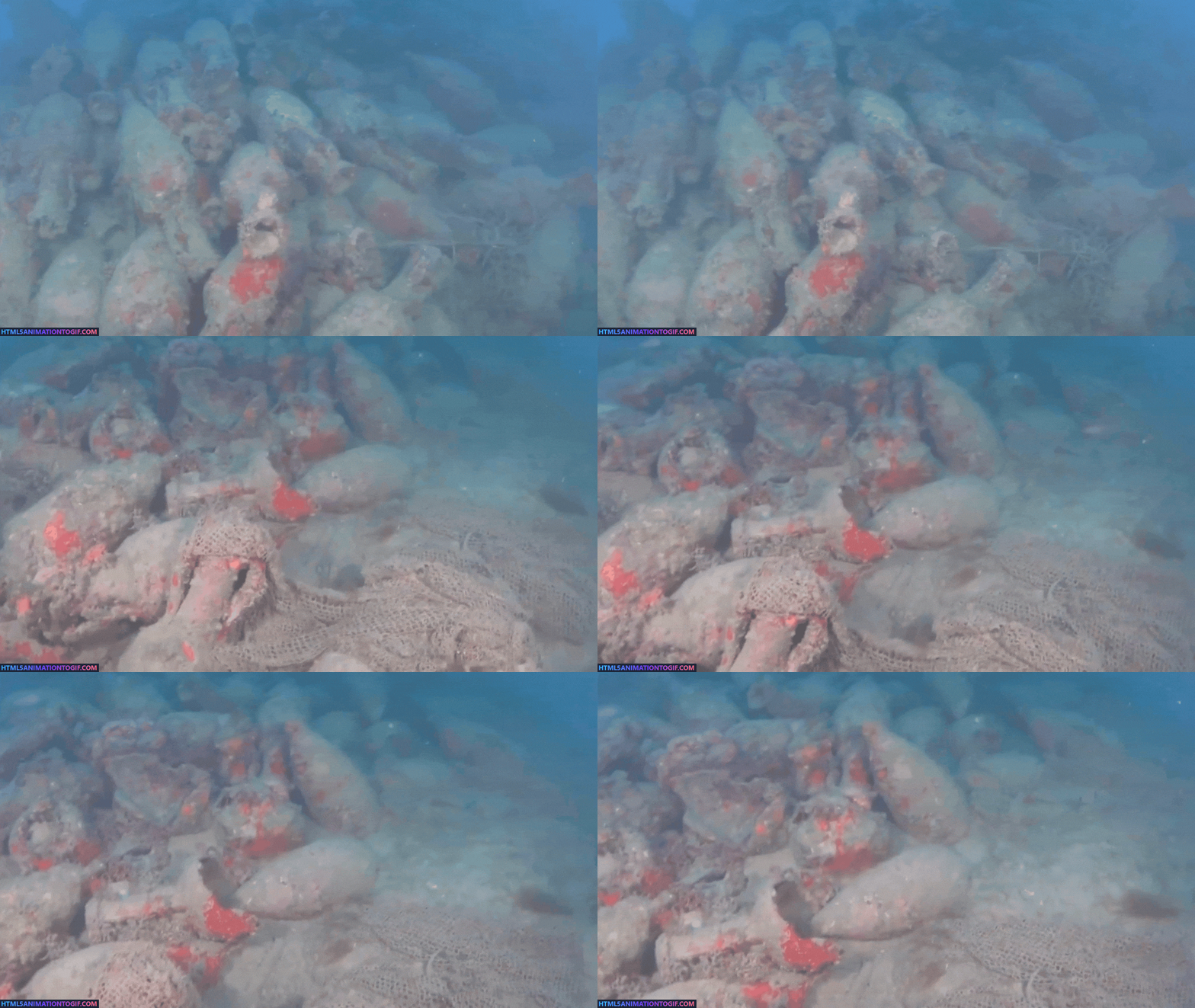
Your boat scanner pings a weird shape on the seabed. It looks like a massive boulder sitting in 46 meters of dark water. You dive down to check it out, expecting a lump of stone. Then your heart stops.
That is exactly what happened to free-diver and fisherman Giacomo De Mola off the coast of Mazara del Vallo in southwestern Sicily. The "rock" was actually an ancient Roman merchant vessel resting on the Mediterranean floor for more than two millennia. Don't miss our earlier post on this related article.
Italy's Culture Minister Alessandro Giuli didn't mince words about the find, calling it one of the most critical underwater archaeological discoveries of recent years. It is a rare, remarkably intact time capsule from the second or first century BC.
Inside the Cargo Hold of a Lost Roman Trader
If you dive down to the site today, you aren't just seeing rotted wood. You are looking at a commercial snapshot of the ancient world. To read more about the background here, The New York Times provides an excellent summary.
The ship measures roughly 21 meters long and 6 meters wide. Packed tightly inside its hull are about 500 amphorae. These are heavy, two-handled ceramic jars with narrow necks. Archaeologists identified them primarily as Dressel 1A types, which were the heavy-duty shipping containers of antiquity, built specifically to haul vast quantities of Italian wine across the Mediterranean.
Think of these jars as the shipping pallets of the ancient Roman economy. They were standardized, sturdy, and stacked by the hundreds in the belly of ships that fueled the appetite of a growing empire.
Why did it sink? We will likely never know the exact cause. Sudden storms, navigational errors, or pirate attacks plagued ancient mariners constantly. But the depth—roughly 150 feet down—kept the wreck safe from modern bottom-trawling commercial fishing nets that usually smash these sites to pieces before anyone notices them.
Why This Discovery Actually Matters
It is easy to look at old pottery as just dusty museum fodder. But wrecks like this rewrite our understanding of ancient globalization.
Long before modern cargo ships crossed oceans, the Mediterranean was a packed highway of commercial exchange. Ships like this one mapped out the economic arteries connecting Rome to the rest of the ancient world. They carried wine, olive oil, and grain across dangerous waters, creating a tightly integrated economy.
When divers like De Mola and Igor Bisulli share footage of eels and snappers weaving through 2,100-year-old wine jars, it sparks public imagination. More importantly, it gives marine archaeologists a pristine site to study ancient shipbuilding techniques. The wood may be degraded, but the layout of the cargo tells an exact story of how weight was distributed, how goods were packed, and how ancient crews navigated the treacherous Sicilian channel.
Protecting History Beneath the Waves
Finding a wreck is only the first step. The moment a high-profile archaeological site hits the news, the threat of illegal looting skyrockets.
Local authorities moved quickly to lock down the area. Italy's Carabinieri Art Squad—a specialized police unit dedicated to protecting cultural heritage—dispatched divers and underwater cameras to map and secure the perimeter alongside regional marine superintendency experts.
The plan now isn't necessarily to drag the whole ship to the surface. Exposing waterlogged ancient wood to air destroys it rapidly if it isn't treated immediately in specialized conservation labs. Instead, archaeologists will map the site digitally, recover select artifacts for study, and leave the main hull protected on the seabed where it has rested since the Roman Republic ruled the world.
Keep an eye on regional archaeological updates out of Sicily over the next year. As excavation technology gets sharper, expect researchers to pull precise chemical signatures from those amphorae, telling us exactly what kind of vintage those ancient Romans were drinking before the ship went down.
:max_bytes(150000):strip_icc()/ar-American-Cheese-taste-test-horizon-4x3-54cc339550cd44b9a818c17bdfd5428d.jpg)