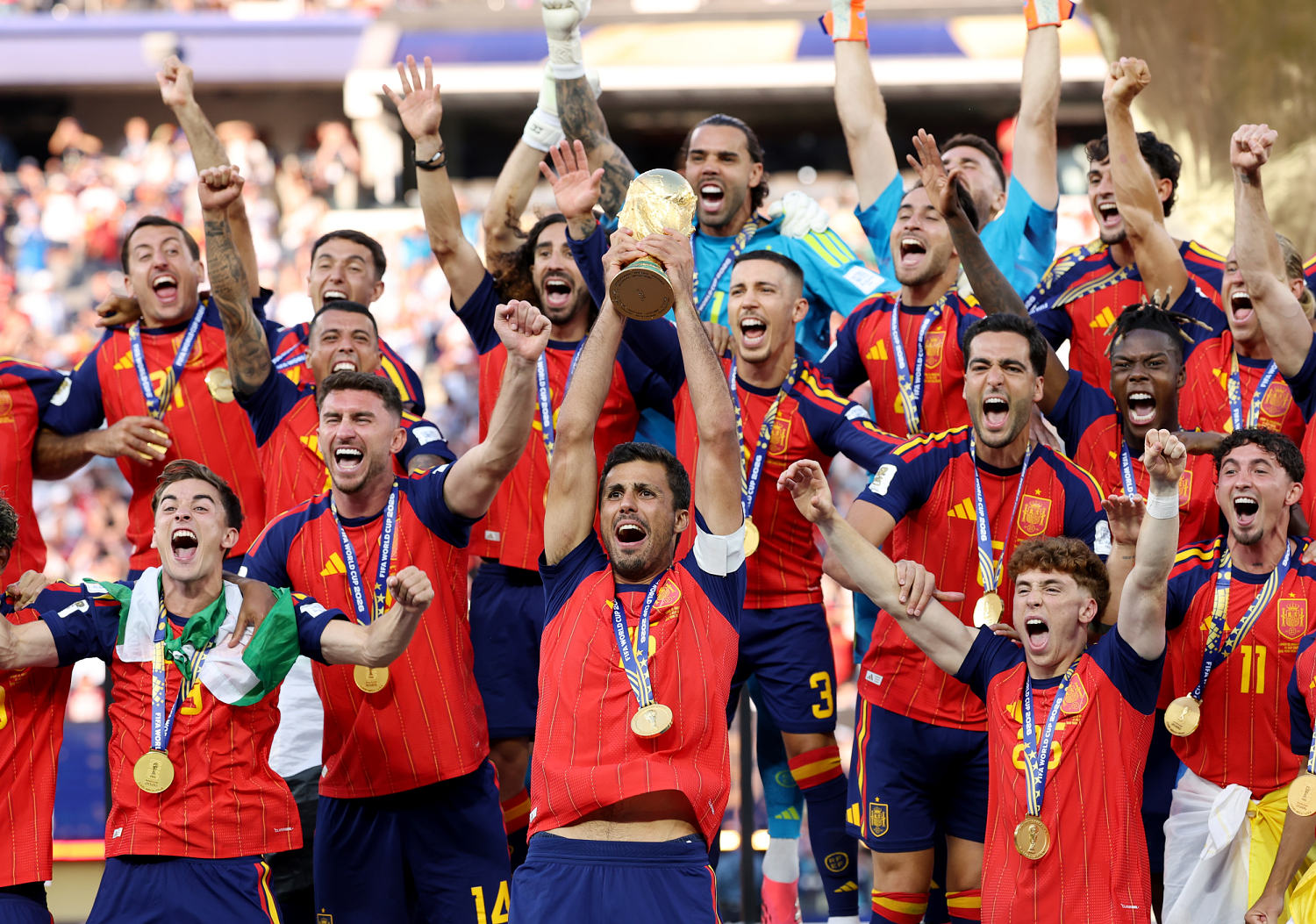
Spain conquered the 2026 FIFA World Cup with a 1-0 extra-time triumph over Argentina at MetLife Stadium, but the headline isn't just about a trophy changing hands. At 19 years and six days old, Lamine Yamal became the youngest player in history to win both a European Championship and a World Cup, completing international football's ultimate double before most players establish themselves in top-flight leagues. Yet Spain's victory was built on a stark tactical reality. Argentina betrayed Lionel Messi. Scaloni threw away his team's attacking identity, deploying an ultra-defensive low block that produced zero shots in 90 minutes and left a 39-year-old Messi isolated, exhausted, and helpless.
When Ferran Torres swept home Spain’s winner in the 106th minute, it felt like the logical conclusion to a match defined by starkly divergent philosophies. Luis de la Fuente’s side dictated terms from kickoff, applying high pressure and relentless tempo. Argentina, meanwhile, surrendered the ball, retreating into their own penalty area as if terrified of the space behind them.
The Death of Argentine Ambition at MetLife Stadium
For ninety grueling minutes of regular time, the defending world champions did not record a single shot toward Unai Simón's goal. Read that stat again. A frontline boasting Lionel Messi and Julián Álvarez spent the entire evening inside their own half, acting as auxiliary full-backs rather than attacking threats.
This wasn't pragmatism. It was cowardice dressed up as tactical caution. Lionel Scaloni entered East Rutherford terrified of Spain’s wingers, opting to park a bus that eventually ran out of fuel. By instructing his midfield to sit on top of the penalty box, Scaloni severed the link between his engine room and his captain.
Messi was forced to drop so deep to touch the football that he was routinely gathering possession forty yards from his own goal line. With no runners ahead of him and a red wall of Spanish pressing surrounding him instantly, the greatest player of his generation was rendered an spectator in his own swansong.
The physical toll became obvious long before extra time. Messi, playing his final international match at 39 years and 25 days, lacked the explosive turn of pace required to break out of a six-man trap on his own. When he needed overlapping runs from Nahuel Molina or surging carries from Alexis Mac Allister, he got stagnant lines and nervous clearances. Argentina didn't just lose a final. They systematically dismantled the very offensive structure that brought them glory in Qatar four years earlier.
How Scaloni Stranded His Captain in a Tactical Cage
The numbers tell a story of self-inflicted paralysis. Argentina accumulated seven yellow cards across 120 minutes, culminating in Enzo Fernández’s dismissal in stoppage time for a reckless second bookable offense. They played with desperation rather than discipline.
| Match Metric | Spain | Argentina |
|---|---|---|
| Final Score | 1 (AET) | 0 |
| Total Shots | 20 | 3 |
| Shots on Target | 6 | 1 |
| Pass Accuracy | 89% | 74% |
| Yellow Cards | 1 | 7 |
| Red Cards | 0 | 1 (Enzo Fernández 90+3') |
Scaloni’s plan hinged on surviving Spain's initial onslaught and snatching a goal on the counter. But counter-attacking requires speed, precision, and width. Argentina offered none of these. Whenever Lisandro Martínez or Cristian Romero won back the ball, they had no outlet. They punted long passes into open grass, instantly handing control back to Rodri and Fabián Ruiz.
It was an insult to Messi's intelligence on the pitch. The captain spent long stretches walking near the center circle, shaking his head as his teammates panicked under moderate pressure. He completed just 22 passes in 120 minutes. His lowest tally in any major tournament knockout match. Argentina abandoned the pass-and-move rhythm that defined their success, choosing instead to foul, hack, and stall.
By the time extra time arrived, Argentina’s legs were gone. The defensive effort of chasing Spanish shadows for two hours burned through their energy reserves. When Dani Olmo fed Pedri, who slid the ball through to Ferran Torres for the decisive goal, Argentina’s defenders were too gassed to step up and play offside. The trap broke because the engine failed.
The Night Lamine Yamal Rewrote Football History
While Argentina suffocated in their own defensive shell, Lamine Yamal put on a masterclass in modern wing play.
Fresh off turning 19, the Barcelona prodigy played with a cool assurance that defied the stage. He didn't score the winning goal, but he dictated where Argentina’s defense moved. Every time Yamal received the ball on the right wing, he dragged two defenders with him, creating massive pockets of space for Dani Olmo and Pedro Porro to exploit.
Yamal finished the match with three successful dribbles, three tackles won, and two key passes, but those numbers barely scratch the surface. His first touch in the seventh minute—picking a 50-yard cross-field diagonal out of the air before slipping past Marcos Acuña—set the tone for the final. He played without fear, unburdened by the weight of a World Cup final.
Pelé was 17 when he won in 1958. Giuseppe Bergomi was 18 in 1982. Yamal now stands alongside them as the youngest players to start a World Cup final, but his achievement carries unique historic weight. He is the first player ever to anchor a continental championship victory and a World Cup title before turning 20.
What makes Yamal terrifying for the rest of global football is his decision-making. Teenagers usually rely on raw pace or unpredictable tricks. Yamal plays with the timing of a 30-year-old veteran. He knows when to slow down the play, when to attack the fullback's inside shoulder, and when to recycle possession. On Sunday night, he looked every bit the heir apparent to the icon standing across from him.
De la Fuente and the Machinery of Continuous Pressure
Spain’s World Cup triumph wasn't born out of individual magic alone. It was the product of a clear tactical model perfected by Luis de la Fuente.
Where previous Spanish teams choked matches through endless sideways passing, this iteration moves with directness and intent. They circulate the ball high up the pitch, and the second they lose it, they counter-press with terrifying aggression. Nico Williams and Lamine Yamal stretch the pitch to its absolute limits, forcing opposing backlines to defend a 70-yard width.
When Argentina tried to build from the back, Spain’s front three immediately blocked the passing lanes to Rodrigo De Paul and Mac Allister. Emiliano Martínez was forced into kicking long 14 times in the first half alone. Each long ball was swallowed up by Aymeric Laporte and Robin Le Normand. Spain turned Argentina's goal kicks into immediate Spanish attacks.
De la Fuente’s bench management proved decisive once again. Recognizing that Yamal and Williams were drawing heavy physical challenges, he introduced Pedri and Ferran Torres in the second half of normal time to inject fresh energy into the half-spaces. The move paid off in extra time. Fresh legs against a depleted, demoralized Argentine defense resulted in the winning goal.
Spain didn't need a individual savior. They functioned as a coordinated unit where every gear turned with exact precision.
The Passing of the Crown in East Rutherford
When the final whistle blew at MetLife Stadium, the contrast between the two figures could not have been starker.
Lionel Messi sat on the turf, head buried in his hands, crying tears of frustration as his international career came to a agonizing close. Minutes later, Yamal walked over to his childhood idol. The two shared a quiet embrace on the pitch—a moment caught by broadcast cameras that instantly swept across the world.
It was the ultimate passing of the torch. Nineteen years after a viral charity photoshoot brought a baby Yamal and a young Messi together in a Barcelona dressing room, their story reached its final chapter under the lights in New Jersey.
Messi leaves international football having delivered Argentina their third World Cup star in 2022, but his final appearance will be remembered as a night of tactical betrayal by a coaching staff that lost its nerve when it mattered most. Argentina relied on grit and physical deterrence, forgetting that football matches are ultimately won by teams brave enough to play.
Spain was brave. Yamal was fearless.
As Argentina begin the painful process of rebuilding without their greatest icon, Spain enter an era of dominance with a 19-year-old phenom who has already won everything the sport has to offer. Lamine Yamal hasn't just replaced Lionel Messi at the pinnacle of global football. He has set a new benchmark for what a teenager can accomplish on the world stage.