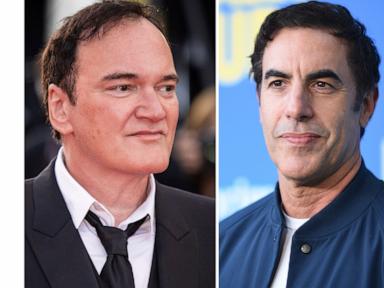
Hollywood directors love to talk about theater as some sort of sacred, raw altar. They usually flee back to the safety of studio trailers the moment a cue light blinks wrong. Quentin Tarantino has never played by Hollywood's handbook. Now, he is bringing his hyper-stylized dialogue, encyclopedic genre obsessions, and explosive theatricality directly to the West End.
Sacha Baron Cohen is stepping up to anchor the production. This collaboration is not merely a celebrity vanity project dropped onto a prestigious London stage. It represents a massive cultural collision between America's premier cinematic provocateur and Britain's sharpest satirical chameleon. The theater world is watching with a mix of awe and deep skepticism.
The Anatomy of the West End Pivot
For decades, the standard trajectory for an aging auteur involved publishing a bloated memoir or retreating into indie obscurity. Tarantino chose a different path. Having long teased his retirement from feature filmmaking after his tenth movie, he has instead turned his sights toward dramatic writing for the stage. London became the staging ground for this ambition for reasons that go far beyond tax credits or prestige.
The West End offers an intimacy and a live feedback loop that 70mm projection rooms can never match. When an audience sits ten feet away from actors hurling Tarantino's meticulously calibrated monologues, every dropped syllable registers instantly. Baron Cohen brings a unique toolkit to this environment. Years of undercover guerrilla performance taught him how to read a room, manipulate tension, and hold a crowd hostage through sheer psychological dominance.
Why Sacha Baron Cohen Matters Here
Casting Baron Cohen is a masterstroke of counter-intuitive engineering. Most people associate him with high-concept public ambushes and broad cinematic comedies. Theater insiders know his dramatic chops run deeper than his box office hits suggest. He possesses a rare discipline required to deliver heightened dialogue without tipping into self-parody.
Tarantino writes dialogue that functions like jazz composition. Every curse word, pop culture reference, and rhythmic pause carries structural weight. If an actor treats the script like casual conversation, the engine stalls. Baron Cohen understands cadence and rhythm. His background in character creation means he approaches the text from the outside in, building a physical presence before worrying about the emotional beats.
The Financial Realities of Live Auteurism
Do not mistake this for art for art's sake. Commercial theater in London is a high-stakes, risk-averse machine driven by international tourism and corporate backing. Bringing two global heavy
Quentin Tarantino Takes the West End With Sacha Baron Cohen
entertainment
cebs
Quentin Tarantino is bringing his distinct cinematic voice to the London stage for the very first time, casting Sacha Baron Cohen in the lead role of a major theatrical production. The project marks a dramatic departure for a filmmaker who has spent decades defining modern American cinema through celluloid, ultraviolence, and nonlinear crime narratives.
For the British capital's West End, the arrival of Tarantino and Cohen represents an explosive collision of two cultural disruptors. For years, industry watchers wondered if the director would ever transition his hyper-stylized dialogue and pop-culture-soaked sensibilities away from the silver screen. Now, that question has been answered in a theater district known for favoring classic revivals and safe commercial draws over raw auteur-driven experiments.
The Anatomy of a West End Gamble
Commercial theater in London operates on a predictable economic engine. Producers back known intellectual property, established musicals, or prestige dramas starring recognizable television actors to guarantee a return on investment. Tarantino dropping a script into this ecosystem is a different calculation entirely.
The production relies heavily on the star power and fearless performance history of Sacha Baron Cohen. Known worldwide for his subversive character work, Cohen brings an inherent theatricality and physical precision that suits Tarantino's rhythm-heavy screenwriting. Yet, executing rapid-fire, stylized dialogue eight times a week in front of a live audience demands a different discipline than film sets where a scene can be reset for the twentieth take.
Behind the curtain, the logistics of mounting a new work by a first-time playwright carry significant financial risk. West End ticket prices have climbed sharply, putting pressure on productions to capture both die-hard cinephiles and traditional theatergoers. Tarantino's name guarantees global press coverage, but sustaining a long run requires converting that initial media frenzy into steady box office momentum.
Why Stage Outlets Matter for Film Auteurs
Directors migrating to the stage usually do so to escape the suffocating financial machinery of modern studio blockbusters. When a filmmaker of Tarantino's stature pivots to theater, it signals a desire for absolute control and direct contact with an audience. There are no test screenings, no studio interference, and no compromise on the final cut.
The theater also offers a stark contrast to the streaming-dominated landscape of contemporary entertainment. In a culture saturated by algorithms and at-home viewing, a live stage play creates artificial scarcity. You have to be in the room on a specific night in London to experience it. This scarcity drives cultural cachet in a way digital releases struggle to match.
Yet, translating a cinematic style built on rapid cuts, sweeping camera movements, and cinematic pastiche into a fixed physical space requires radical reinvention. Tarantino cannot rely on a close-up to emphasize a threat or a sweeping pan to establish isolation. The storytelling must happen entirely through actors, space, and spoken cadence.
<Carousel>
  <Video source="youtube" query="Sacha Baron Cohen acting performance highlights West End style" count="3"/>
</Carousel>
The Cultural Impact on London Theater
The presence of American film royalty reshaping the West End highlights a broader shift in global entertainment. London has increasingly become a laboratory for high-profile artistic experiments before they face the harsher, more cynical commercial pressures of Broadway.
Critics will scrutinize every minute of the production, measuring whether a master of cinematic pulp can successfully command a medium historically dominated by classical text. At the same time, the box office will test whether audiences are willing to pay premium prices for original dramatic writing rather than nostalgic adaptations.
This production changes the conversation around what major artists can do when they step outside their comfort zones. If the gamble pays off, it opens a pipeline for other directors seeking an unmediated connection with audiences. If it stumbles, it serves as a reminder that the stage remains an unforgiving medium that humbles even the most celebrated visual storytellers.
The curtain is set to rise, and the industry is watching to see whether the dialogue that defined a generation of cinema translates to the boards.