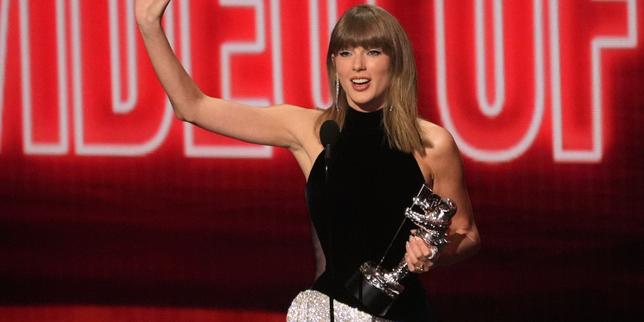
Every major entertainment outlet spent the morning after the MTV Video Music Awards hyperventilating about Taylor Swift. They praised her reign, pointed to her latest collection of moonman trophies, and treated a polite nod to Dolly Parton as a masterclass in cultural preservation. It is a lazy consensus built by people who mistake media saturation for artistic friction.
The standard narrative paints Swift as a musical titan whose sheer sonic output forces the industry to bow. That is a convenient fiction for PR departments. Swift does not dominate award shows because her latest bridge rewrote the history of pop composition. She dominates because she engineered an impenetrable corporate ecosystem that treats music as collateral. In related developments, read about: Why Mighty Sparrow Was the Undisputed Voice of the Caribbean.
Let us look past the pyrotechnics and the manufactured shock of red carpet appearances. The industry loves to talk about her songwriting prowess, but what we are witnessing is not a triumph of melody. It is a masterclass in modern attention monopoly.
The Myth of Organic Dominance
We hear constant chatter about how Swift connects with fans through vulnerable lyricism. This frames her success as an emotional accident, a lightning strike of raw relatability. Bloomberg has analyzed this fascinating issue in great detail.
I have watched executives at major labels scramble to reverse-engineer her release strategies for years, and every single one of them misses the point. They try to copy the variant vinyl drops, the Easter eggs, the cryptic social media countdowns. They think the secret lies in the marketing gimmicks.
They ignore the structural reality. Swift stopped competing in the music industry years ago. She built her own arena, set her own rules, and forced everyone else to play a rigged game of catch-up. When an artist controls the entire supply chain of their own nostalgia, awards cease to be metrics of artistic achievement. They become quarterly earnings reports.
The VMAs are not a gallery of cultural merit. They are a marketing exchange. MTV needs Swift's gravitational pull to keep a dying cable broadcast relevant for thirty minutes of trending Twitter clips. Swift needs the institutional stamp of mainstream broadcast television to maintain the illusion of an ongoing underdog crusade. It is a symbiotic loop of corporate preservation disguised as a pop culture coronation.
The Dolly Parton Smoke Screen
When Swift paused her victory lap to offer a reverent nod to Dolly Parton, commentators lost their collective minds. They called it passing the torch. They called it honoring the elders.
It was a brilliant defensive maneuver.
Aligning herself with Parton places Swift in a lineage of untouchable American icons, shielding her from the valid criticisms leveled at contemporary hyper-capitalist pop stars. But let us look at the structural difference between Parton and Swift. Parton built her empire on working-class anthems, owning her publishing, and writing timeless standards that permeated rural honky-tonks before corporate boards ever touched them.
Swift builds her empire on exclusivity, legal containment, and algorithmic saturation. Comparing the two is like comparing a public library to a gated venture capital fund. One invites the public in; the other monetizes the gate.
When you frame every strategic career move as an emotional tribute to country music royalty, you disarm the skeptics. You make it impossible to critique the business model without looking like a cynic who hates successful women. That is the genius of the operation. The armor is made of Teflon nostalgia.
The Cost of Total Monopolization
What happens when one artist consumes all the oxygen in the room? We get an industry terrified of risk.
Labels look at Swift's billion-dollar stadium tours and record-shattering vinyl variants and conclude that nobody should ever invest in mid-tier developmental artists again. Why fund a gritty indie rock band or a daring R&B disruptor when you can spend that entire annual budget manufacturing thirty different colored vinyl editions of an album that sounds identical to the last one?
The lazy narrative claims Swift saves the music business. The reality is much darker. She has consolidated it to the point of suffocation.
Independent record stores are drowning under boxes of unsold variant collector editions they were forced to buy to secure allocation. Emerging artists cannot get vinyl pressing plants to look at their orders because major conglomerates have booked out the presses eighteen months in advance to churn out Swift's latest archival vault track release.
Nobody in the mainstream press wants to write about this because the backlash is swift and absolute. The stan culture machinery has made objective critique a professional hazard. If you point out that a three-hour stadium concert heavy on production spectacle and light on sonic evolution is starting to resemble a Vegas residency for millennials, you get buried under an avalanche of coordinated digital hostility.
Breaking the Loop
If we want actual innovation in pop culture, we have to stop treating commercial dominance as artistic validation.
Stop pretending that breaking streaming records is the same thing as pushing cultural boundaries. Stop confusing market share with mastery. When we reward sheer operational scale with institutional trophies, we send a clear message to every young writer and producer: do not bother taking risks. Just build a better funnel.
Swift is a brilliant strategist. She outmaneuvered the old guard, took back her masters, and proved that an artist can out-corporation the corporations. But let us stop calling it a triumph of art when it is actually a triumph of logistics.
The next time an award show hands out another golden statuette to the reigning monarch of pop, ask yourself what else was on the ballot, and why you never heard a single note of it.