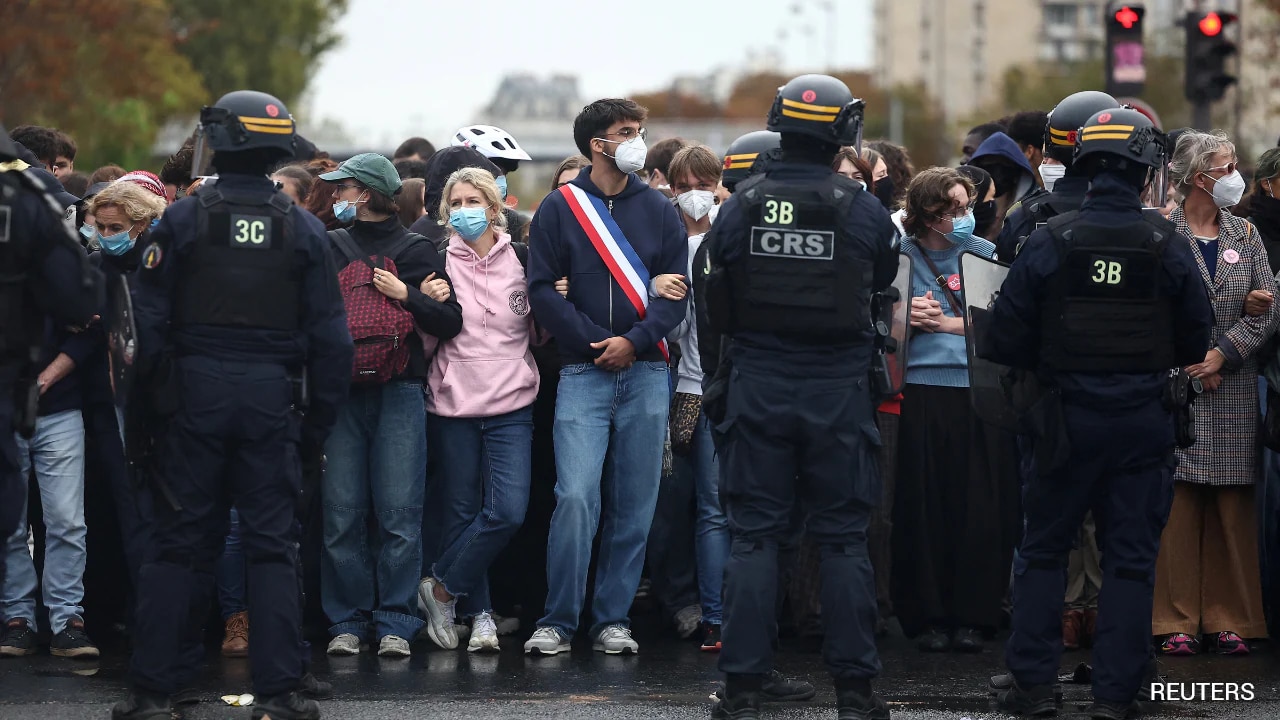
Thousands of demonstrators flooded the cobblestone arteries of Paris following a critical judicial intervention that dismantled a government-imposed prohibition on public assembly. Emmanuel Macron’s administration had initially sought to muzzle the streets, citing severe public safety risks and the constant threat of property damage during a season of intense fiscal friction. Yet, the judiciary stepped in, drawing a sharp, unmistakable line between executive convenience and constitutional liberties. The court ruling struck down the blanket ban, arguing that restricting the fundamental right to protest requires a far higher threshold of imminent danger than the state had provided.
When the police prefectures lost their legal shield, the streets erupted. Demonstrators carrying union banners, makeshift placards, and chanting slogans against pension reforms surged toward major public squares. The scent of tear gas mixed with the crisp autumn air within hours, as security forces moved in to contain the swelling crowds.
Understanding this clash requires looking past the immediate spectacle of flying batons and shattered glass. At its core, the tension in Paris represents a deep institutional fracture between an increasingly centralized executive branch and a citizenry unwilling to accept economic restructuring dictated from the top down.
The Anatomy Of A Legal Reversal
Governments rarely surrender control willingly. When the French interior ministry attempted to suppress upcoming demonstrations through administrative bans, legal scholars immediately recognized the constitutional vulnerability of the move. French administrative law operates under the principle of proportionality. The state must prove that a measure is strictly necessary and that no lesser restriction will suffice to maintain public order.
The administrative court in Paris found the government’s blanket prohibitions wanting. By criminalizing participation in unauthorized marches before they even began, the state overstepped its constitutional boundaries. The ruling underscored a core tenet of the Fifth Republic: public order cannot be maintained by suspending civil liberties altogether.
This legal defeat left the executive branch scrambling. Having staked significant political capital on maintaining order and pushing through contentious labor and retirement policies, the administration found itself legally cornered. The courts forced the state to tolerate what it desperately wished to silence.
The Economic Tinderbox
The crowds filling the boulevards are not monolithic. They represent a coalition of convenience forged by shared economic anxiety. Labor unions, students, public sector workers, and independent contractors have found common ground in their opposition to state-mandated austerity measures and rising living costs.
Inflation has eroded purchasing power across Europe, but France carries a distinct cultural tradition of militant labor resistance. When the government attempts to alter retirement ages or trim public expenditures, the reaction is not merely grumbling; it is mobilization.
[Government Policy Shift] -> [Heightened Inflation & Cost of Living] -> [Labor & Public Mobilization] -> [Judicial Review] -> [Street Demonstrations]
The state argues that structural reforms are essential for long-term fiscal stability. Without adjustments to pension systems and public spending, national debt ratios risk violating European Union guidelines, potentially triggering a downgrade in sovereign credit ratings. On the other side of the barricades, the working public views these fiscal arguments as a smokescreen designed to protect capital at the expense of labor.
Policing The Republic
Managing mass demonstrations in a major European capital is an exercise in high-stakes logistics. French law enforcement agencies face an impossible dilemma. If they deploy heavy-handed tactics, including tear gas, water cannons, and aggressive baton charges, they risk exacerbating the violence, radicalizing moderate protesters, and generating damaging media optics. If they take a passive approach, property destruction escalates, businesses suffer, and the government faces accusations of losing control.
The tactical shift toward mobile, aggressive intervention squads has transformed the nature of Parisian protests. Instead of static lines holding back crowds, security forces deploy specialized units designed to isolate radical elements, known colloquially as casseurs, who infiltrate peaceful marches primarily to loot and clash with police.
However, distinguishing between a peaceful demonstrator and an agitator in a dense, smoke-filled street is notoriously difficult. Innocent bystanders frequently find themselves caught in the crossfire of tear gas canisters, leading to widespread anger against the police force as an institution.
Institutional Resilience Under Stress
France has weathered generational cycles of civil unrest, from the yellow vest movement to historic general strikes. Each crisis tests the durability of democratic institutions. The current standoff demonstrates both the strength and the fragility of the French constitutional framework.
The judiciary functioned precisely as designed, acting as a check on executive overreach even during a period of high national anxiety. Yet, the inability of the political class to negotiate lasting settlements with labor organizations points to a deeper structural failure in representative politics. When parliament and negotiation tables fail to resolve societal friction, the conflict inevitably migrates to the asphalt.
As the tear gas clears from the Parisian squares and municipal workers sweep up the debris, the fundamental questions remain entirely unresolved. The government has not altered its legislative agenda, and the unions have shown no willingness to compromise on core demands. The courts have guaranteed the right to march, but marching alone does not write policy.
The confrontation in Paris is far from an isolated event. It is a bellwether for Western democracies attempting to navigate fiscal austerity, populist pressure, and the erosion of trust between citizens and state authority. The barricades may come down when night falls, but the political fault lines running beneath the surface of the French Republic continue to widen.