Ever walked into a room and felt like a giant? Or maybe you've spent the whole night looking up at people's chin hair. It’s a weirdly personal thing. Height is one of those metrics we treat as a personality trait, even though we have zero control over it. If you search for the average height of a man, you’ll get a clean, tidy number. But reality is messy.
In the United States, the average man stands at about 5 feet 9 inches (roughly 175 cm). That's the baseline. It’s the number the CDC—the Centers for Disease Control and Prevention—has been tracking for decades. But that number is a liar. It hides the fact that height varies wildly by age, ethnicity, and even what year you were born. A guy in his 20s is statistically taller than his grandfather, not just because the grandfather is shrinking, but because of better nutrition during childhood. Recently making news in related news: Why Your Child Safety Strategy Is Designed Backward.
We care about this because society tells us to. Evolutionarily, height was linked to power. Today, it’s mostly linked to dating app filters and NBA dreams.
The Numbers Nobody Tells You
Most people think 5’10” is the average. It isn't. When you look at data from the National Health and Nutrition Examination Survey (NHANES), the actual mean for American men over age 20 is closer to 5’9.1”. More insights into this topic are explored by Healthline.
Why the disconnect? Honestly, it’s because men lie. We round up. A guy who is 5’8.5” says he’s 5’9”. A guy who is 5’10” says he’s 6 feet. This "height inflation" creates a distorted perception of what "normal" looks like. If you're 5’9”, you are exactly in the middle of the pack. You are the literal definition of average.
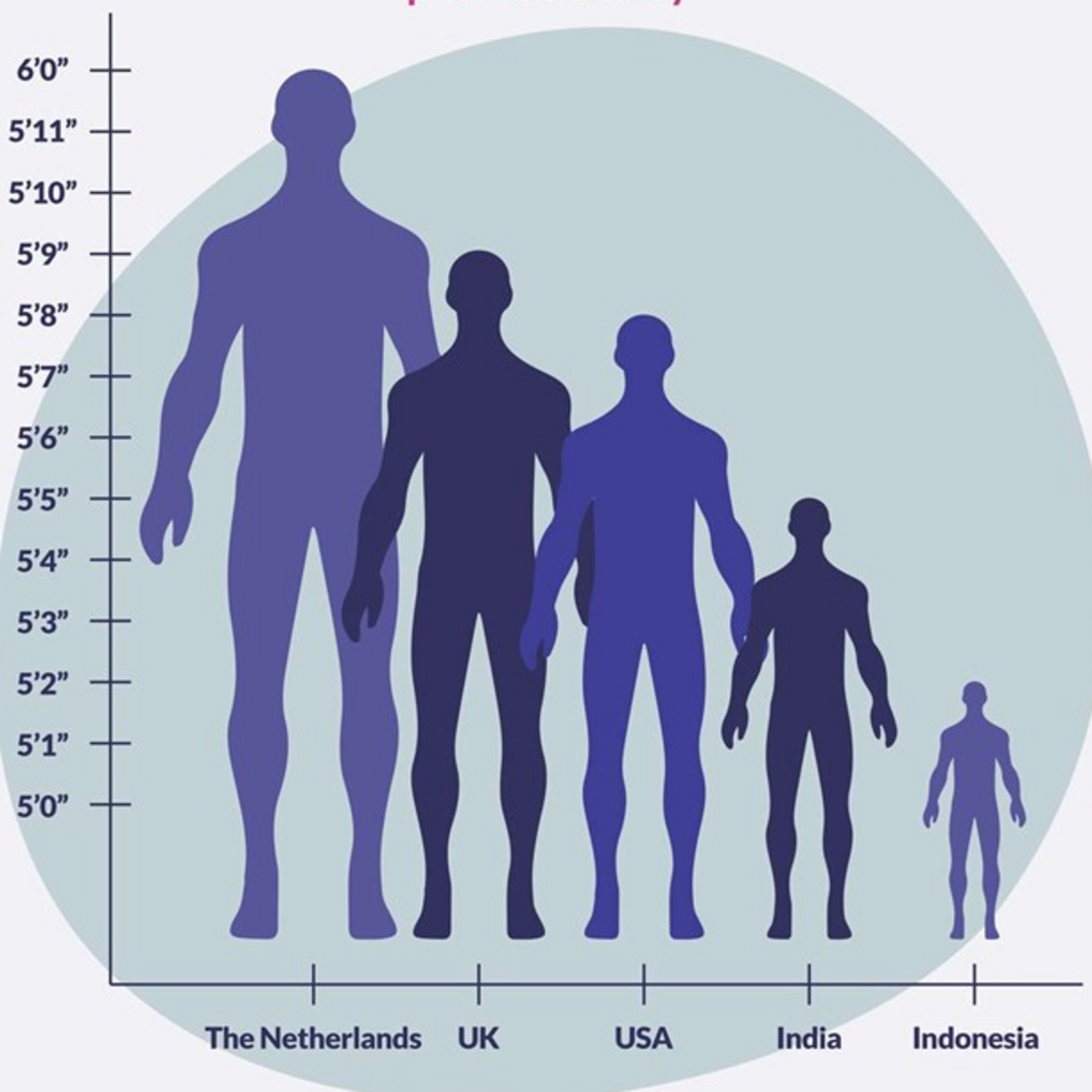
Geography changes everything. You can't just look at one global number. If you’re standing in the Netherlands, you’re looking at an average of 6 feet (182.5 cm). Those guys are outliers. In parts of Southeast Asia, like Timor-Leste, the average might be closer to 5 feet 3 inches.
Diet is the biggest factor here. The Dutch weren't always the tallest people on Earth. In the mid-1800s, they were actually quite short. Then their economy shifted, they started consuming massive amounts of dairy, and their healthcare system became one of the best in the world. Height is basically a biological bank statement. It shows how much a country has invested in its kids.
The Age Gap in Stature
Age matters. A lot.
Data shows that men between the ages of 20 and 39 are generally taller than those aged 60 and older. Part of this is the "secular trend"—the tendency for each generation to outgrow the last due to better environment. But part of it is just the inevitable compression of the spine. We lose about half an inch every decade after 40.
Gravity is a jerk.
Why the Average Height of a Man Varies So Much Globally
If you want to see the impact of wealth on biology, look at North and South Korea. They share the same genetic pool. Yet, studies on North Korean defectors compared to South Koreans show a significant height gap. South Koreans are generally taller. Why? Protein. Consistent calories.
The NCD Risk Factor Collaboration (NCD-RisC) tracks these global shifts. They’ve noted that while height is leveling off in many Western countries, parts of Africa and Asia are seeing rapid increases.
- Netherlands: ~182.5 cm (6'0")
- USA: ~175.3 cm (5'9")
- China: ~171.8 cm (5'7.5")
- India: ~165 cm (5'5")
It’s not just "good genes." Genes determine your potential, but your environment determines if you reach it. Think of it like a plant. You can have the best seeds in the world, but if you don't water them, they stay small.
The Mid-Century Growth Spurt
During the 20th century, the average height of a man in developed nations shot up. We conquered many childhood diseases. We added vitamins to milk. We stopped working children in coal mines. All of that energy that used to go toward fighting off infections was suddenly available for bone growth.
But here’s the kicker: Americans have stopped getting taller. We hit a plateau around the 1980s. Meanwhile, Northern and Central Europeans kept going. Some researchers think this is due to the American diet—lots of calories, but not necessarily the right nutrients for optimal growth.
The Psychology of Being "Average"
We need to talk about the "6-foot rule" on dating apps. It’s a weird cultural obsession. Statistically, only about 14% to 15% of men in the U.S. are 6 feet or taller. Yet, if you look at Tinder profiles, you’d think it was 50%.
This creates a massive amount of "height dysphoria."
Dr. Abraham Buunk has done some fascinating research on "intrasexual competition." Basically, taller men are often perceived as more dominant or higher status. It’s a primal lizard-brain thing. In the workplace, there is a documented "height premium." Studies have suggested that for every inch of height, a man might earn a certain percentage more in annual income.
Is it fair? No. Is it real? Unfortunately, yes.
But being the average height of a man has its own perks. Planes are designed for you. Cars are designed for you. You don’t have to worry about hitting your head on low doorways in old European cities. You are the "standard user" for the entire world’s manufacturing.
Health Risks: The Tall vs. Short Debate
There is a trade-off for everything.
Taller men might have a higher risk of certain cancers because they have more cells, and more cells mean more chances for something to go wrong during division. They also tend to have more joint and back issues. On the flip side, shorter men have historically shown a slightly higher risk for heart disease, though the reasons are debated—some think it’s related to smaller arteries, others think it’s tied to childhood nutrition.
Basically, the "sweet spot" for longevity is often right around that average mark.
How to Measure Yourself Correctly
Most people measure themselves wrong. They use a tape measure against a wall and try to mark it with a pencil while looking in a mirror. You'll get it wrong every time.
- Morning is best. You are actually tallest right when you wake up. Throughout the day, the discs in your spine compress. You can lose nearly a full centimeter by dinner time.
- The Floor Matters. Don't measure on carpet. It squishes. Use a hard floor.
- Lose the shoes. This sounds obvious, but people forget. Socks too.
- The "Stadiometer" method. Stand with your heels, butt, and back of your head touching the wall. Look straight ahead—don't tilt your chin up. Have someone else place a flat book on your head, perpendicular to the wall, and mark the bottom of the book.
If you do this, you might find you're a bit shorter than you thought. Don't panic. You're just being honest with the data.
The Future of Human Height
Will we keep getting taller? Probably not much more.
There seems to be a biological ceiling. Even in the Netherlands, the growth rate is slowing down. We are reaching the limit of what the human skeleton can comfortably support. Plus, our modern lifestyle is pretty sedentary.
The average height of a man is likely to stay stable in the West for the foreseeable future. The real changes will happen in developing nations as they catch up in terms of nutrition and sanitation. We might eventually see a world where the "average" is more uniform across the globe.
Genetics vs. Environment
It’s roughly an 80/20 split. About 80% of your height is determined by the DNA your parents handed down. The other 20% is lifestyle.
If both your parents are 5’5”, you’re probably not going to wake up as a 6’4” shooting guard. But if you have access to high-quality protein, clean water, and plenty of sleep during your pubertal growth spurts, you’ll likely land at the top end of your genetic potential.
Actionable Insights for the "Average" Guy
If you’re stressed about where you fall on the chart, stop. Here is how to actually handle the reality of the numbers:
- Focus on Posture: Most men "lose" an inch simply by slouching. Strengthening your core and your posterior chain (back muscles) can make you look and feel taller than someone who is technically an inch taller but hunches over their phone.
- Dress for Your Frame: Don't wear clothes that are too baggy. They swallow you up and make you look shorter. Well-tailored clothes that hit at the right spots (wrists and ankles) create a clean silhouette.
- Understand the Bias: Recognize that "heightism" exists in professional settings. If you’re on the shorter side of the average, focus on "presence." Taking up space through body language and vocal tone often compensates for physical stature.
- Check the Source: When you see a "study" about height, look at the sample size. A study of 100 college students in California doesn't represent the world. Always look for NHANES or NCD-RisC data for the real truth.
- Health over Inches: If you’re a parent, focus on your child's nutrition during the first 1,000 days of life and their pre-teen years. That’s when the "height "foundation" is poured.
At the end of the day, 5 feet 9 inches is just a number. It's a snapshot of a population, not a ceiling on your potential. Whether you're above, below, or right on the line, the way you carry the frame you have matters more than how far it is from the floor.
Keep your nutrition in check, stand up straight, and remember that the "average" is just a middle point in a very wide, very human spectrum.
Next Steps for Tracking Your Health
- Consult a Growth Chart: If you are tracking a child's height, use the World Health Organization (WHO) growth standards rather than generic internet charts.
- Monitor Bone Density: Especially as you age past 50, height loss can be a sign of osteoporosis. Mention any significant height loss (more than an inch) to your doctor.
- Body Composition Matters: Remember that BMI (Body Mass Index) is calculated using height. If you are very muscular or have a unique build, your BMI might be "high" even if you're healthy. Focus on waist-to-height ratio instead.