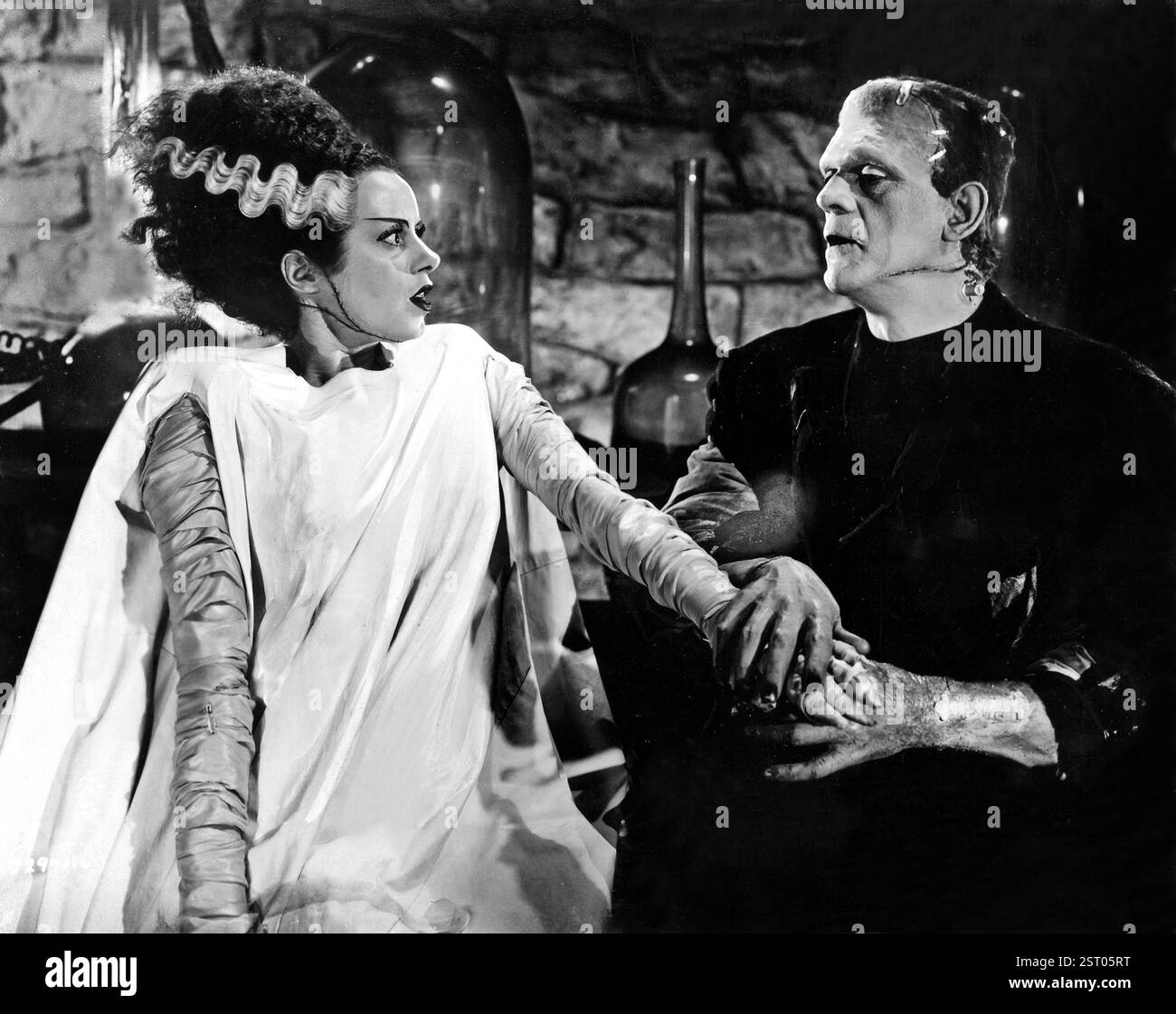
She’s on screen for roughly five minutes. Maybe less, depending on how you count the prologue. Yet, Elsa Lanchester as The Bride of Frankenstein is the most enduring image in the history of horror cinema. It’s weird, right? You have this massive, sprawling legacy built on a character who doesn’t even have a name and never says a single word of dialogue. She just hisses. Like an angry swan. Or a territorial cat. Honestly, that hiss was Elsa’s idea, and it’s probably the reason we’re still talking about her nearly a century later.
James Whale, the director, knew exactly what he was doing when he cast her. He didn’t just want a monster; he wanted a paradox. He wanted someone who could play Mary Shelley—the delicate, intellectual author—and then pivot into a jagged, lightning-scarred nightmare. Elsa Lanchester was that person. She was a bohemian, a rebel, and a woman who lived a life far more interesting than the "monster's mate" label suggests.
People forget that Bride of Frankenstein (1935) isn't just a sequel. It’s a masterpiece of camp, German Expressionism, and sheer technical audacity. At the center of it all is Elsa, wrapped in bandages, sporting a Nefertiti-inspired wig with lightning-bolt streaks, and delivering a performance that redefined what "feminine" looked like in Hollywood’s Golden Age.
Why Elsa Lanchester as The Bride of Frankenstein Works (Even Now)
Most people assume the Bride's look was just some makeup artist's random whim. It wasn't. Jack Pierce, the legendary makeup genius at Universal, spent hours—sometimes half a day—gluing Elsa into those wrappings. The hair? It was built over a wire frame. It wasn't just a wig; it was a sculpture. Elsa herself was tiny, but that hair made her look like a towering, unnatural deity.
The movement is what kills me. She doesn't walk like a human. She moves in staccato jerks, like a bird or a marionette with tangled strings. This wasn't accidental. Elsa took inspiration from the swans in London's Regent's Park. She watched how they’d puff up and hiss when they felt threatened. She brought that "hiss" to the set, and it terrified Boris Karloff. Imagine that. The man who played the original Monster, a guy used to being the scariest person in the room, was genuinely unsettled by this petite British woman making animal noises at him.
The makeup was brutal. Elsa was literally bound in bandages so tight she couldn't go to the bathroom. She had to be fed through a straw. Her eyes were taped open for certain shots to give her that wide-eyed, unblinking, "just-born" look. It’s a level of physical commitment that most modern actors would find claustrophobic. But Elsa had this background in "The Cave of Harmony," a London nightclub she ran, where she performed avant-garde songs and sketches. She was used to being weird. She embraced the discomfort because she knew the visual impact was everything.
The Dual Role: Mary Shelley and The Monster
One of the smartest things James Whale did was have Elsa play both Mary Shelley in the film’s opening and the Bride at the end. It’s a bit of meta-commentary that often goes over people’s heads. By having the creator of the story also play the most tragic creature in the story, Whale was making a point about the artist and the art. Or maybe he just liked the irony. Either way, Elsa’s Mary Shelley is all soft curls and polite smiles, while her Bride is all sharp angles and primal fear.
It’s a bizarre contrast.
The prologue features Mary Shelley talking to Lord Byron and Percy Shelley on a dark, stormy night. Elsa plays Mary with a sort of mischievous intelligence. Then, fast-forward an hour, and she’s the screeching, horrified result of Henry Frankenstein’s ego. The transition is jarring. It makes the Bride’s rejection of the Monster even more heartbreaking. Boris Karloff’s Monster finally finds someone like him, reaches out a hand, and says, "Friend?"
And she screams.
She hates him. She’s disgusted by him. It’s the ultimate subversion of the "happily ever after" trope. The Bride isn't a prize; she’s a person with her own (admittedly new) agency, and her first act of free will is to reject her intended mate. That’s why the movie has survived. It’s not just a monster flick; it’s a tragedy about identity and the horror of being forced into existence.
The Secret Life of Elsa and Charles Laughton
You can't talk about Elsa Lanchester without talking about her husband, the powerhouse actor Charles Laughton. Their marriage was... complicated. That’s a polite way of putting it. Laughton was gay, a fact Elsa discovered early in their marriage. Despite this, they stayed together for decades. They were partners in every sense of the word, except perhaps the traditional one.
They lived in a world of art and high-society Hollywood, yet Elsa always felt like an outsider. She wasn't a "glamour girl" like Jean Harlow or Greta Garbo. She was a character actor. She was eccentric. She wore capes. She sang bawdy songs. In many ways, she was the perfect person to play the Bride because she understood what it felt like to be a bit of a freak in a world that demanded conformity.
She eventually wrote two memoirs. If you ever get a chance to read Elsa Lanchester: Herself, do it. It’s biting and funny. She talks about the pain of the Bride makeup, sure, but she also talks about the absurdity of Hollywood. She never quite got the leading lady roles she probably deserved, but she became a cult icon instead. Which, honestly, is a much cooler legacy.
The Technical Wizardry of 1935
We take CGI for granted now. Back in '35, if you wanted a lab to look like it was exploding with electricity, you had to actually mess around with dangerous equipment. Kenneth Strickfaden, the electrical effects guy, used real Tesla coils. The set was buzzing. It was loud. It smelled like ozone.
When you see the Bride being lowered from the ceiling in that glass coffin-like contraption, that’s real weight. Elsa was strapped in. The cinematography by John J. Mescall used heavy shadows and canted angles—what we call "Dutch angles"—to make everything feel slightly off-kilter. It’s a visual language that screamed "wrongness."
Why the Hiss Matters
- It replaced the need for dialogue.
- It bridged the gap between human and animal.
- It reflected Elsa's own rebellion against the "damsel" trope.
- It created a sound bite that has been sampled in music for 90 years.
There’s a misconception that the Bride died at the end of the film when the lab blew up. Technically, yes, the floor falls out, and the whole place goes up in smoke. But in the world of Universal Monsters, nobody stays dead if there's a dollar to be made. Except for the Bride. Universal never really brought her back in the way they did Dracula or the Wolfman. She remained a one-hit wonder, which only adds to her mystique. She wasn't diluted by ten mediocre sequels. She stayed perfect. She stayed iconic. She stayed that one terrifying moment of rejection in a burning castle.
Modern Influence and the "Bride" Aesthetic
Look at pop culture today. You see Elsa Lanchester’s DNA everywhere. From The Rocky Horror Picture Show (Magenta’s hair is a direct lift) to Tim Burton’s Corpse Bride. Even Marge Simpson’s beehive is a comedic nod to that 1935 silhouette.
The "Bride" has become a shorthand for the "rebellious feminine." She is the creation that refuses to play her part. In the era of the "Female Rage" subgenre in horror—think Pearl or The Witch—Elsa’s performance feels surprisingly modern. She wasn't a victim; she was a witness to the madness of men, and she chose death over being a submissive companion.
Practical Steps for Film Lovers and Researchers
If you want to truly appreciate what Elsa Lanchester did, don't just watch the clips on YouTube. You need the full context.
- Watch the 1931 Frankenstein first. You need to see the Monster’s loneliness to understand why the Bride’s rejection in the 1935 sequel is so devastating.
- Listen to the score. Franz Waxman’s score for Bride of Frankenstein is one of the first truly great film scores. It has a "Bride" theme that sounds like a wedding march gone through a meat grinder.
- Look at the lighting. Notice how Elsa is lit differently than Boris Karloff. He is often lit from below to look heavy and grounded. She is lit with high-contrast rim lighting to make her look ethereal and ghostly.
- Read up on James Whale. He was an openly gay director in the 1930s, which was almost unheard of. His perspective as an outsider heavily influenced why the "monsters" in his films are always more sympathetic than the "normal" people.
- Explore Elsa's later work. Check out Witness for the Prosecution. She’s older, she’s playing a nurse, and she’s hilarious. It shows her range beyond the bandages.
Elsa Lanchester gave us a character that survived the test of time because she didn't try to be "pretty" or "likable." She tried to be honest. She played a creature that had been ripped from the void and thrust into a world of screaming men. Her reaction—that sharp, piercing hiss—is the only sane response to an insane situation. That’s why, 90 years later, we still see her face on t-shirts, posters, and in the DNA of every "weird" girl who refuses to fit the mold.
The Bride was never just a monster’s mate. She was Elsa Lanchester’s masterpiece of physical acting, a silent scream against the expectations of her time. If you’re looking for the roots of modern horror, you don’t start with the men in the capes. You start with the woman with the lightning in her hair.