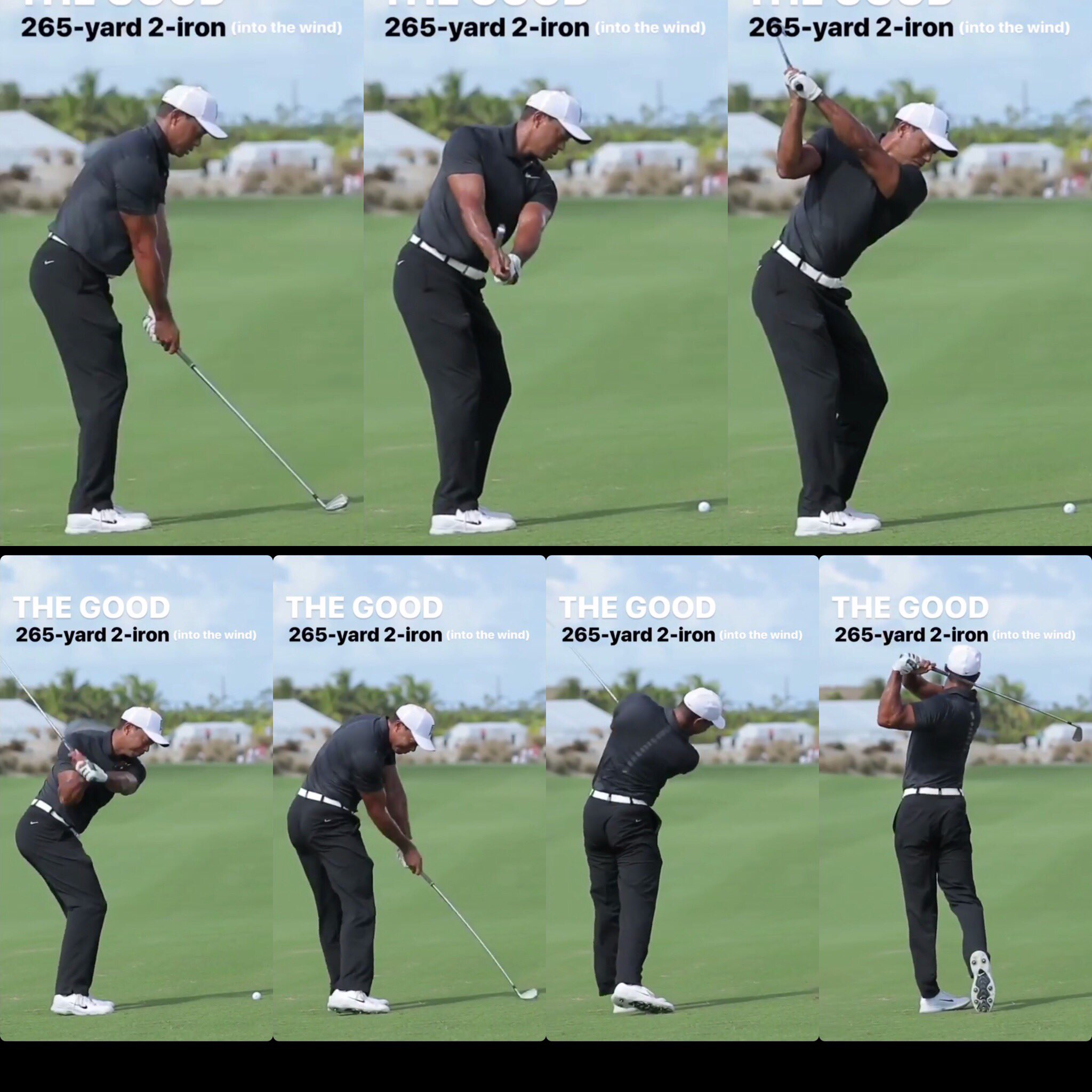
Look at any grainy footage of Tiger Woods from the 1997 Masters or the 2000 U.S. Open at Pebble Beach. You see a violent, beautiful, and terrifyingly efficient athletic motion. It changed everything. Before Tiger, professional golfers looked like your uncle at a country club barbecue. After Tiger, they looked like Olympic decathletes. But the tiger woods iron golf swing isn't just about raw power or gym-rat muscles; it’s a masterclass in how to compress a golf ball better than anyone who has ever lived. Honestly, most amateurs try to copy the wrong parts of his move, and that’s why they slice it into the woods while Tiger was busy sticking long irons to ten feet.
He was different. He is different.
The Secret Sauce of the Tiger Woods Iron Golf Swing
It starts with the setup. If you’ve ever watched Tiger live, you notice he’s wider than he looks on TV. His base is rock solid. In his prime—the "Butch Harmon era"—Tiger’s iron play was built on a massive shift of weight and a release that felt like a whip cracking. He didn't just hit the ball. He pulverized it.
Most people talk about his "stinger," that low-boring 2-iron that never rose more than 15 feet off the ground. But the real magic happened in his standard iron shots. He had this incredible ability to keep the clubhead square to the path for what felt like an eternity. His coach at the time, Butch Harmon, focused on getting Tiger to "stay wide" in the takeaway. No early wrist hinge. Just a big, sweeping arc that created massive leverage.
Then came the transition. This is where most mortals fail. Tiger’s hips cleared so fast it’s a miracle his spine didn't snap. But he kept his chest over the ball. That "cover" is the hallmark of the tiger woods iron golf swing. By keeping his chest down, he ensured the low point of his arc was always ahead of the ball. He took divots that looked like dollar bills—deep, uniform, and perfectly straight.
The Myth of the "Vertical" Swing
People think Tiger’s swing was always steep. Not true. While he did come down into the ball with a lot of force, his plane was remarkably consistent. In the early 2000s, he was actually quite shallow with his long irons, which allowed him to "sweep" the ball off the turf with minimal spin. This is why his ball flight didn't balloon into the wind. It just pierced through it.
He changed coaches. He went to Hank Haney. Then Sean Foley. Then Chris Como. Each iteration of the tiger woods iron golf swing tried to solve a different problem—usually related to his failing knees or his back. With Haney, he got "flatter." The club went more around his body. He lost some of that "trapping" sensation but gained a more predictable miss. With Foley, it became hyper-technical. He focused on "loading" the left side early. It was robotic, maybe even a bit stiff, but his iron stats remained legendary.
Why Compression is Everything
If you want to understand why his irons sounded different, you have to talk about shaft lean. At impact, Tiger’s hands were significantly ahead of the clubhead. This effectively turned a 7-iron into a 5-iron in terms of loft, but with the control of a shorter club.
He didn't flip his wrists. He didn't scoop. He hit down to make it go up.
That's the paradox of golf. Amateurs try to help the ball into the air. Tiger tried to bury it in the dirt, and the physics of the grooves and the turf interaction did the rest. You can hear the "thud" in old clips from the Tiger Slam. It’s a heavy sound. It’s the sound of the ball being compressed against the face until it has no choice but to launch with 130 mph of ball speed.
The "Stinger" and Creative Shot-Making
You can't discuss the tiger woods iron golf swing without mentioning the variety. Most guys on Tour today hit one shot: a high draw. Tiger had nine. He could hit a high cut, a mid-flight straight ball, or a low hook with the same 6-iron.
His "stinger" wasn't just a gimmick. It was a tactical weapon used to find fairways under pressure. To hit it, he would move the ball back in his stance, shorten his follow-through (the "sawed-off" finish), and lean hard into his left side. It required incredible hand-eye coordination. If you try this at home and mistime it by a millisecond, you're looking at a shank or a topped ball that travels twenty yards. Tiger did it on the 72nd hole of a Major.
The Role of the Legs
Tiger’s leg snap is the stuff of legend and surgical reports. In his younger days, his left leg would straighten so violently at impact that it looked like it was jumping. This "ground force" is what modern instructors like George Gankas preach today, but Tiger was doing it naturally in 1994.
The problem? It’s hard on the body.
That snapping motion created huge torque on his knee. As he aged, the tiger woods iron golf swing had to become more "quiet." He couldn't jump anymore. He had to learn to use his torso and arms more efficiently. The 2019 Masters win was a testament to this evolution. He wasn't the longest guy anymore, but his iron play was surgical. He picked apart Augusta National not with power, but with distance control.
Distance Control: The Real Metric of Greatness
Tiger almost never missed long or short. Left and right? Sure, he’d hit a wild drive now and then. But his iron distances were dialed in to the yard. Part of this was his "windows." He didn't just look at the flag; he looked at a spot in the air he wanted the ball to fly through.
If he had 155 yards, he knew exactly how a 10 mph wind would affect a 3/4 8-iron versus a full 9-iron. Most players guess. Tiger calculated.
What You Can Actually Learn from Tiger
Let’s be real: you aren't going to swing like 2000 Tiger. Your back would give out by the third hole. But there are pieces of the tiger woods iron golf swing that apply to everyone.
First, the grip. Tiger’s grip was surprisingly neutral. Not too strong, not too weak. This allowed his hands to be active without being "flippy."
Second, the tempo. Even when he was swinging at 125 mph with a driver, his transition from the top was smooth. He never rushed the start of the downswing. He let the club "fall" into the slot before accelerating. Amateurs usually do the opposite—they jerk the club from the top and lose all their power before they even get to the ball.
The "Tiger Lean"
If you watch him closely, his head drops slightly during the downswing. This isn't a mistake. It’s a sign that he’s loading into the ground. He’s getting "short" to get powerful. Then, at impact, he extends. This vertical move is where the speed comes from.
But notice his eyes. They stay level. He doesn't tilt his head like some modern players. He stays incredibly centered.
Equipment and the "Tiger Spec"
It's also worth noting that Tiger played (and plays) some of the most difficult irons in the world. For most of his career, he used true muscle-back blades. No cavity backs. No "forgiveness."
These clubs have a tiny sweet spot, about the size of a pea. If you miss it, your hands will sting for an hour. Tiger played them because they offered the most feedback. He wanted to feel exactly where on the face he hit the ball. This feedback loop is what allowed him to refine the tiger woods iron golf swing into the most precise weapon in sports history. He also prefers a heavier swing weight (usually around D4 or D5) and True Temper Dynamic Gold Tour Issue X100 shafts. These are basically telephone poles—stiff, heavy, and designed for guys who swing exceptionally hard.
The Mental Side of the Strike
Tiger famously said he could feel the ball on the face of the club during the strike. That's likely a bit of hyperbole, but it speaks to his connection with his equipment. He wasn't just swinging a stick; he was wielding a tool.
When he stood over a ball, he wasn't thinking about "swing keys." He was visualizing the flight.
"I see the shot, I feel the shot, I hit the shot."
That’s it. All the technical work happened on the range. On the course, the tiger woods iron golf swing was purely reactive. This is a huge lesson for the rest of us. We spend too much time thinking about our elbow position or our hip rotation while standing over the ball. Tiger did that work in the off-season so that under pressure, he could just "play golf."
Nuance in the Short Irons
With wedges and short irons, Tiger was a master of "dead hands." He didn't want a lot of wrist action. He wanted a big, chest-driven turn that produced a very consistent, low-spin launch. This made his shots stop on a dime. By minimizing hand action, he took the "luck" out of the game. The ball went where the chest pointed.
Actionable Steps to Improve Your Iron Play
To capture just a fraction of the Tiger magic, you have to change your priorities. It’s not about swinging harder; it's about swinging better.
- Establish a Wide Takeaway: Stop picking the club up with your hands. Use your shoulders to push the club away from your body for the first two feet of the swing. This creates the arc necessary for power.
- Focus on "The Cover": At impact, feel like your buttons on your shirt are pointing at the ball, not the sky. This ensures you hit down and compress the ball.
- Control Your Finish: Tiger’s balance was impeccable. If you can't hold your finish until the ball lands, you're swinging too hard. Slow down until you find your center.
- Practice Your Windows: Don't just hit 7-irons at the range. Try to hit one high, one low, and one "standard." This develops the "feel" that made the tiger woods iron golf swing so versatile.
- Get Fitted: Tiger’s clubs are built to his exact specs. If your clubs are too long, too short, or have the wrong flex, you’ll never find a consistent impact position.
Tiger Woods didn't just play golf; he solved it. His iron swing was the primary tool he used to dismantle courses and opponents alike. While the injuries have slowed him down, the fundamentals of his move—the width, the compression, and the artistic shot-shaping—remain the gold standard for anyone who wants to take their game seriously. Stop trying to hit it 300 yards and start trying to hit it "pure." That’s the real Tiger way.