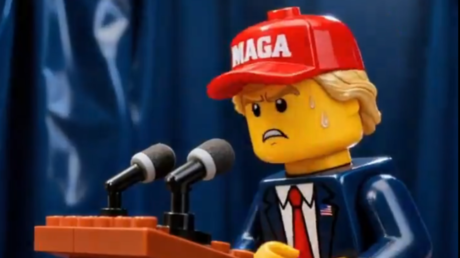
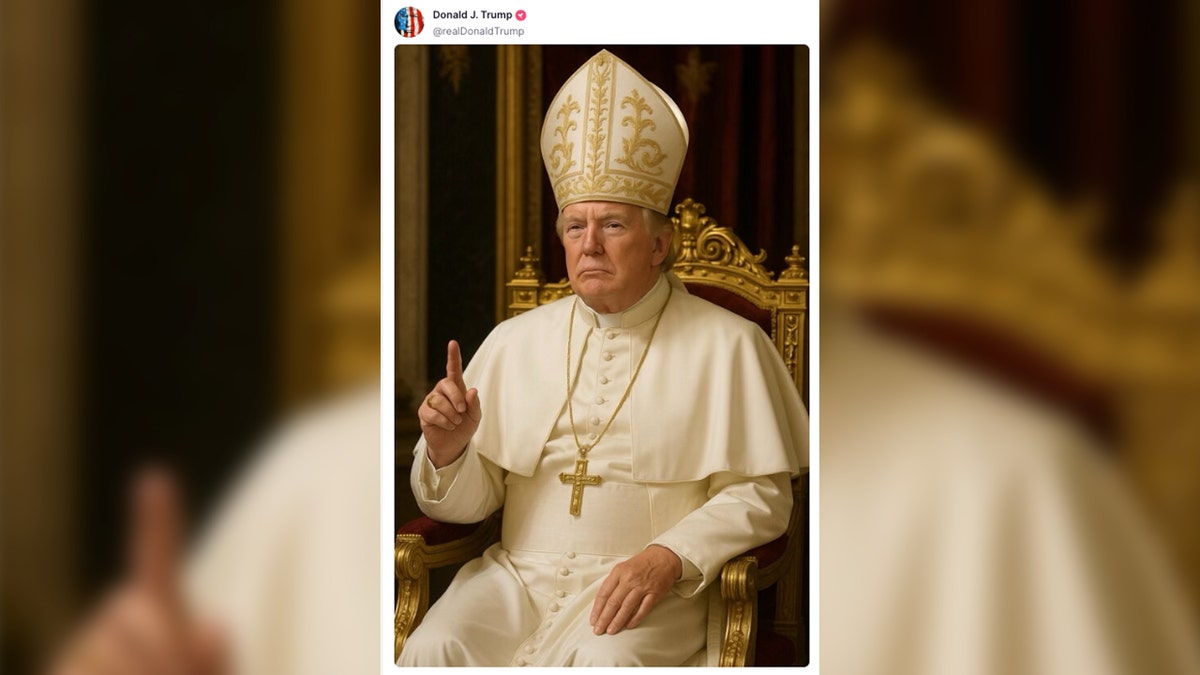
The media is currently hyperventilating over a digital image of a synthetic Christ. They call it madness. They call it a breakdown of the executive mind. They see a social media post and scream "insanity" because it deviates from the approved aesthetic of the ruling class.
They are missing the most significant shift in political communication since the invention of the printing press. If you found value in this post, you might want to read: this related article.
When Donald Trump shares an AI-generated image of Jesus, or takes a rhetorical swing at the Vatican, he isn't losing his grip on reality. He is performing a hostile takeover of spiritual symbolism. The pearl-clutching from the "intellectual" establishment isn't actually about religious piety; it’s about the loss of their monopoly on truth. For decades, the gatekeepers told you what was sacred and what was sacrilegious. Now, a GPU in a basement can rewrite the visual language of faith in ten seconds, and the traditional power structures are terrified.
The Myth of the Rational Voter
The "insanity" narrative relies on a flawed premise: that voters want a stoic, predictable bureaucrat who follows the liturgical calendar to the letter. This is a fantasy held by people who spend too much time reading white papers and not enough time talking to humans. For another angle on this story, refer to the latest coverage from Associated Press.
Politics is not a debate club. It is a war of vibes.
By utilizing AI-generated religious imagery, Trump is leaning into the Post-Truth Aesthetic. In this world, the "realness" of the photo is irrelevant. Its "truthiness"—the emotional resonance it strikes with a specific base—is the only metric that matters. To the critic, an AI Jesus is a "hallucination." To the supporter, it is a digital folk-art representation of a perceived spiritual alliance.
Critics point to his friction with the Pope as evidence of a mental fracture. They forget that the United States was founded by people who viewed institutional religious authority with extreme suspicion. Attacking the Vatican isn't a bug; it's a feature of the American populist tradition. It is a direct appeal to the "priesthood of all believers" over the centralized hierarchy of a foreign state.
Digital Iconoclasm and the Death of the Expert
We are witnessing the birth of Algorithmic Populism.
The "experts" tell us that AI is dangerous because it can create misinformation. What they mean is that AI allows the masses to create their own mythology without asking for permission. When a political figure uses AI, they are bypassing the professional photographers, the ad agencies, and the legal departments.
I have watched legacy media organizations spend millions trying to "fact-check" memes. It is a fool’s errand. You cannot fact-check a feeling. You cannot "debunk" a digital icon. The competitor's article focuses on the sanity of the man, while the man is busy redefining the reality of the medium.
Let’s talk about the mechanics of the "AI Jesus" post.
- Low Friction: It costs nothing to produce.
- High Engagement: It triggers an immediate, visceral reaction from both fans and haters.
- Plausible Deniability: If it goes too far, it’s just a "meme" or "tech experimentation."
This isn't a sign of a failing mind. It is a sign of a high-speed adaptation to a world where the attention span is measured in milliseconds. The "insane" label is just a coping mechanism for people who can't keep up with the rate of change.
The Pope vs. The Populist
The clash with the Pope is framed as a diplomatic disaster. In reality, it is a brilliant bit of brand positioning. By positioning himself against the globalist hierarchy of the Church, Trump solidifies his role as the ultimate outsider.
Historically, kings and emperors fought the Papacy for centuries. This isn't "insanity"; it is a return to the Westphalian struggle—the idea that the sovereign state (and its leader) owes no higher earthly allegiance.
The "lazy consensus" says that a candidate must court the Catholic vote by bowing to the Bishop of Rome. The data suggests otherwise. Modern religious voters are increasingly "de-denominationalized." They care less about what a man in a palace in Italy says and more about who is fighting the culture war on their behalf at home.
The Hallucination of Stability
The media wants a return to "normalcy." But normalcy is a dead letter.
We live in an era where:
- The economy is managed by black-box algorithms.
- The news is curated by engagement-hungry bots.
- Social interaction is mediated by silicon-based intelligence.
In this context, using AI to generate religious imagery is the most "sane" thing a politician can do. It is an acknowledgment of the current environment. To pretend we are still in the era of three TV networks and a unified national discourse is the true delusion.
The "insanity" diagnosis is a lazy analytical tool. It’s what people use when they don't understand the underlying logic of a system. When the Wright brothers first tried to fly, people called them crazy. When Steve Jobs talked about a computer in every pocket, people called him a dreamer.
When a politician uses AI to bypass the media filter and speak directly to the lizard brain of the electorate, the media calls him a madman because they are no longer the ones holding the microphone.
Stop Asking if He’s Insane
The question "Is he insane?" is a distraction. It's a "People Also Ask" query designed to keep you clicking on clinical-sounding articles that offer no actual insight.
The real question is: Why does this work?
It works because we have entered the age of Simulated Sovereignty. The voters aren't looking for a policy manual; they are looking for a protagonist in a digital drama. AI Jesus isn't a religious statement; it’s a character beat. The fight with the Pope isn't a theological dispute; it’s a plot point.
If you are waiting for a return to "dignified" political discourse, you are waiting for a train that left the station in 2015 and has since been dismantled for parts. The future of politics is synthetic, polarized, and deeply weird.
The Cost of the Contrarian Path
There are downsides to this approach, of course.
- Total Devaluation of Truth: When everything is a meme, nothing is sacred.
- Hyper-Polarization: You don't just disagree with the "other side"; you live in a different physical reality.
- Institutional Decay: If the Pope and the President are just combatants in a Twitter feud, the gravity of their offices evaporates.
But acknowledging these downsides doesn't make the strategy "insane." It makes it effective. The competitor thinks they are witnessing a breakdown. I am telling you that you are witnessing a breakthrough in the dark art of digital persuasion.
The "experts" will continue to write their post-mortems and their psychological profiles. They will continue to use words like "unhinged" and "erratic." Meanwhile, the images will continue to be shared, the base will continue to be energized, and the traditional gatekeepers will continue to wonder why their "logical" arguments are failing to land.
You aren't watching a man lose his mind. You are watching the world lose its old skin.
Don't look at the AI Jesus. Look at the people who are terrified of it. That is where the real story lives. The fear isn't that the leader is crazy; the fear is that the old rules no longer apply, and the people in charge of the old rules have no idea what to do next.
The age of the rational actor is over. Welcome to the era of the sacred algorithm.
Stop complaining about the madness and start studying the method.