Dust smells like old paper and forgotten time. If you have ever stood in a gravel driveway on a humid Saturday morning, nursing a paper cup of lukewarm coffee while scanning tables draped in stained bedsheets, you know the exact texture of that silence. It is the silence of things left behind.
Most yard sales are minor tragedies of accumulation. A plastic bin of dented Christmas ornaments. A paperback thriller with water-damaged pages. A blender missing its lid. You look at these items and you see the precise moment someone decided they were done carrying them.
Then, rarely, you see something else.
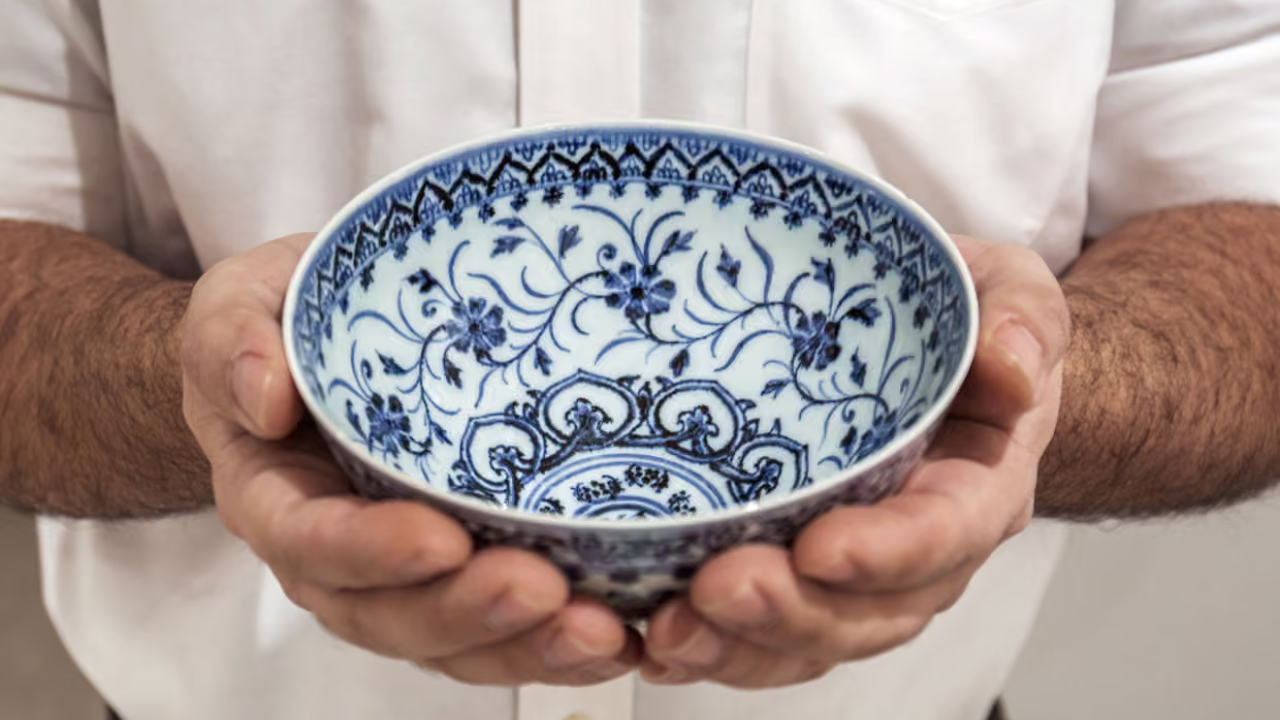
Picture a man in Connecticut, a few summers ago, walking past a box of mismatched silverware and pausing. Not because he is a seasoned appraiser with a jeweler's loupe tucked in his pocket, and not because he hears angels singing over porcelain. He pauses because his eye catches a line. A blue so deep it feels wet, curving across a white surface with the careless grace of a brushstroke applied by a hand that had done it ten thousand times before.
He turns it over. It costs thirty-five dollars.
In the calculus of modern yard sales, thirty-five dollars is an aggressive price for a dish. It is the kind of number that makes you hesitate. It is the cost of a mediocre lunch, or half a tank of gas, or a paperback box set. You think: Is this bowl really worth more than a large pizza?
He paid the thirty-five dollars anyway.
That single transaction—a crumpled green bill traded for a piece of fired mud—triggered a chain reaction that would eventually lead to a Sotheby's auction room, where gavel falls sound like small gunshots and fortunes change hands in the span of a breathless heartbeat.
We live in an age that worships provenance. We want the certificate of authenticity. We want the digital ledger, the verified receipt, the institutional stamp of approval that tells us something is safe to care about. We are terrified of being fooled.
Yet history is written by people who looked at trash and saw treasure.
Consider what happens next: The man takes the bowl home. He puts fruit in it. Maybe he drops a set of rogue keys into its center, listening to the sharp clink of brass against glaze. He treats it like a dish because, functionally, physically, stubbornly, it is a dish. It holds things. It sits on a wooden counter catching the afternoon slanted light.
Weeks pass. Months, perhaps.
Until curiosity, or a casual conversation, or a sudden, nagging itch at the back of the mind pushes him to send a few photographs to an auction house.
Let us pause right there, at the digital upload button.
Imagine the sheer weight of skepticism required to send photos of a flea market find to experts who handle museum-grade antiquities. You expect a polite, automated brush-off. You expect the digital equivalent of a shoulder shrug. You expect an email back saying, Thank you for your submission, but this is a twentieth-century reproduction from a gift shop in Rhode Island.
Instead, the phone rings. Or the email arrives, stripping the breath from your lungs.
It is not a reproduction. It is fifteenth century. It is Ming Dynasty, specifically the Yongle period, forged during an era when ceramic artists in China were working with a level of chemical and aesthetic mastery that modern science still struggles to fully replicate. There are only a handful of these known to exist in the entire world. Most of them reside behind thick, climate-controlled glass in institutions like the National Palace Museum in Taipei or the British Museum.
And this one? It was sitting under a stack of old magazines next to a box of VHS tapes in Connecticut.
How did it get there?
History is a leaky vessel. Things slip through the floorboards of empire, trade routes, estate sales, and attic cleanouts. A sailor brings home a souvenir. A diplomat's widow downscales her estate in the 1950s. A clueless relative inherits a box marked china and assumes it means the country of origin, not the material, packing it away in a dark basement where it stays for fifty years, gathering invisible layers of grime.
The bowl is decorated with cobalt blue motifs of lotus, peony, chrysanthemum, and pomegranate blossoms. The painting is not stiff; it is alive. The cobalt bleeds slightly into the glaze in a way that connoisseurs call "heaping and piling"—a glorious technical flaw that became an artistic signature of the early fifteenth-century imperial kiln yards at Jingdezhen.
When you run your finger over those dark spots, you are touching the literal iron impurities in the cobalt ore, bubbling up through the glaze six hundred years ago under the white-hot breath of a wood-fired dragon kiln.
By the time the bowl reached the auction block at Sotheby’s in New York, the stakes had shifted entirely.
It was no longer about thirty-five dollars. It was about seven hundred and twenty-one thousand, eight hundred dollars.
Read that number again. $721,800.
That is not just an appreciation in value. That is a rupture in reality. It is the kind of math that breaks your brain. It forces you to look around your own living room, at the thrifted mug on your desk, the paperback book on your nightstand, the odd little brass figurine you picked up in a thrift store in Maine for four bucks, and wonder: What am I missing?
We are surrounded by history, but we walk through it like ghosts through a wall. We are so accustomed to mass production—to items stamped out by identical steel molds in factories thousands of miles away—that we have forgotten what an artifact feels like. We have forgotten that human hands shaped everything we touch, long before those hands turned to dust.
When the hammer came down in that auction room, it didn't just enrich a man from Connecticut. It validated a fundamental human impulse: the urge to collect, to preserve, to rescue beauty from the jaws of oblivion.
There is a profound vulnerability in admitting that we do not know what we are looking at. Most of us would have walked past that bowl. We would have seen the blue pattern, thought it looked nice, checked the bottom for a modern sticker made in China, and put it back down because we had groceries to buy and traffic to beat. We are in too much of a hurry. We optimize our lives for efficiency, stripping out the drift, the wandering, the accidental discovery.
The yard sale is the last great democratic hunting ground.
In a world dominated by algorithmic curation—where your Spotify feed knows your musical tastes before you do, and your shopping cart is predicted by data points harvested from your mouse clicks—the yard sale remains wonderfully, beautifully chaotic. It is entirely analog. It is messy. It relies on eye contact, cash, and dumb, glorious luck.
You cannot algorithm your way into finding a Ming Dynasty bowl at a suburban driveway sale. You have to be there. You have to look. You have to take a gamble on thirty-five dollars.
Think about the previous owners.
Who bought it first? Was it a court official in Nanjing? Did it sit on a teakwood table while scholars sipped green tea and debated poetry? How did it cross oceans? Did it survive shipwrecks, revolutions, attic fires, and spring cleanings?
Objects outlive us by orders of magnitude. We are merely their temporary custodians. We rent our possessions from the future.
When the Connecticut buyer handed over that crumpled thirty-five dollars, he wasn't buying an investment portfolio. He was buying a mystery. He was participating in a lineage of stewardship that stretches back across centuries of wars, dynasties, and forgotten lives.
The bowl doesn't care about the money. Porcelain is cold, dense, and indifferent. It sits there, holding its cobalt flowers, as unfazed by a price tag of seventy-five cents at a rummage sale as it is by a nearly three-quarter-million-dollar payout in Manhattan.
Value is a shared hallucination. But beauty, real and unyielding, carved from clay and fire and human patience six hundred years ago, is something else entirely.
The next time you walk past a table of junk on a Saturday morning, slow down. Look closer at the shadows underneath the dust. Look for the line that doesn't quite match the rest.
Something extraordinary is always waiting in the pile.