Metal does not care about draft stock.
It does not care about a national championship ring gleaming in a velvet box, or the roar of a hundred thousand voices echoing off concrete walls in Ann Arbor, or the quiet, desperate hope of a seventh-round pick trying to claw his way onto an active NFL roster. When two tons of steel meet asphalt at highway speed, physics is the only referee on the field, and it never throws a flag.
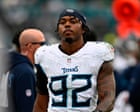
For Tennessee Titans outside linebacker Jaylen Harrell, the collision that left him seriously injured was not an isolated bolt of bad luck. According to police reports and emerging details surrounding the incident, the wreck was the violent final period at the end of a chaotic sentence—one that allegedly began inside the cabin of a moving vehicle, with an assault on the person behind the wheel.
Stop. Read that again.
We are conditioned to consume sports news in sterile, bite-sized updates. A player is listed as questionable. A player is placed on the non-football injury list. A player is involved in an altercation. The headlines wash over us like background noise while we wait for Sunday afternoon. We treat these young men like avatars in a simulation, forgetting the terrifying fragility of a twenty-something nervous system carrying the weight of an entire family’s expectations, bruised ribs, sleep deprivation, and the constant, gnawing dread of being cut before Tuesday.
To understand what happens when a promising young athlete allegedly lashes out at a driver moments before a catastrophic crash, you have to step out of the stadium lights and into the suffocating darkness of a late-night car ride.
The Anatomy of a Split-Second Spiral
Consider a hypothetical scenario to understand the mechanics of that kind of panic—not to excuse a single alleged blow, nor to invent facts not yet proven in a courtroom, but to feel the claustrophobia of the moment. Imagine you are sitting in the back seat at two in the morning. The streetlights strobe across your face in a hypnotic, nauseating rhythm. Your body aches from six days of colliding with three-hundred-pound linemen. Your phone is buzzing with texts from an agent reminding you that special teams reps are your only lifeline to a second contract. Maybe you have had too much to drink. Maybe the driver takes a turn you didn't expect, or says a word that hits an exposed nerve.
In a normal state of mind, you speak up. You ask to pull over.
In a state of acute emotional dysregulation, your brain hijacks the steering wheel long before your hands ever reach for the front seat.
That is the invisible architecture behind the police reports detailing Jaylen Harrell’s crash. The bare facts read like a tragic police blotter: an NFL linebacker, a rising talent out of the University of Michigan, involved in a single-vehicle or multi-vehicle wreck so severe it sent him to the hospital with serious injuries. Then comes the detail that turns a sympathetic tragedy into a complicated moral wreckage—the allegation that Harrell assaulted the driver immediately preceding the impact.
Think about the sheer terror inside that cabin. A driver trying to keep a vehicle between painted lines at sixty miles an hour while absorbing physical blows. A passenger so lost to rage, confusion, or impairment that self-preservation evaporates entirely. Nobody wins in that equation. The driver is fighting for survival; the passenger is actively dismantling his own future with his bare hands.
The Myth of the Invincible Athlete
I have sat in recovery rooms and locker room hallways with men who spent their entire lives being rewarded for controlled violence, only to watch them shatter the moment the whistle blew. When you are six-foot-four and two hundred and fifty pounds, the world treats you like a tank. Coaches praise your motor. Scouts measure your wingspan and your forty-yard dash, cataloging you like thoroughbred livestock. Nobody measures how well you regulate cortisol when the lights go out. Nobody asks what happens when the aggression required to survive on third-and-long leaks into a Tuesday night.
We love the highlight reel, so we ignore the psychological whiplash.
Look at Jaylen Harrell’s trajectory leading up to this point. At Michigan, he was part of a defensive front that suffocated offenses and carried a storied program all the way to a national title. He wasn't the loudest superstar in the room; he was a grinder, a guy who set the edge, did the dirty work, and earned a shot in the pros when the Titans called his name in the 2024 NFL Draft. Making it to the league as a late-round pick is not a victory lap—it is an audition that never ends. Every practice is a survival test. Every film session is a public execution of your flaws.
When an athlete under that kind of microscopic pressure snaps, the public reaction usually splits into two equally useless camps. One side immediately demands blood, calling him a thug and demanding his immediate release before the police report is even dry. The other side rushes to wrap him in bubble wrap, treating him solely as a tragic victim of a car accident while conveniently erasing the human being sitting in the driver's seat.
Both reactions miss the point entirely.
The Person Behind the Wheel
Let us talk about the driver, because in the rush to check Harrell’s injury status and calculate what this means for Tennessee’s linebacker depth chart, the person driving the car becomes a footnote.
Whether the driver was a friend, a hired rideshare professional, or an acquaintance doing a favor, they stepped into that vehicle expecting to get from point A to point B. They did not sign a waiver to become a sparring partner in a moving cage. Being assaulted while operating a vehicle is not a minor scuffle; it is an existential threat to everyone on the road. Every commuter sharing that stretch of asphalt—the nurse heading home from a double shift, the father driving his kids back from a late flight—had their lives placed in the hands of a driver who was allegedly being struck while trying to steer.
Accountability does not cancel out empathy, and empathy does not erase accountability. Holding both of those truths in your hands at the same time is uncomfortable, which is precisely why most sports commentary avoids it. It is easier to talk about salary cap implications and roster exemptions than it is to look squarely at the damage a young man can inflict on himself and others in three seconds of unbridled fury.
What the Police Report Cannot Measure
People searching for updates on Jaylen Harrell want clear answers. They want to know the exact severity of his injuries. They want to know what criminal charges are pending, whether the NFL will suspend him under the Personal Conduct Policy, and whether he will ever put on a helmet again.
Those answers will trickle out through press releases, court dockets, and league memos over the coming months. The legal system will weigh the evidence of the alleged assault. Doctors will assess broken bones, lacerations, or internal trauma. The Titans front office will make a cold, calculated business decision about whether a seventh-round developmental player is worth the public relations headache and the rehabilitation timeline.
Yet the most profound consequences of that night will never appear on an injury report.
Think of the silence of a hospital room at four in the morning after the adrenaline fades and the pain medication wears thin. The monitors beep with indifferent precision. Outside the door, a police officer might be waiting to take a statement, or an agent is pacing the hallway trying to manage a crisis that cannot be spun. In that quiet, the illusion of invincibility dies completely. You are no longer an NFL linebacker. You are just a twenty-something kid staring at the ceiling, trying to piece together how a single night turned your body into wreckage and your name into a cautionary tale.
We see this pattern repeat across professional sports with sickening regularity. A young man climbs to the top of a brutally competitive mountain, only to trip on the loose gravel of his own unchecked impulses. Sometimes it is a nightclub altercation; sometimes it is a reckless speed on an empty highway; sometimes it is an outburst in the back of a car that turns a routine drive into a near-fatal crash. Behavioral psychologists have long noted that high-stakes environments without adequate emotional decompression create a pressure cooker. When your entire identity is fused to physical dominance, vulnerability feels like weakness, and anger becomes the only safe emotion to express.
The Long Road Back to Reality
If Jaylen Harrell recovers physically—and everyone with a shred of decency hopes he makes a full medical recovery—his real work will have nothing to do with bench presses or pass-rushing drills.
Rebuilding a body takes months of sweat, surgical screws, and grueling physical therapy. Rebuilding trust, however, requires looking into a mirror without flinching. It requires sitting across from the person you allegedly hurt and owning the terror you caused, without hiding behind lawyers, PR statements, or the excuse of a bad night. It requires figuring out why the anger was sitting so close to the surface in the first place.
For the rest of us watching from the sidelines, this story is a mirror we rarely want to look into. We love the violence of football when it is packaged between commercial breaks and sanctioned by league rules. We cheer when a linebacker drives a quarterback into the turf, celebrating the ferocity, the speed, the uncompromising aggression. Then, when that same unbridled intensity spills over into the real world on a dark highway, we act shocked that a human being could not simply flip a switch.
The wreckage on the side of that road is cleared away now. The tow trucks have gone, the glass has been swept from the shoulder, and the traffic moves past at seventy miles an hour without slowing down. Somewhere in a hospital bed, a young man is learning the hardest lesson of his life, staring at the ceiling and listening to the steady, mechanical rhythm of a machine reminding him that he is still alive.