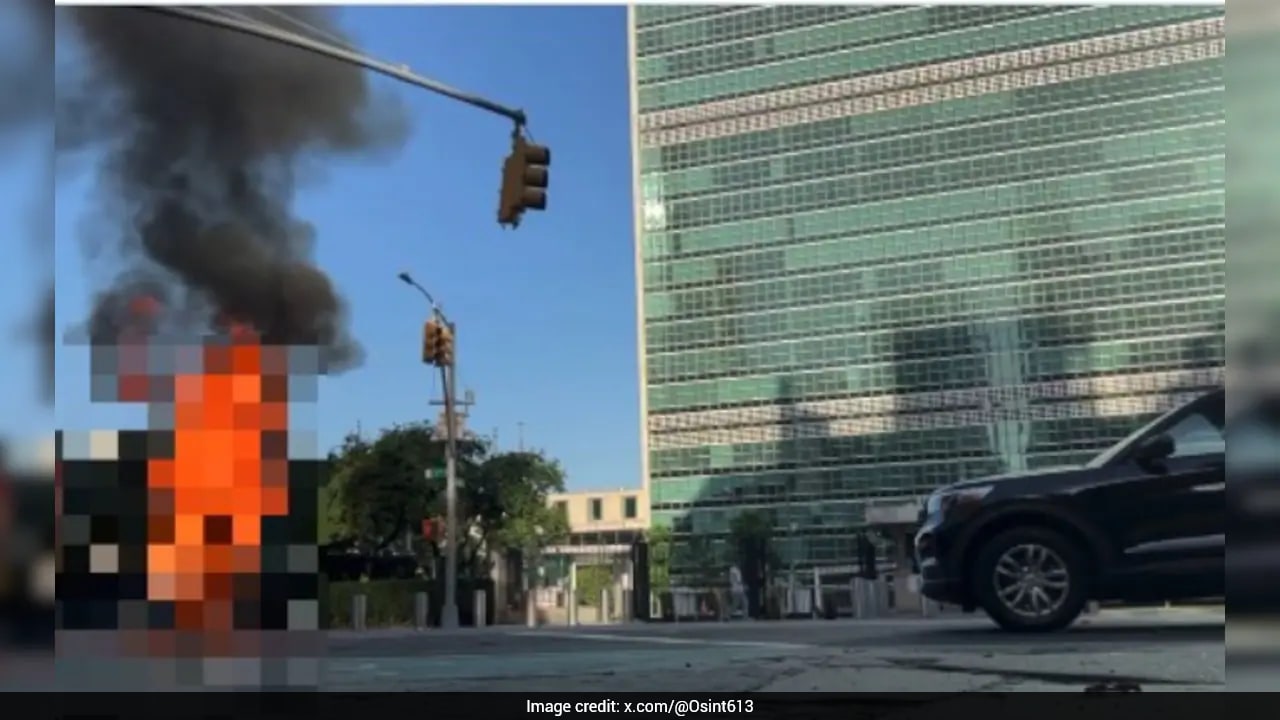
A man stepped onto the sidewalk of First Avenue in Manhattan, right during the chaotic evening rush hour. He wore traditional monastic robes. He planted a Tibetan flag firmly on the concrete. Then, he set himself on fire.
Traffic kept moving. Horns honked. Within fifteen seconds, first responders rushed over with fire extinguishers to smother the flames. But the damage was done. The man, later identified by friends and activist groups as Lobga Rangzen, was rushed to Bellevue Hospital. He didn't survive.
This didn't happen in a remote Himalayan village or on the streets of Lhasa. It happened right outside the United Nations headquarters in New York City. For two decades, Rangzen lived a quiet life in America, earning a living as an Uber driver. Yet, on a Thursday evening, he chose the most extreme, agonizing form of protest available to a human being.
Honestly, it's easy to look at an act like this and see desperation. But if you talk to anyone deep within the Tibetan diaspora, they'll tell you this wasn't just despair. It was a calculated, tragic reaction to a massive legal shift that just happened on the other side of the world.
The Shockwave Behind the Fire
Why now? The timing isn't random. Just days before Rangzen stepped outside the UN, a sweeping new law went into effect in China. It's called the ethnic unity law.
Don't let the friendly name fool you. Human rights watchdogs and international legal experts view this piece of legislation as a terrifying escalation in forced assimilation. The law formally mandates the erasure of distinct minority cultures across China, targeting groups like Tibetans and Uyghurs. It pushes for the mandatory use of the Chinese language in schools and penalizes anything deemed "separatist."
But here's the kicker that drove Rangzen to the edge. The law explicitly gives Beijing the supposed legal basis to target and take action against dissidents living completely outside of China's borders.
Think about that. You escape an authoritarian regime. You move to New York. You drive an Uber for twenty years. Suddenly, a law is passed saying your speech in America makes you a criminal in the eyes of your homeland, and your family back home could pay the price.
Lobsang Paljor, a fellow Uber driver who knew Rangzen from local community gatherings, shared that Rangzen was furious. He was consumed by the tightening chokehold Beijing was placing on his people. Before he struck the match, Rangzen went live on Facebook. He pleaded for Tibetan independence and begged his community to never lose their heritage.
When the Protest Moves to Western Soil
We've seen self-immolation linked to Tibet before. The International Campaign for Tibet has tracked more than 150 of these horrifying protests since 2009. But almost all of them happened inside Tibet or in neighboring regions under heavy Chinese surveillance.
Bringing this act to the United States changes the dynamic completely. It strips away the geographical buffer that lets Western onlookers treat the Tibetan conflict as a distant, historical tragedy.
When police cordoned off First Avenue, the physical remnants of the protest spoke volumes. A Tibetan flag sat on the sidewalk for an hour while investigators walked the scene. Officers collected leaflets left behind. One piece of paper carried a stark, four-word message: "CHINA OUT OF TIBET."
The UN itself tried to play it down. A spokesperson noted that the incident occurred after scheduled meetings finished, meaning no official business was disrupted. That's a corporate response to a human catastrophe. The reality is that the UN has long avoided directly challenging Beijing on Tibet. Dialogue between Chinese officials and representatives of the Dalai Lama broke down way back in 2010. Since then, it's been a wall of silence.
The Myth of Peaceful Liberation
Beijing insists Tibet has been an integral part of its territory for seven centuries. The official narrative calls the 1950 military invasion a "peaceful liberation" from a feudal system.
But history tells a wildly different story. Before the Chinese Communist Party took over, Tibet operated with de facto autonomy. It had its own government, its own currency, and its own legal systems. The subsequent 1951 Seventeen Point Agreement was signed under immense military duress.
In the 1990s, the Free Tibet movement was a massive cultural phenomenon in the West. You couldn't go to a rock festival without seeing a booth for it. Massive benefit concerts featured bands like U2 and Rage Against the Machine. But as the decades rolled on, global attention drifted. China grew into an economic superpower, and Western governments quietly deprioritized Tibetan human rights to preserve trade deals.
Tencho Gyatso, the president of the International Campaign for Tibet, publically mourned Rangzen, calling him a tireless advocate. The tragedy highlights a brutal truth about modern activism. When the world stops listening to your letters, your marches, and your speeches, the pressure builds until someone decides to turn their own body into a signal fire.
What Happens to the Movement Now
If you think this act will force Beijing to rethink its ethnic unity law, you're dreaming. Xi Jinping has steadily increased institutional control over minority regions since taking power in 2012. The state apparatus will likely clamp down even harder, censoring any mention of the New York incident online to prevent copycat protests inside Tibet.
But for the global Tibetan diaspora, Rangzen’s death is a wake-up call. It proves that the long arm of authoritarian policy can reach right into a vehicle on the streets of Manhattan and destroy a life.
The immediate next step for the international community isn't to offer empty condolences. It requires Western governments to aggressively challenge the extraterritorial reach of China's new laws. If an activist doesn't feel safe expressing dissent in New York City, then international sovereignty is already compromised. Keep your eyes on how the US State Department and the European Union handle diplomatic relations over this ethnic unity law in the coming weeks. The diplomatic fallout is just getting started.