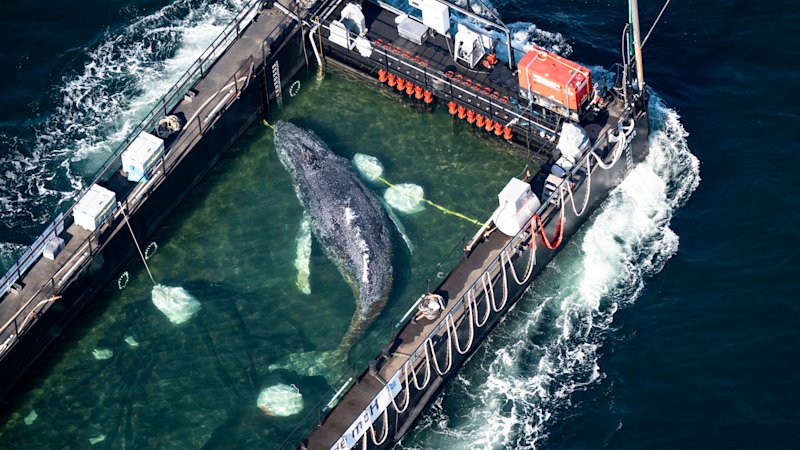
The story of Timmy, the young humpback whale who captured the hearts of millions in Germany, didn't end with a movie-style victory. On May 2, 2026, after weeks of intense public debate and failed initial attempts, a privately funded team finally released the whale from a barge into the North Sea. Many cheered. Some wept. But beneath the surface of this media sensation lies a harsh reality that most coverage missed.
People often project human emotions onto wild animals in distress. That’s exactly what happened here. When you see a giant mammal struggling in shallow water, your instinct is to help. You want a happy ending. Scientists, however, look at the situation through a different lens. They saw a sick, compromised creature, and they saw a rescue attempt that many described as cruel.
The Reality Behind The Rescue
Timmy was first spotted near Germany's Baltic Sea coast on March 3. He was miles away from his natural habitat in the Atlantic Ocean. Why a young whale would wander so far off course remains a mystery. Experts suggest he might have been chasing a shoal of herring or simply became disoriented during his migration. Regardless of the reason, the outcome was immediate and severe.
The Baltic Sea is not a whale's playground. Its salt content is significantly lower than that of the Atlantic. For a humpback, this isn't just uncomfortable; it’s physically damaging. Timmy developed painful, blister-like skin lesions. Rescuers spent days applying kilos of zinc ointment, a desperate measure to ease the animal's suffering. He was also potentially entangled in fishing gear, further limiting his movement and ability to feed.
When a large whale stays in shallow water for too long, the physical toll is brutal. Gravity works against them. Their internal organs are not designed to support their own immense body weight without the buoyancy of deeper water. This can lead to crushed organs and restricted blood flow. By the time private entrepreneurs stepped in with a million-dollar rescue plan, experts from institutions like the Oceanographic Museum in Stralsund argued that the animal was already too far gone.
Science Versus Public Sentiment
The divide between the public and the scientific community was massive. While thousands of people baked whale-shaped cakes, composed songs, and even got tattoos of the creature, the International Whaling Commission labeled the entire operation "inadvisable."
The tension creates a tricky ethical dilemma. Is it ever right to force a medical intervention on a wild animal when the likelihood of survival is slim? Supporters argued that leaving him to die was an act of abandonment. Critics argued that dragging a dying animal onto a barge and transporting him across the ocean was, in the words of one museum director, "pure animal cruelty."
This isn't just about one whale. It's about our relationship with nature. We want to believe we can fix anything. When we see a problem, we throw resources at it. But sometimes, nature requires us to step back. Letting an animal die in peace, as painful as it is to watch, is often the most humane choice.
What Happens Now
Timmy is equipped with a GPS tracker. As of now, he’s swimming freely in the North Sea, but the road ahead is treacherous. The Danish environment ministry has already made it clear: they won't intervene if he strands again. They view beaching as a natural occurrence.
If you're following this story, manage your expectations. A tracker shows movement, but it doesn't show health. Swimming "in the right direction" is a good sign for today, but the long-term survival rates for whales that have undergone such trauma are notoriously low. The best-case scenario is that he regains his strength and finds his way back toward the Atlantic. The realistic scenario is much harder to accept.
If you care about marine conservation, don't focus only on the dramatic rescues. Support the boring, long-term work that prevents these situations in the first place. That means pushing for cleaner oceans, regulating fishing gear that leads to entanglements, and supporting research into migration patterns.
We need to learn from Timmy. We need to respect the boundary between human intervention and natural processes. Next time a high-profile case hits the headlines, look for the experts' perspective before getting caught up in the online noise. Sometimes the most powerful thing we can do is acknowledge the limitations of our power.