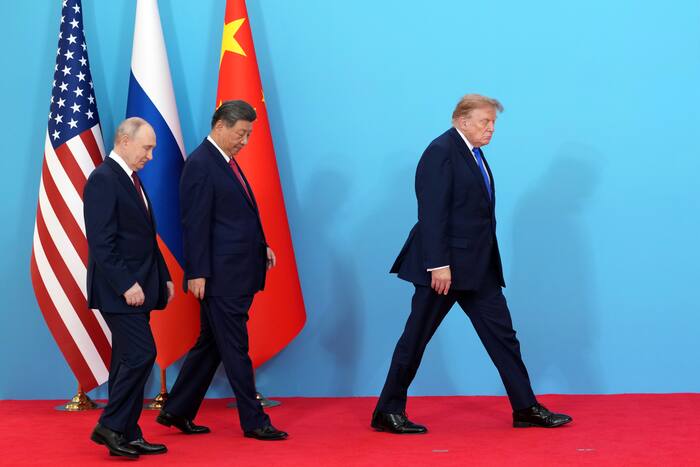
Hosting simultaneous high-level bilateral engagements with rival superpowers inside a multilateral forum is not an exercise in diplomatic etiquette; it is a spatial and temporal routing problem designed to manufacture asymmetric leverage. When Xi Jinping welcomes Vladimir Putin and Donald Trump to the Asia-Pacific Economic Cooperation (APEC) summit, Beijing operates as the central node in a classic strategic triangle. Standard political commentary treats these encounters as theater—analyzing handshakes, seating charts, and body language as isolated cultural signals. That framing misses the structural reality. Protocol in Beijing functions as a hard signaling mechanism that establishes hierarchy, manages domestic audience costs, and locks both Washington and Moscow into predetermined negotiating lanes before a single policy concession is drafted.
To understand how Beijing extracts strategic value from hosting both leaders simultaneously, analysts must strip away journalistic metaphors and evaluate the summit through three operational frameworks: spatial signaling geometry, the asymmetric cost function of bilateral concessions, and multilateral agenda capture.
The Architecture of Triangular Diplomacy
In international relations theory, specifically Lowell Dittmer’s framework of the strategic triangle, a "pivot" player achieves optimal positioning when it maintains positive, functional relations with two wings that remain mutually hostile or deeply estranged. At APEC, China occupies the pivot role. The United States and Russia occupy the wings.
A host nation controls the physical and chronological infrastructure of a summit. Every minute allocated to one leader, every venue selected for a private dinner, and every joint communiqué draft circulated prior to the plenary session alters the bargaining leverage of the participants. Beijing does not merely accommodate two schedules; it uses the friction between those two schedules to remind each guest of their dependency on Chinese mediation or market access.
Protocol as a Hard Signaling Mechanism
Diplomatic protocol is the public ledger of bilateral status. Because major powers cannot openly state their dominance over peers without triggering immediate domestic backlash in the counterparty's capital, they encode status into physical arrangements.
- Arrival Sequencing and Greeting Tiers: The rank of the official sent to the tarmac—ranging from a vice minister to a Politburo Standing Committee member—sets the baseline temperature of the visit. Sending a higher-ranking official to greet Putin than Trump, or vice versa, communicates immediate alignment without uttering a word of policy critique.
- Venue Stratification: Beijing separates transactional diplomacy from strategic alignment through architecture. A formal meeting inside the Great Hall of the People signals institutional weight and state-to-state formality. An informal walk or private tea at Zhongnanhai or the Diaoyutai State Guesthouse signals personal trust and strategic depth. By granting one leader an intimate venue while keeping the other strictly within formal plenary spaces, the host visibly stratifies the relationships.
- Visual Framing and Optics: State media camera angles are calibrated to project centrality. When Xi stands between two leaders or hosts them sequentially against identical backdrops, domestic and international audiences receive a consistent visual message: Beijing is the indispensable clearinghouse for global stability.
Chronological Sequencing and Information Asymmetry
The order in which Xi meets Putin and Trump dictates the informational baseline of the summit. If Xi meets Putin first, Beijing and Moscow can synchronize their talking points, establish red lines regarding sanctions or regional security, and present a unified front before Trump enters the room. This sequence forces the American delegation into a reactive posture, compelling Washington to spend diplomatic capital probing the depth of Sino-Russian coordination rather than advancing its own trade or security agenda.
Conversely, meeting Trump first allows Xi to test Washington’s willingness to offer tariff relief, technology export adjustments, or bilateral stability guarantees. Xi can then carry those exact parameters into his subsequent meeting with Putin, using the prospect of a U.S.-China détente as subtle leverage to keep Moscow compliant with Beijing's economic terms. In both scenarios, the pivot player holds complete information about both bilateral tracks, while the two wing players must rely on incomplete intelligence and public readouts to infer what was agreed upon behind closed doors.
The Asymmetric Cost Function of Bilateral Engagements
Every leader arriving at APEC carries a distinct domestic political constraint—what political scientist James Fearon defines as "audience costs." A leader incurs audience costs when they make public commitments or project strength domestically, only to back down or appear subordinate abroad. Beijing’s summit management exploits the radically different audience cost structures of Moscow and Washington.
Moscow’s Dependency Vector
Russia enters APEC under severe structural constraints. Cut off from Western capital markets, subjected to comprehensive export controls, and locked in a prolonged attrition conflict in Ukraine, Moscow relies on China as its primary economic lifeline, energy buyer, and supplier of dual-use industrial components.
- Asymmetric Trade Reliance: China absorbs massive volumes of discounted Russian crude oil, pipeline gas, and coal, while supplying the machine tools, microelectronics, and heavy vehicles that keep the Russian economy functioning.
- Diplomatic Isolation Offset: For Putin, appearing alongside Xi on a major multilateral stage demonstrates to domestic elites and the Global South that Western isolation campaigns have failed.
- The Consequence of Dependency: Because Putin needs the visual validation of the summit more than Xi does, Moscow’s bargaining power is capped. Putin cannot afford a public disagreement with Xi over pipeline pricing, Central Asian influence, or payment settlement bottlenecks caused by Chinese banks fearing secondary U.S. sanctions. Beijing extracts quiet economic concessions from Moscow simply by providing the stage.
Washington’s Transactional Paradox
Donald Trump approaches summitry through a fundamentally different operational lens: bilateral transactionalism combined with high domestic visibility. Unlike Putin, who requires multilateral legitimacy, Trump routinely questions the utility of multilateral institutions like APEC, preferring direct, leader-to-leader dealmaking where success is measured in immediate, quantifiable deliverables—agricultural purchases, industrial investment pledges, or tariff reductions.
This creates a specific vulnerability that Beijing systematically targets. To claim a domestic victory, Trump needs a tangible announcement. Xi controls the regulatory levers over Chinese state-owned enterprises, allowing Beijing to offer headline-grabbing purchase commitments or market-access adjustments that cost the Chinese economy relatively little in the long term, in exchange for immediate pauses on U.S. tariffs or delays in semiconductor export restrictions.
The friction arises when Trump’s demand for visible, rapid wins collides with Beijing’s preference for broad, ambiguous framework agreements. If Beijing withholds a deliverable until the final hours of the summit, the U.S. delegation faces a stark choice: accept a watered-down communiqué to avoid leaving empty-handed, or walk away and trigger immediate market volatility and tariff escalation at home.
Multilateral Agenda Capture at APEC
APEC was founded in 1989 to promote free trade, open investment, and regional economic integration across the Pacific Rim. Its consensus-based decision-making model—where every member economy holds an effective veto over joint declarations—makes it uniquely susceptible to great-power paralysis.
When Xi, Putin, and Trump converge at APEC, the forum’s original technocratic mandate is subordinated to three competing geopolitical agendas.
Weaponizing Consensus Rules
In previous APEC summits, disputes over language regarding the war in Ukraine or trade protectionism prevented leaders from issuing a unified joint declaration, forcing the host nation to release a unilateral "Chair's Statement." Beijing views this procedural bottleneck not as a failure, but as an opportunity to demonstrate institutional control.
By controlling the drafting committee, Chinese diplomats steer the summit’s core vocabulary away from Western regulatory standards—such as labor rights, environmental compliance, and state-owned enterprise subsidies—and toward Beijing’s preferred concepts: "connectivity," "inclusive globalization," and "supply chain stability."
- Countering Protectionism: Beijing uses Trump’s tariff policies as a foil, positioning China as the primary defender of the rules-based trading system. This rhetoric appeals directly to Southeast Asian and Latin American APEC members whose export-driven economies suffer from U.S. trade barriers.
- Neutralizing Security Critiques: By framing APEC strictly as an economic forum, Beijing invalidates American attempts to introduce regional security issues—such as maritime disputes in the South China Sea or cross-strait tensions—into the official plenary agenda. Moscow reinforces this framing, using its veto power to block any language referencing European security or sanctions.
Supply Chain Bifurcation vs. Regional Integration
The underlying economic reality of APEC is the ongoing rewiring of global supply chains. Washington seeks to build resilient, non-Chinese manufacturing networks through "friend-shoring" and targeted tariffs. Beijing seeks to preserve its central position in regional manufacturing by integrating its domestic industrial base with ASEAN economies, routing Chinese components through third-party countries for final assembly.
At the summit, these two strategies clash directly over the rules of origin and digital trade standards. Beijing leverages its status as the largest trading partner for nearly every APEC member to lock in bilateral digital economy partnerships and green-energy investment deals on the sidelines of the main event. Even if the formal APEC plenary produces no binding trade liberalization, Beijing accomplishes its strategic objective through a web of bilateral side agreements signed under the summit's umbrella.
Operational Mechanics of a Three-Way Summit
Managing the physical and diplomatic convergence of Xi, Putin, and Trump requires intense operational precision. Missteps in scheduling or public messaging carry immediate market and security consequences.
The Pull-Aside and the Counter-Signal
Beyond scheduled bilaterals, the informal "pull-aside"—a brief, unscripted conversation on the margins of a plenary session or gala dinner—serves as a critical pressure valve.
If Xi and Trump hold an extended, cordial pull-aside captured by pool photographers, it immediately signals to Moscow that Beijing retains viable diplomatic options with Washington, tempering Russian demands on energy pricing or military-technical cooperation. Conversely, if Xi and Putin display overt camaraderie while Trump is relegated to brief, formal interactions with mid-level officials, it signals to Washington that pressure tactics will only accelerate Sino-Russian integration.
Managing Secondary Sanctions Friction
A major substantive bottleneck between Beijing and Moscow lies beneath the surface of public displays of friendship: the compliance behavior of Chinese financial institutions. Following U.S. executive orders authorizing secondary sanctions on foreign banks facilitating Russia's military-industrial base, major Chinese state banks quietly restricted cross-border ruble-yuan settlements to protect their access to the U.S. dollar clearing system.
At APEC, Putin’s primary operational goal in his bilateral with Xi is securing a reliable, sanctions-proof payment mechanism—such as specialized regional clearing banks or barter arrangements—that bypasses dollar exposure. Xi must balance this request against his simultaneous negotiations with Trump. If Xi grants Putin an explicit financial workaround while negotiating tariff relief with Trump, Beijing risks triggering immediate congressional and executive retaliation from Washington, collapsing the U.S. track entirely.
Limitations of the Pivot Strategy
While occupying the pivot position in a strategic triangle confers distinct tactical advantages, the posture carries severe structural risks. Standard commentary often overstates Beijing’s ability to manipulate both Washington and Moscow indefinitely. In practice, the pivot strategy operates within narrow boundaries and suffers from three inherent vulnerabilities.
- The Realignment Trap: If Beijing pushes Washington too hard on trade or regional security, it risks hardening bipartisan consensus in the U.S. toward total economic decoupling, permanently foreclosing the American market and technology ecosystem. Conversely, if Beijing yields too much to Trump’s demands to secure tariff relief, it risks alienating Moscow, potentially prompting Russia to hedge its bets by improving ties with India, Japan, or even exploring a separate bilateral accommodation with Washington.
- Credibility Erosion: Playing both sides requires deliberate ambiguity. Over time, persistent ambiguity erodes trust with both partners. Washington views Chinese commitments to market reform or fentanyl precursor control as tactical stalling maneuvers. Moscow views Chinese reluctance to fully integrate financial systems or finalize the Power of Siberia 2 pipeline as evidence that Beijing prioritizes Western market access over its "no limits" partnership with Russia.
- Middle-Power Backlash: APEC consists of 21 member economies, not three. When Beijing, Washington, and Moscow hijack the summit for great-power signaling, middle powers like South Korea, Australia, Japan, and Singapore lose faith in the forum's utility. These nations respond by accelerating alternative minilateral frameworks—such as the Comprehensive and Progressive Agreement for Trans-Pacific Partnership (CPTPP) or targeted security pacts—that exclude China, Russia, or both, gradually hollowing out the very multilateral stage Beijing seeks to dominate.
Strategic Forecast and Positioning
The convergence of Xi, Putin, and Trump at APEC will not produce a grand geopolitical bargain; the structural contradictions between American hegemony, Chinese industrial mercantilism, and Russian revisionism are too deep to be resolved in a weekend of bilateral meetings. Instead, the summit will function as a calibration exercise for managed competition.
For policymakers, corporate strategists, and institutional investors tracking the outcome of these engagements, the signal lies not in the joint communiqués, which will remain deliberately vague, but in three specific operational indicators:
- Monitor Financial Clearing Mechanisms, Not Rhetoric: Ignore warm statements regarding Sino-Russian friendship. Track whether the People’s Bank of China announces new institutional channels for cross-border settlement with Moscow. The absence of a concrete banking mechanism indicates that Beijing is prioritizing its financial access to the West and remains deterred by U.S. secondary sanctions.
- Audit Deliverable Timelines in U.S.-China Readouts: If Trump and Xi announce a trade or investment framework, examine the enforcement mechanisms and timelines. Memoranda of understanding lacking binding quarterly purchase targets or regulatory verification protocols represent tactical truces designed to delay tariffs rather than structural shifts in bilateral policy.
- Watch Side-Deal Velocity Among ASEAN Members: Evaluate the volume of bilateral infrastructure, digital trade, and critical mineral agreements signed between China and Southeast Asian APEC members during the summit. Beijing will measure its success not by winning over Washington, but by locking regional supply chains into Chinese standards while Washington remains preoccupied with bilateral tariff disputes.
